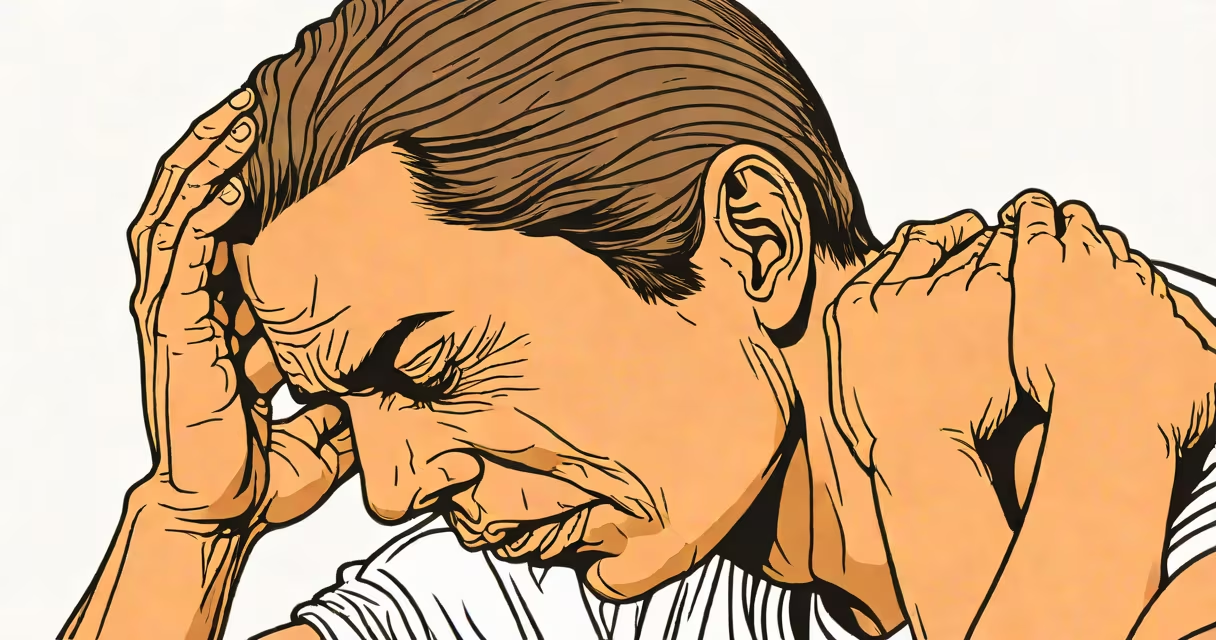
A headache of neck is a continuous or throbbing pain that spans the front of the head through the sides and extends to the base of the skull. It typically results from muscle tension, nerve irritation, or referred pain originating in the cervical spine. This pattern often indicates a tension-type headache, cervicogenic headache, or migraine with aura.
Such headaches arise when the trigeminal nerve system activates in response to stress, poor posture, or neck strain. The pain may feel tight or band-like around the head, especially behind the eyes and at the base of the skull. Unlike migraines that often start unilaterally, this type frequently affects both sides symmetrically. The sensation can last hours to days and worsen with movement or prolonged sitting.
According to the International Classification of Headache Disorders (ICHD-3), tension-type headaches account for 75% of all primary headaches. They are not life-threatening but can impact daily function. When pain radiates from the forehead to the back of the neck, it suggests involvement of the upper cervical nerves, particularly the greater occipital nerve, which runs from the base of the skull to the scalp.
Pain from the forehead to the back of the neck follows sensory pathways originating in the cervical spine. Nerves in the neck, especially C1-C3, share connections with the trigeminal nerve, which supplies the face and forehead. When neck muscles tighten or joints become inflamed, signals travel along these shared pathways, creating pain perceived in the head.
Common triggers include sustained forward head posture during screen use, emotional stress, dehydration, or disrupted sleep. A 2021 study published in Cephalalgia found that individuals who spend more than 6 hours daily on digital devices report twice the incidence of tension-related head pain compared to those with lower screen time.
For example, someone working at a desk with a monitor positioned too low may develop a forward head posture. Over time, this increases strain on the suboccipital muscles and facet joints in the upper neck. As tension builds, it compresses the greater occipital nerve, leading to pain that begins at the base of the skull and spreads forward.
Not all forehead-to-back-of-neck headaches are the same. The most common types differ in origin, symptoms, and treatment:
| Type | Origin | Key Symptoms | Distinctive Feature |
|---|---|---|---|
| Tension-type | Muscle contraction in scalp, neck, jaw | Band-like pressure, bilateral pain, no nausea | Worsens with stress or poor posture |
| Cervicogenic | Neck joint or soft tissue dysfunction | Pain starts in neck, radiates to head; limited neck motion | Pain improves with neck movement or manual therapy |
| Occipital neuralgia | Irritation of the greater occipital nerve | Burning, electric shock-like pain at base of skull | Sharp, shooting pain triggered by touch or movement |
| Migraine with aura | Brainstem and cortical hyperexcitability | Visual disturbances, pulsating pain, sensitivity to light/sound | May begin in back of head and spread forward |
One key distinction: cervicogenic headaches originate in the neck but are felt in the head. They often mimic tension headaches but respond poorly to standard painkillers. A 2019 review in Neurology found that 40% of patients initially diagnosed with tension headaches actually had cervicogenic origins after imaging and physical exam.
Another non-obvious point: pain from the back of the neck to the forehead does not always stem from the brain. Many assume it's neurological, but structural issues in the upper spine-such as facet joint arthritis or disc degeneration-are frequent culprits. These conditions alter nerve signaling and cause referred pain patterns.
People often mistake a forehead-to-back-of-neck headache for a migraine due to similar symptoms. However, migraines typically involve nausea, vomiting, photophobia, and unilateral onset. A headache that starts at the base of the skull and spreads forward may still be a migraine variant, such as a hemiplegic or basilar-type attack, though these are rarer.
Occipital neuralgia is another frequently missed diagnosis. Its sign is sharp, stabbing pain that feels like an electric shock. It often occurs after trauma, such as whiplash, or in people with chronic neck stiffness. Without proper assessment, it may be treated as tension headache, delaying effective care.
Red flags requiring prompt medical evaluation include sudden onset, fever, weight loss, neurological deficits (weakness, numbness, vision changes), or worsening pain despite rest. These may indicate secondary causes like meningitis, brain tumor, or spinal cord compression. The American Academy of Neurology advises seeking imaging if new-onset headache develops after age 50 or follows head injury.
Sarah, a 34-year-old graphic designer, reported a persistent ache from her forehead to the back of her neck. She described it as "tight bands squeezing my head," lasting 6-8 hours daily. Her pain began after a week of long work sessions with her laptop on her lap.
She tried ibuprofen and caffeine, which offered minimal relief. After visiting a physical therapist, she was diagnosed with cervicogenic headache due to reduced range of motion in her upper cervical spine and tenderness over the greater occipital nerve. Manual therapy and home exercises improved her symptoms within four weeks.
This case illustrates how posture-driven neck strain leads to widespread head pain. It also shows that treating the root cause-neck mechanics-provides better outcomes than masking symptoms with medication.
Recognizing the pattern of pain of neck enables timely intervention. Early action prevents chronicity and reduces reliance on medication. Identifying the correct type ensures targeted relief, not just symptom suppression.