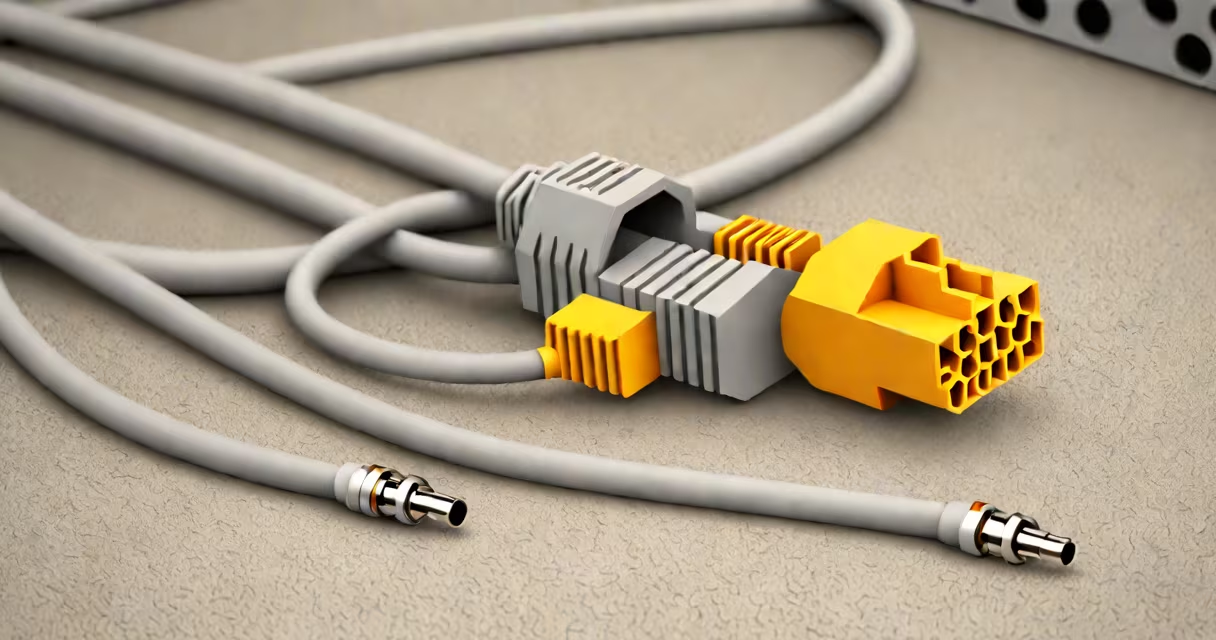
A heavy duty ethernet cable is a shielded, physically reinforced network cable designed to withstand harsh environments, including industrial settings, outdoor installations, and high-traffic areas where standard cables would fail. These cables feature durable outer jackets, braided shielding, and reinforced connectors to resist abrasion, crushing, moisture, and temperature extremes.
Unlike standard ethernet cables used in homes or offices, heavy duty variants are engineered for longevity under stress. They maintain consistent data transmission speeds-often up to 10 Gbps-across long runs even when exposed to vibration, dust, oil, or frequent movement. The construction prioritizes mechanical resilience over flexibility, making them ideal for factory floors, warehouses, outdoor surveillance systems, and military applications.
According to the Telecommunications Industry Association (TIA), cables rated for industrial use must meet specific mechanical and environmental standards, including resistance to impact, flexing, and chemical exposure. Heavy duty ethernet cables often comply with TIA-568-C.2 and ISO/IEC 11801 standards, ensuring performance consistency under demanding conditions.
Heavy duty ethernet cables function identically to standard twisted-pair cables-data travels via differential signaling across four pairs of insulated copper wires. The key difference lies in the physical structure that protects those wires. The core consists of eight individually shielded conductors arranged in four twisted pairs, which reduce crosstalk and electromagnetic interference (EMI).
Shielding is applied at multiple levels. Each pair may have individual foil shielding (FTP), and the entire bundle is enclosed in a braided metal shield (STP or S/FTP). This dual-layer defense blocks external EMI from motors, power lines, or radio signals. The outer jacket is typically made from PVC, polyurethane, or thermoplastic elastomer (TPE), materials chosen for their resistance to abrasion, UV light, and oils.
Connectors are another critical element. Instead of standard molded RJ45 plugs, heavy duty cables often use reinforced strain-relief boots, locking mechanisms, or even threaded couplings. These features prevent accidental disconnection during equipment movement or vibration. Some models include metal shells around the plug to further protect the pins.
Heavy duty ethernet cables vary based on application. The most common types are categorized by category rating, shielding level, and jacket material.
| Type | Category Rating | Shielding | Jacket Material | Use Case |
|---|---|---|---|---|
| Industrial Cat6a | Cat6a (10 Gbps) | F/UTP or S/FTP | PVC or TPE | Factory automation, machine control |
| Armored Cat5e | Cat5e (1 Gbps) | Braided + foil | Steel-reinforced PVC | Outdoor security cameras, temporary setups |
| Outdoor-rated Cat6 | Cat6 (1 Gbps) | Foil + braid | UV-resistant polyethylene | Long-distance runs, solar panel monitoring |
One non-obvious distinction: not all armored cables are equally effective. A steel-braided jacket offers superior crush resistance but increases weight and reduces bend radius. For changing environments like robotic arms or moving conveyors, a flexible TPE jacket with spiral armor provides better fatigue life than rigid metal armor.
Another common misconception is that heavier cables always mean higher speed. A Cat5e armored cable still maxes out at 1 Gbps, while Cat6a supports 10 Gbps only if properly terminated and installed within specified distances. Speed depends on the category, not the thickness alone.
Heavy duty ethernet cables are deployed where reliability is non-negotiable. In manufacturing plants, they connect PLCs (programmable logic controllers) to supervisory systems. A single disconnection can halt production lines, costing thousands per minute in downtime.
In a warehouse in Detroit, I observed a fleet of automated guided vehicles (AGVs) using Cat6a armored cables to communicate with central servers. The cables ran along concrete floors, crossed forklift paths, and were occasionally dragged by pallet jacks. After 18 months of continuous use, none had failed-compared to standard cables that degraded within six months.
For outdoor deployments, such as connecting remote weather stations or traffic monitoring systems, cables must endure temperature swings from -40°C to +70°C. The National Institute of Standards and Technology (NIST) recommends using cables with UV-stabilized jackets and low-temperature flexibility ratings for such conditions.
Many assume that "heavy duty" simply means thicker or sturdier. But a thick cable without proper shielding or insulation can still suffer signal degradation due to EMI. Conversely, a thin cable with full shielding and proper twist rate can outperform a bulky, unshielded one.
Another confusion arises between "industrial" and "outdoor" cables. While both are rugged, outdoor cables prioritize weather resistance-moisture, sunlight, and temperature cycling-whereas industrial cables focus on mechanical durability and EMI suppression. An outdoor-rated cable may lack the crush resistance needed in a factory.
Finally, some users mistake "shielded" for "armored." Shielding reduces noise; armor prevents physical damage. A cable can be shielded but not armored (e.g., indoor Cat6), or armored but unshielded (e.g., basic patch cables). True heavy duty cables combine both.
Suppose you're installing a surveillance system across a 200-meter perimeter fence at a mining site. Standard Cat6 cable would degrade quickly due to rodent chewing, ground shifting, and exposure to diesel fumes. You choose a Cat6a armored cable with a TPE jacket, F/UTP shielding, and IP68-rated connectors.
The installation team runs the cable through conduit buried 1 meter underground. At each camera node, they use a waterproof junction box with sealed connectors. The cable handles 10 Gbps video streams from 16 HD cameras without packet loss-even during thunderstorms. After two years, inspection shows no signs of wear, corrosion, or signal drop.
This setup wouldn't work with a standard office-grade cable. The difference lies in material selection, shielding integrity, and connector design-all hallmarks of a true heavy duty ethernet cable.
When selecting a heavy duty ethernet cable, verify the category rating, shielding type, and environmental specifications. Not all cables labeled "rugged" meet industrial standards. Always check for compliance with TIA-568 or ISO/IEC 11801.