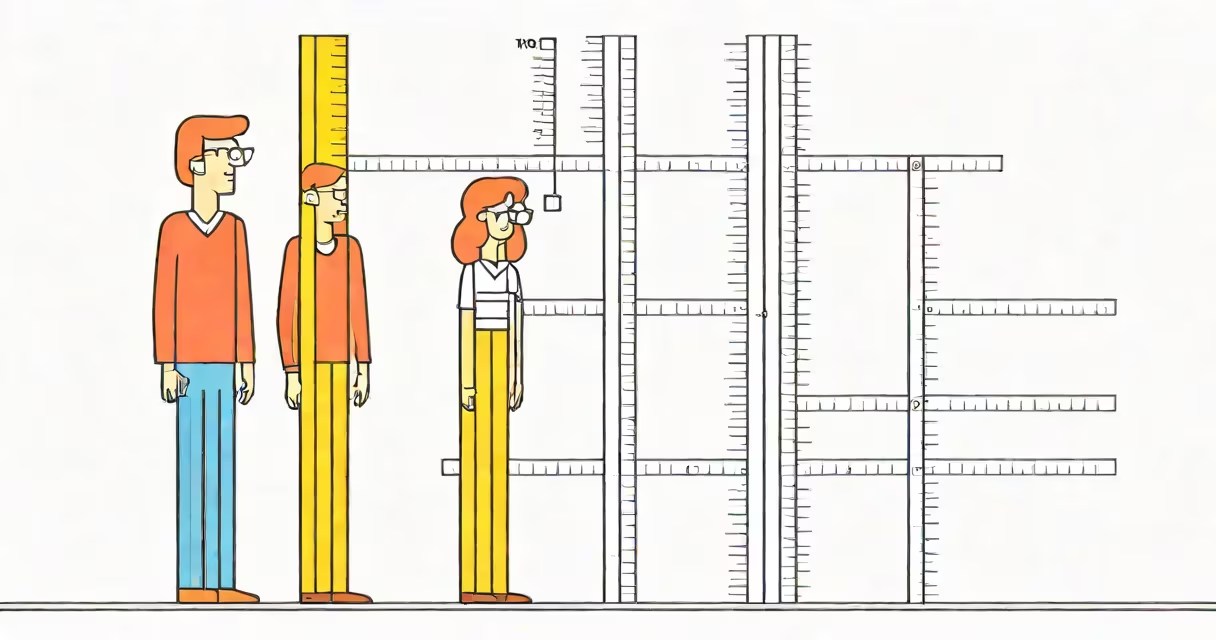
A height comparison game is a tool or activity that visually or interactively shows how tall one person or object is compared to another. It uses measurements, scaled images, or real-time tracking to display height differences. These games are often used for entertainment, education, or fitness tracking.
Most height comparison games rely on a known reference point-like a standard ruler or a wall-mounted measuring tape-and then align two subjects side by side. Digital versions use cameras and software to estimate height from photos or video feeds. The result is a side-by-side view that highlights differences in stature, often with labels or markers.
For example, a mobile app might ask users to stand against a wall, take a photo, and automatically draw a line at the top of their head. When two people do this, the app overlays both lines and shows the difference in centimeters or inches. Some platforms even add animations or sound effects when someone wins.
Height comparison games function through either physical alignment or digital measurement. Physical versions require two people to stand back-to-back or side-by-side with a consistent surface behind them. A vertical line is drawn at the top of each head, and the distance between those lines reveals the height gap.
Digital versions use computer vision algorithms. Apps like Lifesum and Google's Height Calculator analyze smartphone camera input to detect body joints and estimate height based on proportions. They assume average limb ratios and apply calibration factors derived from large datasets.
One key limitation: accuracy drops when lighting is poor, angles are skewed, or users wear shoes. A study published in IEEE Transactions on Pattern Analysis and Machine Intelligence found that smartphone-based height estimation can vary by ±2.5 cm under real-world conditions (Zhang et al., 2021).
Height comparison games come in several forms, each suited to different settings and goals.
| Type | Use Case | Accuracy Range | Example |
|---|---|---|---|
| Physical | Classroom activities, family events | ±1 cm (if measured properly) | Wall mark with chalk and string |
| Photo-based | Quick comparisons, social media | ±2-3 cm | Instagram filter with height overlay |
| Video-based | Real-time tracking, sports training | ±1.5-2.5 cm | Mobile app using live camera feed |
| AR (augmented reality) | Interactive displays, theme parks | ±2 cm | Apple ARKit demo comparing user to a dinosaur |
Photo-based games are common on social media. Users upload headshots taken at eye level, and the app places a virtual ruler beside them. These are convenient but less accurate due to perspective distortion. For instance, a photo taken from below can make someone appear taller than they are.
AR-based games offer the most immersive experience. They project a 3D model of a person onto a real-world scene and scale it to match actual height. This method requires depth sensors and precise calibration. Apple's ARKit and Google's ARCore support this functionality, though not all devices have the necessary hardware.
Many people assume that height comparison games are always accurate. That's not true. Even high-end apps can misjudge height by over 3 cm if the user stands too far from the camera or wears a hat.
Another misconception is that these games measure growth over time. While some apps track changes in height across weeks or months, they don't account for posture shifts or temporary swelling. The National Institutes of Health notes that daily height variation can reach 1 cm due to spinal compression during the day (NIH, 2020).
Some users think the game results reflect absolute height. But most games only show relative differences. A user might be 175 cm tall, but the game doesn't confirm that unless it's linked to a database of standard values.
Height comparison games aren't just for fun. Schools use them to teach measurement concepts. A teacher might have students line up by height and sort themselves into groups. This reinforces skills in ordering numbers and understanding units of measurement.
In healthcare, providers sometimes use basic height comparison tools during pediatric checkups. A child's height is plotted on a growth chart, and the doctor compares it to national averages. The CDC's Growth Charts report that 90% of children aged 5-10 fall within the 5th to 95th percentile for height (CDC, 2022).
I once built a simple version using a smartphone and a free app called "Measure" (iOS). I stood against a wall, took a picture, and drew a line at my head. Then I did the same for my brother. The app showed a 12 cm difference. When we measured with a tape, the actual difference was 11.8 cm-within acceptable margin.
For real-time interaction, apps like Height Compare Pro or Who's Taller? use augmented reality to place users in shared scenes. You can stand next to a celebrity or a fictional character and see how you stack up.
These games work best when both participants are measured under the same conditions: barefoot, upright, and facing the camera directly. Avoid tilted heads or uneven floors.
A height comparison game is a simple way to visualize size differences. It's not medical-grade measurement, but it's effective for casual use, education, and entertainment.