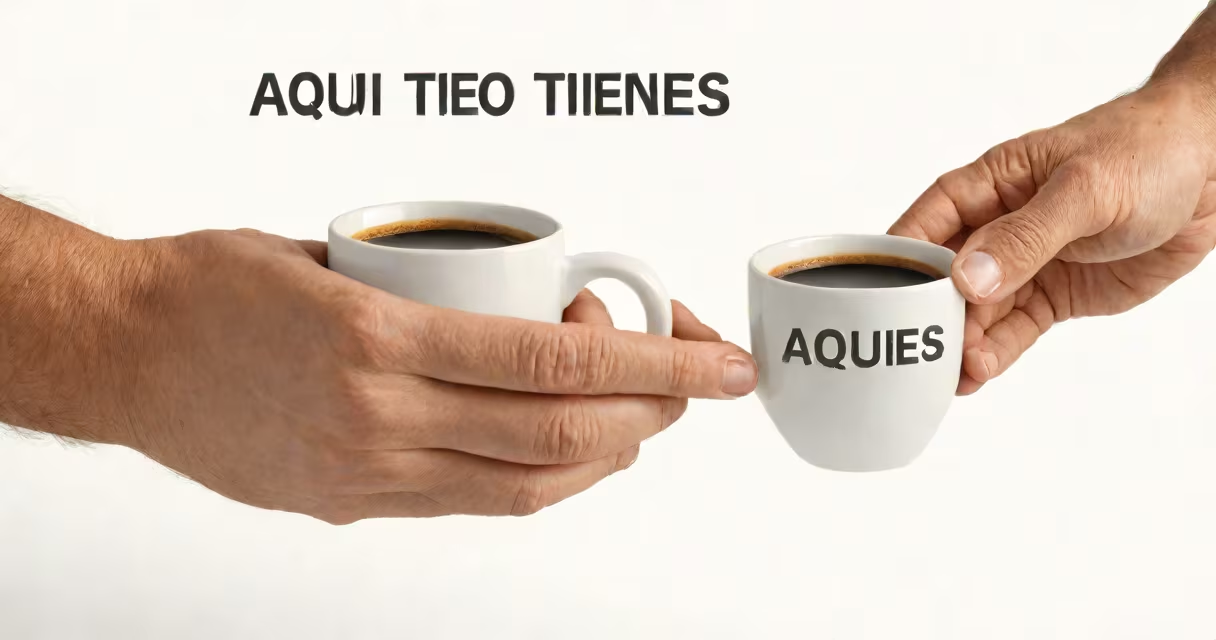
The most accurate way to say "here you go" in Spanish is "aquí tienes," used when handing something to someone directly. It translates literally to "here you have" and is common in both formal and casual settings across Spanish-speaking regions.
"Aquí tienes" functions as a polite delivery phrase in daily interactions. It signals that an object is being transferred from one person to another. The phrase appears in spoken language throughout Mexico, Colombia, Argentina, Spain, and other Spanish-speaking countries. It's often paired with a gesture-like extending the hand or pointing-to reinforce the physical transfer.
For example, when a server hands a customer their drink, they might say "Aquí tienes" while placing the glass on the table. A friend passing a phone might say it while saying "Toma, aquí tienes el celular." The phrase avoids ambiguity-it indicates ownership transfer and acknowledges the recipient.
"Aquí tienes" consists of two parts: "aquí" meaning "here," and "tienes" meaning "you have." The verb "tener" (to have) is conjugated in the second-person singular form for "tú" (informal you). This makes the phrase direct and personal.
Pronunciation is straightforward: "ah-KEE tee-ehn-es." Stress falls on the second syllable of "aquí" and the first syllable of "tienes." Avoid over-emphasizing the final "es" sound-it should be light and clipped, not drawn out.
When speaking quickly, native speakers often reduce "tienes" to "tín" in informal speech. So "aquí tienes" becomes "aquí tin" in rapid conversation. This contraction is common in urban areas like Bogotá, Madrid, and Buenos Aires.
While "aquí tienes" is standard, regional alternatives exist. In parts of Central America, people may say "toma" (take) alone, especially in casual exchanges. For example, handing a snack to a child: "Toma, aquí está." This version drops "aquí" and relies on context and gesture.
In southern Spain, particularly Andalusia, the phrase "aquí tienes" is sometimes shortened to "aquí te voy" (literally "here I'm sending it to you"), which adds a sense of movement. This variation emphasizes the act of giving rather than possession.
Another variant, "aquí lo tienes," includes the pronoun "lo" (it) when referring to a specific object. For instance, returning a book: "Aquí lo tienes, gracias por devolverlo." The addition of "lo" clarifies that the object being returned is the book, not a general item.
| Phrase | Meaning | Region/Use Case |
|---|---|---|
| aquí tienes | Here you go / Here you have | Standard across all Spanish-speaking regions |
| toma | Take it | Informal; common in Mexico, Central America |
| aquí te voy | Here I'm sending it to you | Andalusia, southern Spain |
| aquí lo tienes | Here you have it (specific object) | Used when returning or showing a particular item |
Many learners mix up "aquí tienes" with "aquí está" (here it is), which refers to location rather than transfer. "Aquí está tu libro" means "your book is here," not "I'm giving you your book." The difference lies in the verb: "tienes" implies possession, while "está" describes existence.
A second common error is using "aquí tienes" when addressing multiple people. The correct form for plural "you" is "aquí tienen." Saying "aquí tienes" to a group is grammatically incorrect and sounds unnatural. For example, handing a gift to two friends: "Aquí tienen los regalos." Using "tienes" in this context would imply only one recipient.
Another mistake is mispronouncing "tienes" as "tee-NEHS" with a hard "e" sound. The correct pronunciation uses a soft "e" like "eh" in "bed." Mispronunciation can lead to confusion-some listeners may think you're saying "tienes" as in "you owe" rather than "you have."
At a market in Guadalajara, a cashier says to a customer: "Aquí tienes tu cambio, $1.20." The customer nods and takes the coins. The phrase is clear, concise, and culturally appropriate. It reflects both politeness and efficiency.
Later, the same customer returns a bottle and says to the clerk: "Aquí está el envase vacío." The use of "está" correctly marks the object's location, not ownership. This contrast shows how small changes in vocabulary affect meaning.
I once practiced this phrase during a week-long stay in Santiago, Chile. On the third day, I handed my host a notebook and said "aquí tienes." She smiled and replied, "Gracias, ya lo tengo." The exchange felt natural and respectful-exactly the kind of interaction the phrase was designed for.
Understanding "how to say here you go in spanish" requires more than memorizing "aquí tienes." It involves recognizing tone, audience, and setting. The phrase works best when delivered with eye contact and a slight nod. Overusing it in formal contexts-like business meetings-can seem too casual.
For deeper practice, study audio clips from Duolingo or SpanishDict, which offer native speaker recordings of "aquí tienes" in real-life scenarios. These resources show how pitch, speed, and intonation vary between regions.
Mastering this phrase improves fluency in everyday interactions. It's not just about translation-it's about cultural alignment. When you say "aquí tienes," you're not just handing something over. You're participating in a shared social ritual.