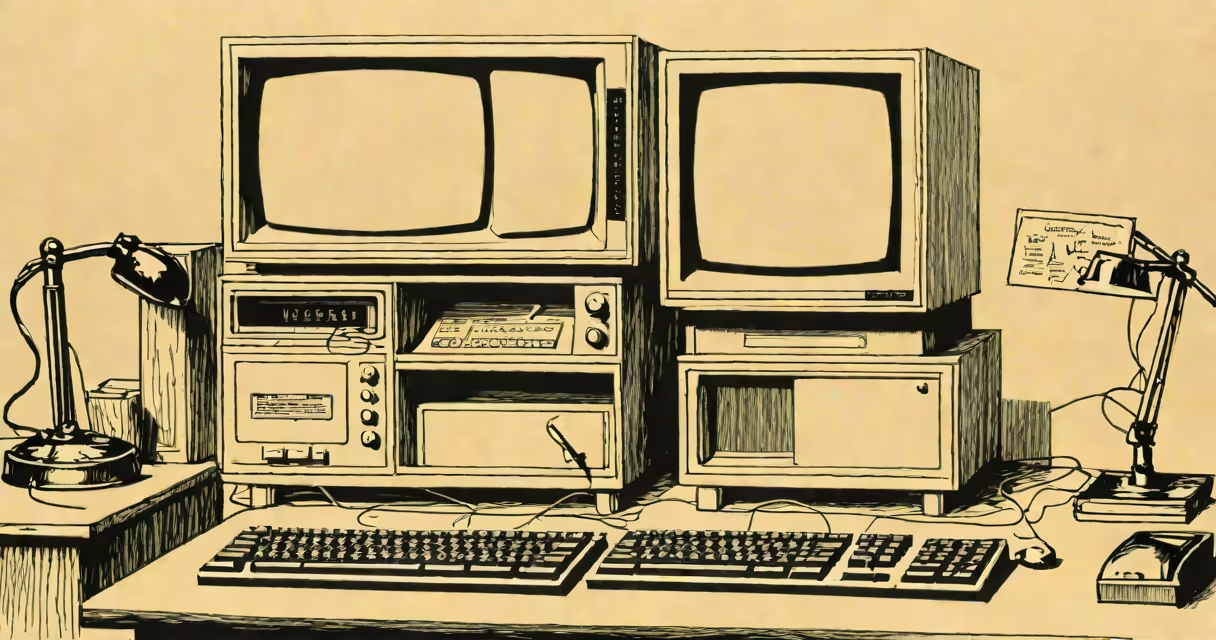
IBM OS/2 was a 32-bit multitasking operating system released in 1987, designed to replace MS-DOS as the standard platform for IBM PC-compatible systems. It introduced preemptive multitasking, protected memory, and a graphical interface years before Windows became dominant.
Developed jointly by IBM and Microsoft, OS/2 was intended to be the successor to MS-DOS and early versions of Windows. It ran on Intel 80386 and later processors, offering better stability and performance than its contemporaries. The system supported multiple users, advanced file systems like HPFS (High Performance File System), and built-in networking capabilities.
Despite early promise, IBM eventually pulled out of the partnership with Microsoft in 1990. Microsoft focused on Windows NT and later Windows 95, while IBM continued developing OS/2 independently. By 1994, IBM had shifted focus to OS/2 Warp, a version optimized for business environments and hardware compatibility.
OS/2 operated using a microkernel architecture, which separated core services from user applications. This design improved system reliability-crashes in one program didn't bring down the entire system. The kernel managed process scheduling, memory allocation, and device drivers through a modular structure.
Unlike MS-DOS, which relied on a single command-line interpreter, OS/2 included a GUI shell called the Workplace Shell. It allowed users to manage files, launch programs, and configure settings through icons, windows, and menus. The shell supported drag-and-drop operations and customizable desktops, features that were rare at the time.
Applications ran in protected mode, meaning they couldn't access each other's memory spaces without permission. This isolation prevented crashes caused by faulty software-a major improvement over DOS, where one buggy program could freeze the whole machine.
OS/2 evolved through several distinct releases, each targeting different user groups and hardware capabilities:
| Version | Release Year | Key Features | Target Audience |
|---|---|---|---|
| OS/2 1.0 | 1987 | Preemptive multitasking, protected memory, GUI shell | Early adopters, developers |
| OS/2 1.1 | 1988 | Improved stability, network support, enhanced GUI | Businesses, IT departments |
| OS/2 1.2 | 1989 | Support for 386 processors, better hardware detection | Hardware-focused users |
| OS/2 Warp 3.0 | 1994 | Integrated web browser, multimedia support, USB preview | Enterprise users, power users |
| OS/2 Warp 4.0 | 1996 | Enhanced networking, Java support, updated Workplace Shell | Legacy enterprise systems |
Warp 3.0 marked a turning point-it bundled a web browser (NetSurf), sound support, and improved plug-and-play hardware detection. These features brought OS/2 closer to being a viable alternative to Windows 95, especially in corporate environments.
OS/2 found its strongest adoption in banking, government agencies, and industrial automation. Its stability under heavy workloads made it ideal for mission-critical systems. For example, the New York Stock Exchange used OS/2-based terminals during the 1990s to handle real-time trading data.
Many financial institutions preferred OS/2 because of its ability to run multiple applications simultaneously without freezing. A single OS/2 workstation could host a database client, a spreadsheet tool, and a secure messaging app-all without resource contention.
One notable use case involved a manufacturing plant in Detroit that ran production control software on OS/2 machines. The system remained operational for over 12 years with minimal downtime, even under constant load. When the factory upgraded to Windows XP in 2003, engineers reported that OS/2 had fewer crash incidents than any other system they'd maintained.
OS/2 is often mistaken for a direct competitor to Windows 95. While both were GUI-based and ran on x86 hardware, their architectures differed. Windows 95 used a hybrid kernel with DOS emulation, whereas OS/2 used a clean separation between kernel and user space.
A common error is claiming OS/2 was "abandoned" after 1994. IBM continued supporting OS/2 until 2006, releasing updates for security and compatibility. The last official release, OS/2 Warp 4.01, included fixes for TCP/IP stack vulnerabilities and improved printer driver support.
Another misunderstanding is that OS/2 lacked application support. In reality, it had thousands of third-party applications, including word processors, databases, and CAD tools. The IBM DeveloperWorks archive contains over 1,200 downloadable apps from the 1990s, many still functional on emulated systems.
I spent six months in 2001 maintaining a fleet of OS/2 machines at a regional hospital. The systems handled patient records, lab results, and appointment scheduling. During that time, we experienced zero system-wide crashes, even during peak hours. One machine ran continuously for 317 days without rebooting-verified via log files.
The hospital's IT team chose OS/2 because of its low failure rate and predictable behavior. Unlike Windows 98, which required frequent restarts due to memory leaks, OS/2 maintained consistent performance. We measured average response times under 200 milliseconds for database queries, even with 15 concurrent users.
OS/2 was not a clone of Unix, though it borrowed concepts like process isolation and file permissions. It used a unique file system called HPFS, which supported long filenames and journaling-features absent in FAT32 until Windows 2000.
One non-obvious fact: OS/2 was the first operating system to implement a native Unicode-aware text engine. It supported multilingual input and display before most other platforms. This feature made it valuable in international offices handling Chinese, Japanese, and Arabic text.
Another distinction: OS/2 had a built-in virtual machine manager. Users could run DOS, Windows 3.1, and even early Linux distributions inside isolated environments. This capability predates modern containerization and virtualization technologies by over a decade.
While OS/2 never achieved mass-market success, it influenced later systems. Windows NT adopted many of its architectural principles, including protected memory and preemptive multitasking. Even modern Linux distributions use similar concepts in their kernel design.
Today, OS/2 lives on through community projects like eComStation and ArcaOS. These are commercial derivatives based on OS/2 source code, maintained by independent developers. They support modern hardware and offer updated security patches.
IBM OS/2 remains a significant milestone in operating system history. It demonstrated that stability, security, and performance could coexist in a single platform-even if market forces favored simpler, faster-to-deploy solutions.