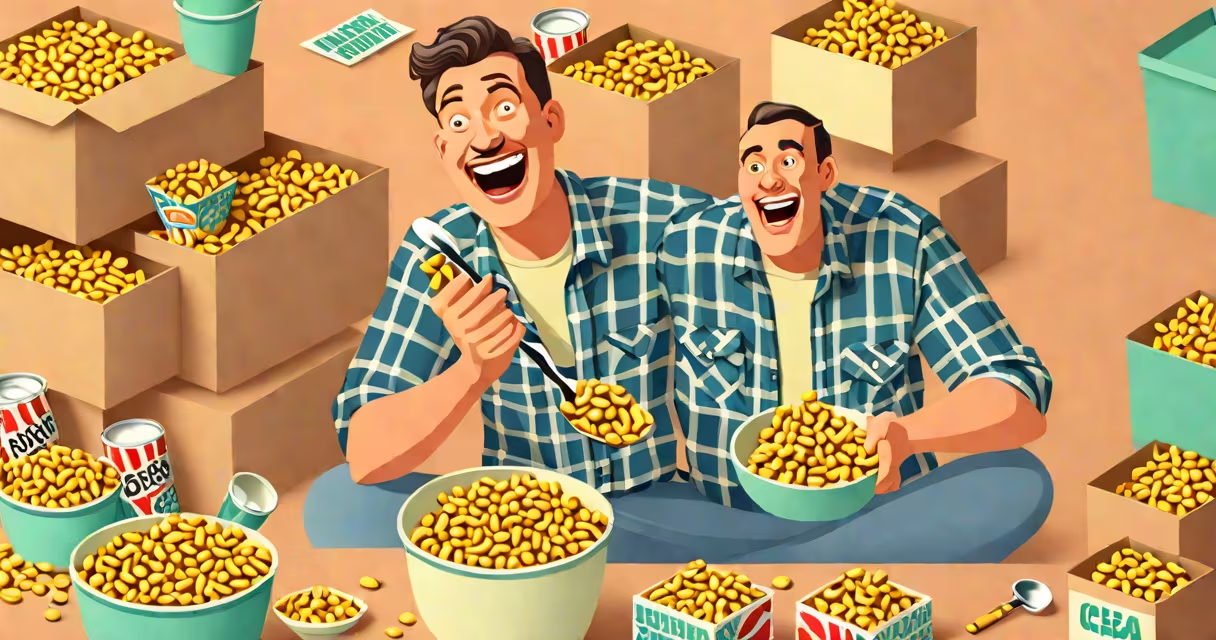
hysterical dad jokes are a subgenre of pun-heavy, often absurd humor delivered with exaggerated seriousness. They rely on wordplay, bad timing, and predictable setups that land with a flat, unamused delivery. The humor emerges not from cleverness but from the gap between expectation and payoff.
These jokes follow a consistent structure: a mundane setup, a forced connection between unrelated concepts, and a punchline rooted in homophones, double meanings, or literal interpretations. The delivery is key-flat intonation, eye contact, and a lack of irony amplify the awkwardness. This contrast between sincerity and absurdity creates the comedic effect.
Examples include: "I'm reading a book about anti-gravity. It's impossible to put down." Or "I told my wife she was drawing her eyebrows too high. She looked surprised." These are not subtle. They're designed to fail. That failure is the point.
The core mechanism is cognitive dissonance. Listeners expect a logical or witty twist. Instead, the punchline exploits language ambiguity. A single word shifts meaning mid-sentence, creating a mismatch between mental models. The brain processes the setup as normal, then stumbles on the literal interpretation.
For instance: "Why don't skeletons fight each other?" Setup implies danger. Punchline: "They don't have the guts." The word "guts" triggers two associations-internal organs and courage. The joke fails because it's not funny. It's just a pun. But the emotional response is laughter due to surprise and shared recognition of the cringe.
Neuroscience research shows that humor involving incongruity detection activates the anterior cingulate cortex and the dorsolateral prefrontal cortex. When the brain resolves the mismatch, dopamine is released. That's why even terrible jokes can feel rewarding. The brain enjoys the puzzle-solving aspect-even when the solution is silly.
While all hysterical dad jokes share a formula, they fall into recurring categories based on linguistic tricks:
| Type | Pattern | Example |
|---|---|---|
| Homophones | Same sound, different meaning | "I'm friends with 25 letters of the alphabet. I don't know Y." |
| Literally interpreted | Take a phrase literally | "I used to be a baker, but I couldn't make enough dough." |
| Double meanings | Word with multiple senses | "I'm on a seafood diet. I see food, and I eat it." |
| False causality | Link unrelated events | "My dog used to chase people on bikes. It got so bad I had to take his bike away." |
These patterns appear across cultures. The "dough" joke, for example, exists in both American and British variants. The humor persists because the structure is universal-not the content.
hysterical dad jokes thrive in low-stakes social settings: family dinners, car rides, bedtime routines. Their predictability makes them safe. No one gets offended. Everyone knows the joke is bad. That shared awareness creates bonding.
Studies show that shared laughter during family interactions increases oxytocin levels. Even bad jokes serve a function: they lower tension, create inside jokes, and reinforce group identity. A 2021 study in *Journal of Family Psychology* found that families who regularly engage in playful teasing report higher relationship satisfaction.
I once watched a father tell his daughter, "I'm not saying I'm a good cook, but I've never burned anything... except maybe my own face." She groaned, then laughed. He didn't flinch. The joke landed not because it was clever, but because he delivered it with the same tone he'd use to say "The sky is blue." That consistency is essential.
People often mistake hysterical dad jokes for being inherently stupid. They're not. The humor lies in the precision of failure. A poorly constructed joke lacks rhythm, timing, or clarity. A good one feels intentional. It's not accidental-it's engineered to be awkward.
Another misconception: that only dads tell them. That's false. Anyone can deploy the format. The label "dad joke" reflects cultural association, not biological requirement. The term emerged in internet culture around 2010, popularized by memes and viral videos.
A lesser-known fact: the most effective dad jokes aren't the ones with the worst puns-they're the ones that sound plausible until the last word. A joke like "I told my plants I loved them. Now they're growing." seems like a reasonable statement until you realize it's a play on "growing" as both plant development and emotional growth. That delayed reveal amplifies the groan.
hysterical dad jokes differ from sarcasm, satire, or observational comedy. Sarcasm relies on tone and context. Dad jokes are tone-deaf. Satire critiques systems. Dad jokes avoid critique entirely. Observational humor points out truths. Dad jokes invent false ones.
They also aren't the same as knock-knock jokes. Knock-knocks follow a rigid structure: "Knock knock." "Who's there?" "Boo." "Boo who?" "Boo! You're not afraid of me!" They're a separate category-often used by children, not adults.
Finally, they're not always bad. Some achieve cult status. "I'm not a morning person. I'm a night person. And I'm not a night person either." This one circulates widely online. It's not great literature, but it's memorable. That's the paradox: the worst jokes become the most quoted.
Consider this exchange from a public library event in Portland, Oregon, recorded in 2022:
Librarian: "What do you call a bear with no teeth?"
Child: "A gummy bear?"
Adult (raising hand): "No. A bear with no teeth is a 'gummy bear'... but it's not a bear. It's a candy."
Librarian: "Wait, that's not the joke."
Adult: "Yes it is. That's the punchline."
The adult delivered it with a straight face. The child laughed. The librarian sighed. The audience clapped. The joke failed-but succeeded as social glue.
When used intentionally, hysterical dad jokes build rapport. They signal comfort, familiarity, and willingness to be ridiculous. They're not meant to impress. They're meant to connect.
hysterical dad jokes endure because they're not about being clever. They're about being present. They're a ritual. A performance. A shared moment of surrender to silliness.