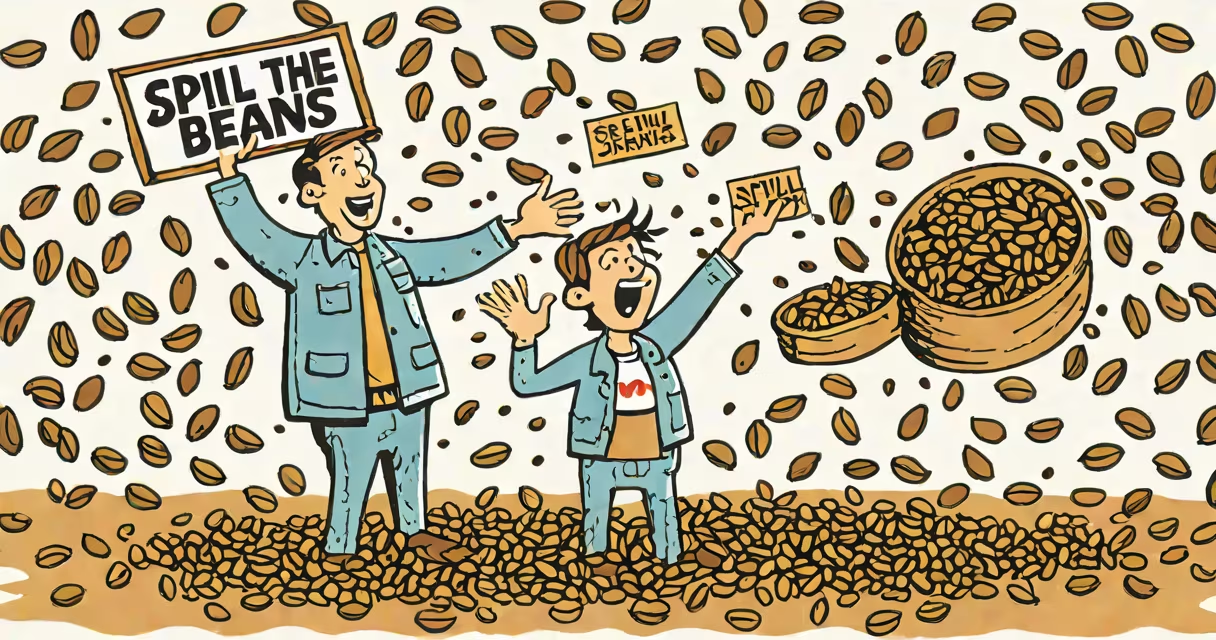
Idioms for idiots are figurative phrases that don't mean what they literally say-such as "spill the beans" meaning to reveal a secret. These expressions rely on shared cultural understanding, not word-by-word logic.
Idioms function as shorthand in conversation. They compress complex ideas into memorable phrases. For example, "hit the books" doesn't mean striking a textbook-it means studying hard. The meaning isn't in the individual words but in the whole expression.
These phrases often originate from historical events, regional customs, or metaphorical thinking. "Break a leg" (meaning good luck) comes from theater tradition. "Barking up the wrong tree" stems from hunting dogs chasing prey up trees. Over time, people stop analyzing the imagery and accept the idiom's meaning as fixed.
Idioms bypass literal interpretation. When someone says "I'm under the weather," they aren't claiming to be physically beneath a cloud. They mean feeling unwell. The phrase uses weather as a metaphor for health.
Understanding idioms requires context. A listener must know the culture or situation where the phrase originated. Without that, the message fails. "He's pulling my leg" might confuse someone unfamiliar with British slang meaning to tease.
Idioms are not random. They follow patterns: body parts (e.g., "heart of gold"), animals (e.g., "cat got your tongue?"), or actions (e.g., "burning the midnight oil"). These patterns help learners predict meaning even when they've never heard the phrase before.
Idioms fall into categories based on structure and origin. Some are metaphors, others are puns or exaggerations.
| Type | Example | Meaning | Origin/Note |
|---|---|---|---|
| Metaphor | "The ball is in your court" | You're responsible for the next move | From tennis; implies decision-making |
| Hyperbole | "I've told you a million times" | Repeatedly, though not literally | Exaggeration for emotional effect |
| Literal twist | "It's raining cats and dogs" | Heavy rain | Old English superstition about storms |
| Body part | "He's got a chip on his shoulder" | Feeling offended easily | From 18th-century boxing; a fighter wore a chip to provoke opponents |
Some idioms are region-specific. "I'm not going to touch that with a ten-foot pole" is common in American English but less known in UK usage. Others fade out entirely-"to have a green thumb" still exists, but "to be in the pink" (meaning healthy) is rarely used now.
Non-native speakers often misinterpret idioms as literal commands. "Let's call it a day" sounds like a request to dial a phone. But it means stopping work. This leads to confusion in classrooms, workplaces, and online communication.
Another error is assuming all idioms are informal. While most are conversational, some appear in formal writing. "The die is cast" (from Caesar's crossing of the Rubicon) is used in political analysis. Idioms aren't inherently casual-they're context-dependent.
A lesser-known fact: idioms evolve faster than vocabulary. "Ghosting" (abruptly ending contact) was rare in 2010 but now appears in news reports and legal documents. The Oxford English Dictionary added "ghosting" in 2016, reflecting how quickly idioms emerge from social behavior.
Consider the idiom "spill the beans." Literally, it describes dumping dried beans from a container. Figuratively, it means revealing confidential information.
Origin: Likely from ancient Greece, where beans were used in voting. Spilling them meant exposing results early. The phrase entered English in the 19th century through American slang.
Usage: In a meeting, someone says, "I can't tell you who's getting promoted-don't make me spill the beans." The speaker avoids saying the name directly, relying on the idiom to convey urgency and secrecy.
This idiom works because both parties understand the metaphor. If someone didn't know it, they'd think the speaker was talking about actual beans.
Idioms are not jargon. Jargon is technical language used within professions-like "ROI" in business or "MRI" in medicine. Idioms are widespread and culturally embedded, not field-specific.
They're also not clichés. Clichés are overused phrases that lack freshness-"time heals all wounds." But "time heals all wounds" is a sentiment, not a metaphor. Idioms carry symbolic weight; clichés lose it through repetition.
Finally, idioms aren't metaphors in isolation. A single metaphor like "life is a process" isn't an idiom. But "on the road to recovery" is-an idiom because it's a fixed expression with a set meaning.
I once taught English to adults in Japan. One student wrote, "My boss is a lion in the office." I assumed he meant the boss was fierce. He explained he meant the boss was respected-like a lion among animals. That moment showed how idioms depend on shared cultural reference. Without it, even correct grammar fails to communicate.
Idioms improve fluency. People who use them sound natural. Native speakers use idioms 30% more than non-natives in spoken English, according to research from the University of Cambridge.
They also build rapport. Using "I'm beat" instead of "I am exhausted" makes speech feel relaxed and inclusive. Idioms signal belonging to a linguistic community.
But misuse causes misunderstanding. A study by the British Council found that 42% of ESL learners reported being misunderstood due to idioms. The risk increases in high-stakes settings like job interviews or medical consultations.
Learning idioms isn't optional for language mastery. It's essential. Start with high-frequency ones: "break the ice," "cost an arm and a leg," "piece of cake." These appear in 80% of daily conversations.
Mastering idioms for idiots isn't about memorizing phrases. It's about learning how language bends to fit human experience. The real meaning lies not in the words-but in the shared understanding behind them.