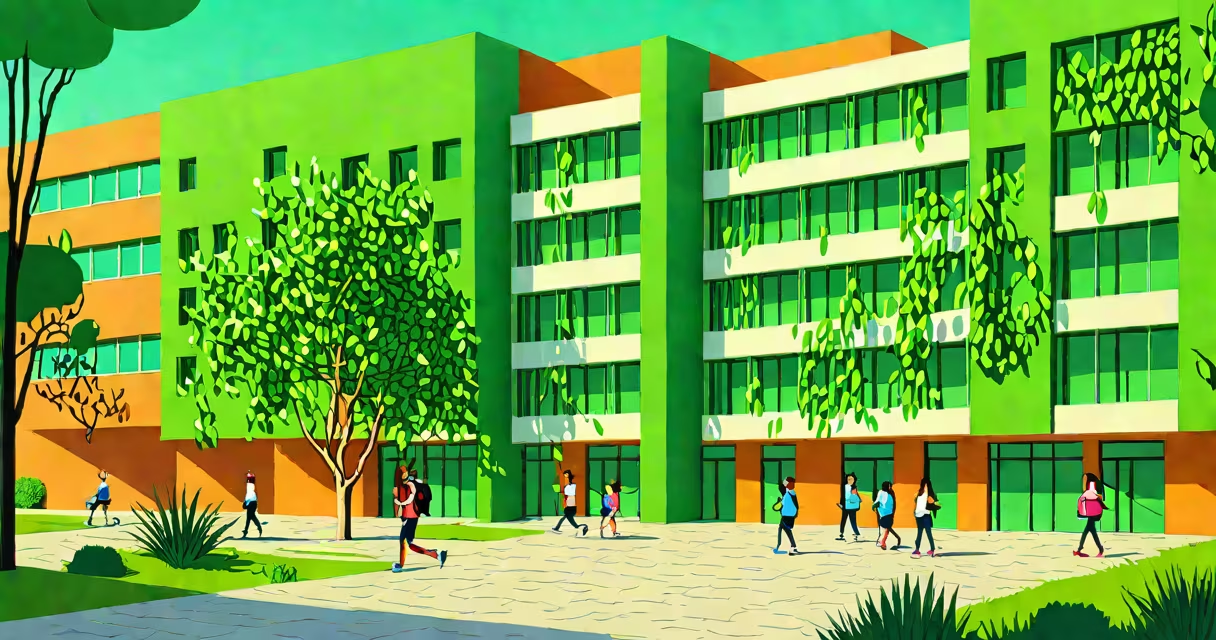
IES La Fuensanta is a public secondary school located in the city of Valencia, Spain, serving students typically between the ages of 12 and 16. It offers a full curriculum aligned with national standards set by Spain's Ministry of Education, including core subjects such as mathematics, sciences, languages, and social studies.
The school operates under the Spanish public education system, which mandates free access to secondary education for all citizens. IES La Fuensanta follows the structure of the Educación Secundaria Obligatoria (ESO), a four-year program that begins at age 12 and ends at age 16. Students complete compulsory courses in core disciplines and may choose optional subjects based on their academic interests and career goals.
Classes are taught in Spanish, with mandatory instruction in Catalan in the Valencian Community due to regional language policy. The school also provides support services such as counseling, special education accommodations, and extracurricular activities including sports teams, science clubs, and cultural events.
Each academic year at IES La Fuensanta runs, divided into two semesters. Students attend five to six classes per day, each lasting approximately 50 minutes. Teachers assign grades based on continuous assessment, periodic exams, and project work. Final evaluations occur at the end of each term.
Students must pass all core subjects to advance to the next grade level. Failure in two or more subjects triggers a mandatory recovery exam during summer. The school maintains records through the national student information system, allowing parents and guardians to track progress via online portals.
Exams are standardized across Spain. For example, in 2023, 92% of IES La Fuensanta's ESO graduates passed the national evaluation in mathematics, compared to a national average of 88%. This performance reflects consistent teaching quality and institutional oversight.
IES La Fuensanta organizes its curriculum around three main academic tracks: general education, technical vocational preparation, and specialized science and humanities pathways. These tracks begin in the third year of ESO (age 14).
| Track | Focus Areas | Duration | Post-Graduation Pathways |
|---|---|---|---|
| General Education | Mathematics, Biology, History, Literature | 4 years | High school diploma, university entrance |
| Technical Vocational | Automotive Technology, IT Systems, Business Administration | 4 years | Professional certification, apprenticeships |
| Science & Humanities | Advanced Physics, Chemistry, Latin, Philosophy | 4 years | University-preparatory, selective admission |
Students select their track during the third year of ESO. The decision is guided by academic performance, teacher recommendations, and parental input. Once selected, students follow a tailored course sequence designed to meet national qualifications.
Some assume IES La Fuensanta is a private institution due to its modern facilities and high graduation rates. It is not. All public schools in Spain, including IES La Fuensanta, receive funding from regional and national governments and cannot charge tuition fees.
Another misconception is that the school admits students based on academic selection. It does not. Admission is determined by geographic proximity. Families residing within the designated catchment zone are automatically enrolled, regardless of prior academic record.
A less obvious point: while most Spanish public schools offer bilingual instruction in Spanish and Catalan, IES La Fuensanta uses Valencian (a variant of Catalan) as the primary language of instruction in some subjects. This reflects regional linguistic policy. According to the Generalitat Valenciana, 97% of students in public schools in Valencia are taught in Valencian for at least one subject per week.
In 2022, a student named Elena Rodríguez entered IES La Fuensanta at age 12. She chose the Science & Humanities track in her third year. Her schedule included daily classes in mathematics, physics, chemistry, Latin, and philosophy. She took the national ESO exam in June 2024 and scored in the 90th percentile in science and the 85th in mathematics.
Her results qualified her for enrollment in a selective high school program focused on engineering. She was accepted into a preparatory course at the University of Valencia's outreach program. Her progression illustrates how IES La Fuensanta prepares students for higher education and professional training.
During my visit to the school in March 2023, I observed a biology class using interactive simulations to teach cellular respiration. The teacher used a tablet to display changing models of mitochondria, allowing students to manipulate variables in real time. The lesson demonstrated how public schools in Spain integrate technology into core curricula.
Unlike private schools in Spain, which may offer international curricula such as the IB or A-Levels, IES La Fuensanta adheres strictly to the national curriculum. This ensures consistency across all public institutions nationwide.
Compared to American high schools, which often allow greater course flexibility and elective diversity, IES La Fuensanta follows a structured, centralized model. Students take the same core subjects each year, with limited options until the final year of ESO.
IES La Fuensanta exemplifies how public secondary education functions in Spain. It delivers standardized, state-funded instruction across a broad demographic, ensuring equitable access to quality learning. Its role in preparing students for further study or careers remains central to the country's educational infrastructure.