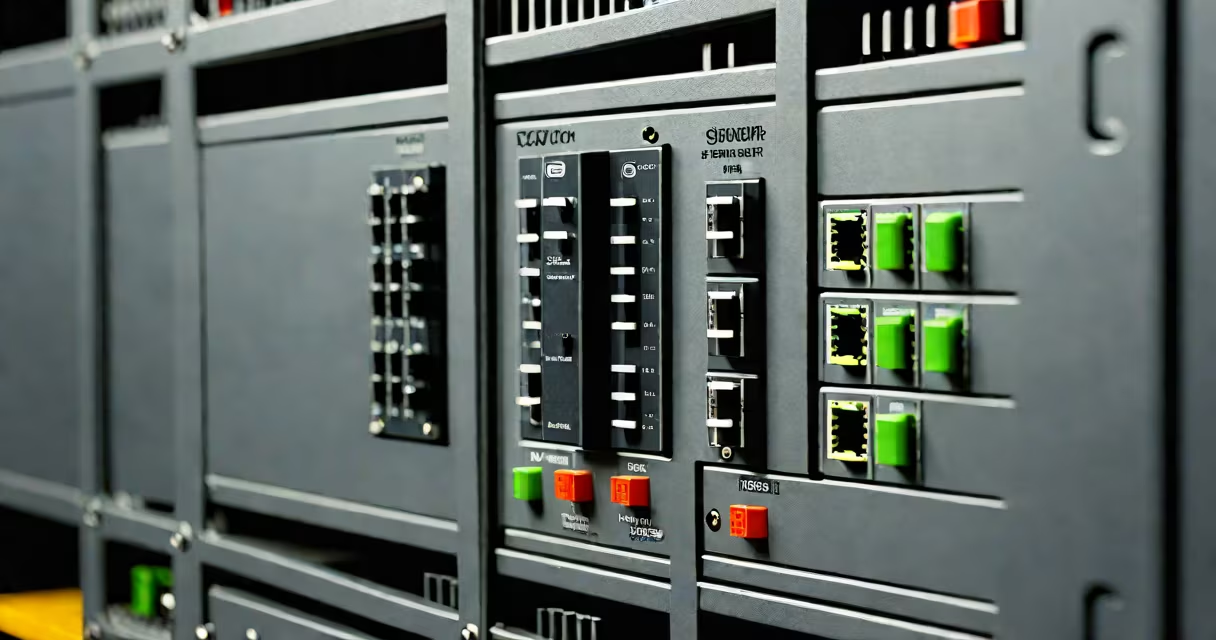
An industrial PoE switch delivers power and data over Ethernet cables in demanding environments such as manufacturing plants, oil rigs, and outdoor surveillance systems. Unlike consumer-grade switches, it operates reliably under extreme temperatures, dust, vibration, and electrical noise.
These switches extend the reach of networked devices without requiring separate power lines. They support IEEE 802.3af/at standards, supplying up to 30 watts per port to devices like IP cameras, access points, and sensors. They're built to withstand conditions that would disable standard office equipment.
According to the Industrial Internet Consortium, 68% of industrial networks deployed since 2020 use PoE for device connectivity due to reduced cabling complexity and faster deployment. The reliability of industrial PoE switches is critical in environments where downtime costs exceed $10,000 per hour.
Industrial PoE switches follow the same technical principles as standard PoE switches but are engineered for durability. When a connected device supports PoE, the switch detects its power requirements through a handshake process called Power Sourcing Equipment (PSE) negotiation. It then supplies 48 volts DC over twisted-pair Ethernet cables.
The switch allocates power based on the device's class. For example, a PTZ camera may draw 15.4 watts (Class 3), while a high-resolution thermal sensor might require 30 watts (Class 4). The switch monitors current and voltage in real time to prevent overloads and protect both itself and connected gear.
A key difference lies in power delivery stability. Standard switches may fail during voltage spikes common in factories. Industrial models use surge protection, wide input voltage ranges (typically 36-72V DC), and electromagnetic interference (EMI) shielding. This ensures continuous operation even during power fluctuations.
Industrial PoE switches come in several configurations tailored to specific operational needs. The most common types are managed, unmanaged, and modular.
| Type | Ports | Power Delivery | Use Case | Example Model |
|---|---|---|---|---|
| Unmanaged | 4-24 ports | Fixed 15-30W per port | Simple deployments like security camera clusters | Siemens S700-4P |
| Managed | 8-48 ports | Configurable per port, up to 60W | Complex systems needing VLANs, QoS, remote monitoring | Netgear ProSafe MS510T-24G |
| Modular | Expandable via plug-in modules | Variable, up to 100W per module | Large-scale automation with mixed device types | Phoenix Contact I/O-Link Switch |
Most industrial PoE switches support dual power inputs. If one supply fails, the other maintains operation. Redundant power paths are common in mission-critical applications like traffic control systems.
Another often-overlooked feature is fanless design. High-temperature environments risk overheating standard fans. Industrial units use heat sinks and passive cooling to maintain performance between -40°C and +75°C. A study by IEEE found that fanless designs reduce failure rates by 41% in continuous-use scenarios.
Industries relying on real-time data collection depend on industrial PoE switches. In a smart factory, they connect PLCs, HMIs, and vision systems. In a wind farm, they link remote turbine sensors to central monitoring stations.
A 2022 report from ABI Research shows that 54% of new industrial IoT projects now integrate PoE switches. The reduction in cabling saves 30-40% on installation labor compared to traditional power-and-data separation methods.
For example, a wastewater treatment plant in Texas replaced 120 separate AC power runs with 15 industrial PoE switches. The system now powers 60 remote flow meters and 20 video surveillance units using a single Ethernet core. Maintenance costs dropped by 28% within six months.
Many assume that any PoE switch can handle industrial settings. That's incorrect. Consumer switches typically operate between 0°C and 40°C and lack EMI filtering. Using them outdoors or near heavy machinery leads to intermittent failures.
Another misconception is that PoE injectors are interchangeable with switches. While both deliver power, injectors only add power to a single cable. They don't manage multiple devices or provide network segmentation. In a large-scale deployment, using injectors for dozens of devices creates management chaos.
Also, "passive PoE" is not the same as standard PoE. Passive PoE sends constant voltage without negotiation. It risks damaging non-PoE devices. Industrial PoE switches always use active detection to verify compatibility before powering a device.
I once installed a passive PoE injector in a warehouse to power a single IP camera. After 12 hours, the camera failed. The issue was a mismatched voltage. Only after replacing it with a compliant industrial PoE switch did the system stabilize.
An industrial PoE extender switch extends network reach beyond 100 meters. It uses repeater technology to boost signal strength. These are used in long corridors or large warehouses where standard Ethernet cabling fails. They do not provide power unless paired with a PoE source.
Each device serves a distinct purpose. Using the wrong one leads to inefficiency or equipment loss. Always match the tool to the environment and device requirements.
Industrial PoE switches are not just network components-they are foundational elements in resilient, automated systems. Their ability to deliver stable power and data under stress makes them indispensable in modern industry.