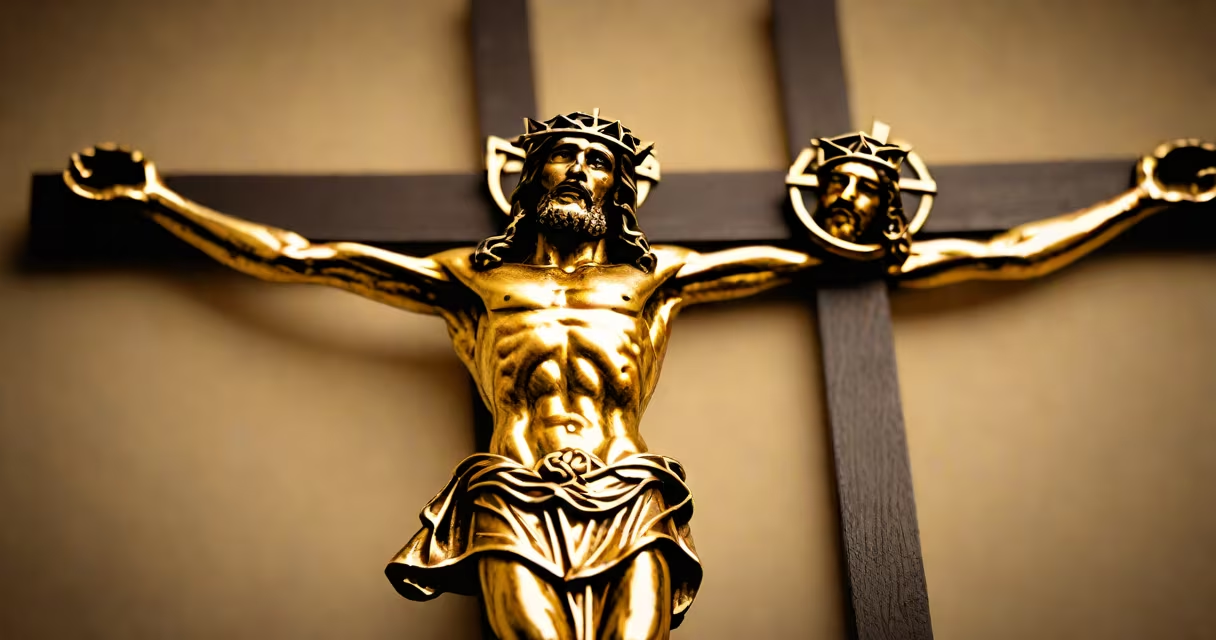
The acronym INRI stands for the Latin phrase "Iesus Nazarenus Rex Iudaeorum," meaning "Jesus of Nazareth, King of the Jews." This inscription was placed on the cross during Christ's crucifixion, according to the Gospels of Matthew, Mark, Luke, and John.
INRI appears in all four canonical Gospels as part of the narrative surrounding Jesus' execution under Roman authority. The phrase was written in three languages-Hebrew, Greek, and Latin-according to John 19:20, though only the Latin version survived in widespread ecclesiastical use. The Latin form became standard in Christian iconography, especially on crosses and crucifixes.
Historically, the title "King of the Jews" carried political weight. Pilate, the Roman governor, used it deliberately to mock Jewish leaders who had demanded Jesus' death. The term was not a claim of divine kingship but a political label reflecting Roman control over Judea. Yet early Christians interpreted it as prophetic fulfillment, aligning with messianic expectations from the Hebrew Bible.
The Gospel of John records Pilate's decision: "Pilate wrote a title and put it on the cross. It read, 'Jesus of Nazareth, King of the Jews.'" (John 19:19). The original Greek text uses "Iēsous ho Nazōraios, basileus tōn Ioudaion," which translates directly to the Latin INRI.
Early Church Fathers such as St. Jerome and St. Augustine cited INRI as evidence of Christ's dual nature-fully human and fully divine. They saw the irony in Pilate's words: a condemned criminal labeled king, yet the title became central to Christian theology. As Augustine wrote in *City of God*, "The cross was the throne of Christ."
Catholic liturgical tradition preserves INRI in devotional contexts. The phrase appears on crucifixes in churches, altars, and religious medals. In the 19th century, Pope Pius IX affirmed the use of INRI in official Catholic documents related to the Passion of Christ.
Many assume INRI means "I am the way" or "In the name of Jesus." These are incorrect. The letters do not stand for any modern spiritual phrase. The confusion often arises because INRI resembles other Latin acronyms used in religious settings, such as IHS (a Christogram derived from the first three letters of "Jesus" in Greek).
Another misconception is that INRI was written in Hebrew or Aramaic. While the original inscription may have included Hebrew script, the surviving version in Christian tradition is exclusively Latin. The Latin form became standardized due to the dominance of Latin in Western Christianity after the fall of Rome.
A lesser-known fact: the letters INRI were sometimes altered in medieval manuscripts to reflect theological shifts. For example, in some 12th-century illuminated Bibles, the "R" was stylized to resemble a crown, emphasizing Christ's royal status. This visual symbol helped reinforce the idea of a suffering king.
INRI appears in several forms across Christian culture:
Some Protestant denominations avoid using INRI due to concerns about ritualism. However, even among non-Catholic traditions, the phrase remains recognizable in hymns and scripture references.
Comparing INRI to similar Latin abbreviations reveals key differences:
| Acronym | Full Latin Phrase | Meaning | Usage Context |
|---|---|---|---|
| INRI | Iesus Nazarenus Rex Iudaeorum | Jesus of Nazareth, King of the Jews | Crucifixion inscription, Christian art |
| IHS | Iesus Hominum Salvator | Jesus, Savior of Mankind | Christogram, monastic symbols |
| XP | Christo Patri | For Christ, the Father | Early Christian graffiti, funerary inscriptions |
While IHS is a Christogram used in prayer and devotion, INRI is tied specifically to the Passion narrative. XP appears in early Christian burials and is associated with martyrdom, not crucifixion.
During a visit to the Basilica of San Francesco in Assisi, I noticed a small wooden crucifix mounted near the altar. The letters INRI were carved in faded gold above the figure of Christ. A pilgrim knelt beside it, whispering prayers. The simplicity of the inscription-four letters-carried centuries of theological weight. It wasn't just history. It was presence.
Understanding the "inri jesus meaning" clarifies how early Christians reinterpreted Roman mockery into sacred truth. The phrase is not merely historical-it remains a touchstone in Catholic teaching on Christ's kingship. According to the Catechism of the Catholic Church (paragraph 654), Christ's reign began at the cross, not in a palace.
Modern scholars confirm the authenticity of the inscription. Dr. James D. G. Dunn, professor of divinity at Durham University, notes in *The New Proof in Its World* (2017) that the use of Latin in Pilate's inscription reflects actual Roman administrative practice. Governors used Latin for official proclamations, even in provinces like Judea.
INRI is not a mystical cipher. It is a precise historical reference rooted in the Gospel accounts, preserved through centuries of faith and art. Its enduring presence reminds believers that Christ's kingship was proclaimed not in triumph, but on a cross.