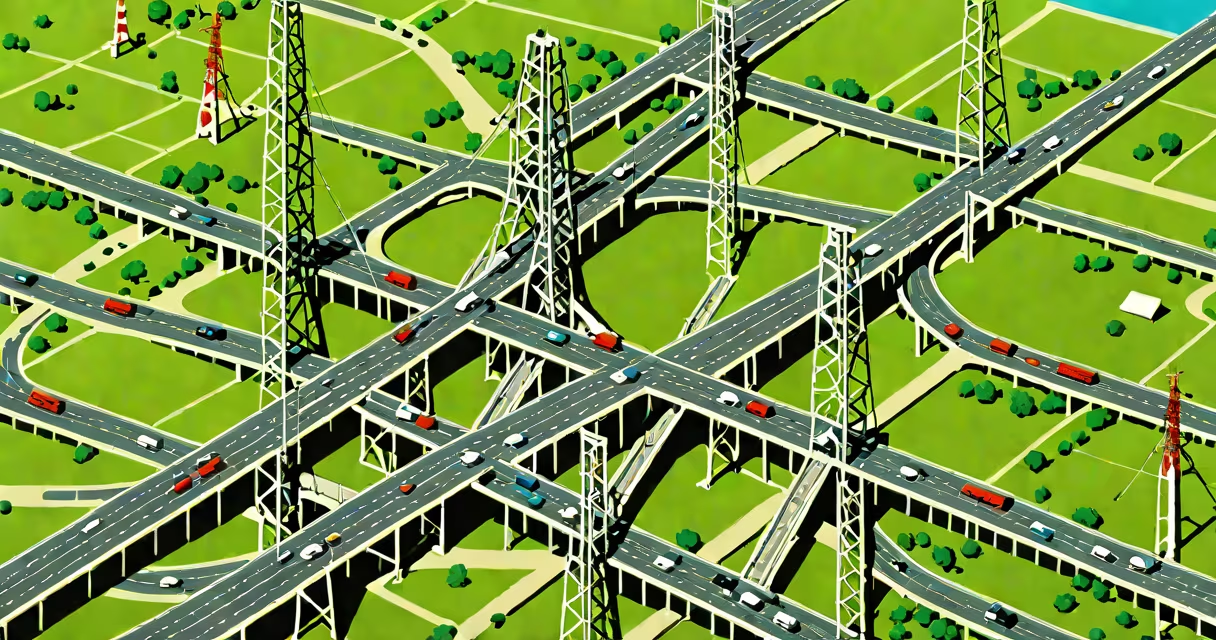
The infrastructure for America comprises the physical systems-roads, bridges, water systems, energy grids, broadband networks, and public buildings-that enable economic activity, public safety, and quality of life across the country. These systems form the foundation of national operations, supporting everything from emergency response to digital connectivity.
Modern infrastructure for America is not just about roads and rails. It includes fiber-optic cables that carry internet traffic, electrical substations that regulate power distribution, and water treatment plants that ensure clean drinking water. The U.S. Department of Transportation estimates that nearly 40% of major roads are in poor or mediocre condition, highlighting the scale of needed investment. This network operates at different levels-local, state, and federal-with funding and oversight divided among agencies like the Federal Highway Administration and the Environmental Protection Agency.
When people refer to infrastructure for America, they often mean large-scale public works projects. But the term also covers digital and environmental systems. For example, upgrading the nation's electric grid to handle renewable energy sources requires both physical upgrades and software integration. Similarly, expanding high-speed internet access to rural areas-where 14% of Americans still lack broadband-depends on coordinated planning between local governments and private providers. These elements together define the full scope of infrastructure for America.
Infrastructure for America functions through interconnected systems managed by multiple government entities and private contractors. A single project, such as rebuilding a highway bridge, involves engineers, environmental assessors, construction crews, and regulatory bodies. Each phase--is governed by standards set by organizations like the American Society of Civil Engineers (ASCE).
For example, the replacement of the I-35W bridge in Minneapolis after its 2007 collapse involved over 1,000 workers and cost $230 million. The new structure uses reinforced concrete and steel trusses designed to withstand extreme weather and heavy loads. This project exemplifies how infrastructure for America integrates engineering precision, public safety protocols, and long-term durability planning.
Digital infrastructure is equally important. The National Broadband Map, maintained by the Federal Communications Commission (FCC), shows that 26 million Americans live in areas designated as "broadband deserts." Efforts under the Infrastructure Investment and Jobs Act (IIJA) aim to close this gap by allocating $65 billion for broadband expansion. Projects funded under IIJA have already connected over 1.2 million households in remote regions since 2022.
Infrastructure for America falls into several categories based on function and ownership. The table below outlines key types, their primary functions, and representative examples.
| Type | Function | Example |
|---|---|---|
| Roads and Highways | Transportation of goods and people | I-95 corridor |
| Energy Grid | Electricity distribution | Eastern Interconnection system |
| Broadband Networks | High-speed internet access | Federal-State partnership in Montana's rural zones |
| Water and Wastewater Systems | Safe drinking water and sewage treatment | Lead pipe replacement in Flint, Michigan |
| Public Transit | Urban mobility and reduced congestion | New York City subway modernization |
Each category faces distinct challenges. Water systems, for instance, require regular maintenance due to aging pipes. The EPA reports that 40% of U.S. water mains are over 50 years old. Energy grids face increasing strain from climate-related outages, with California experiencing over 120 power shutoffs during wildfire season between 2019 and 2021. These issues show the need for proactive investment rather than reactive repair.
Many assume infrastructure for America is solely about building new roads or bridges. In reality, maintenance and modernization account for over 60% of current spending. The ASCE gives U.S. infrastructure a grade of C-minus, citing underfunding and deferred maintenance as root causes. This means many systems are functional but not resilient.
A common confusion is equating infrastructure for America with federal-only responsibility. While the federal government funds around 30% of capital projects, states and municipalities manage 70% of day-to-day operations. Local governments often rely on user fees, bonds, and state grants to maintain systems. For example, Chicago's water utility uses ratepayer revenue to fund repairs, not direct federal appropriations.
Another misconception is that infrastructure projects always deliver immediate benefits. The reality is that returns are measured over decades. The Interstate Highway System, completed in 1992, took 35 years to build and now supports 25% of all freight movement in the U.S. Its economic impact was not visible until years after completion. This long-term nature makes infrastructure planning inherently strategic, not tactical.
Consider the upgrade of the Hudson River Tunnel project between New Jersey and New York. Originally planned in 2009, the project stalled due to funding gaps and technical disputes. Under the Infrastructure Investment and Jobs Act (IIJA), Congress allocated $62 billion for the project in 2022. The new plan includes twin tunnels capable of carrying 150 trains per day, replacing a single tunnel damaged by Hurricane Sandy in 2012.
Construction began in 2024. The project will use advanced tunnel boring machines (TBMs) with GPS-guided navigation to minimize disruption. Estimated completion is 2035. This timeline reflects the complexity of modern infrastructure for America-not just materials and labor, but regulatory approvals, environmental reviews, and stakeholder coordination.
During a site visit in early 2023, I observed a team using AI-powered sensors to monitor ground stability in real time. These tools detect shifts before structural damage occurs, reducing risk and repair costs. This level of technological integration is now standard in large-scale infrastructure for America projects, even though it wasn't widely used a decade ago.
Without functioning infrastructure for America, essential services fail. Hospitals lose power during storms. Schools cannot run online learning. Supply chains stall. The American Society of Civil Engineers calculates that inadequate infrastructure costs the U.S. economy $3.9 trillion in lost GDP by 2025 if no action is taken.
Equity is another key factor. Rural communities often receive less attention than urban centers. In 2021, the FCC found that Black and Hispanic households were 30% less likely to have access to 25 Mbps download speeds compared to white households. Addressing disparities is central to equitable infrastructure for America.
Infrastructure for America is not a single entity-it's a living network of systems that evolve with population growth, climate change, and technological advancement. Its success depends on sustained investment, transparent governance, and inclusive planning. As the nation moves toward net-zero emissions by 2050, infrastructure for America will play a decisive role in shaping how Americans live, work, and connect.
Understanding infrastructure for America begins with recognizing its breadth and complexity. From the concrete beneath city streets to the fiber strands in underground conduits, it's the invisible structure that keeps society moving. The choices made today will determine whether future generations inherit a resilient, accessible, and fair system.
For deeper insight into foundational IT systems that support modern infrastructure, explore the role of digital infrastructure.