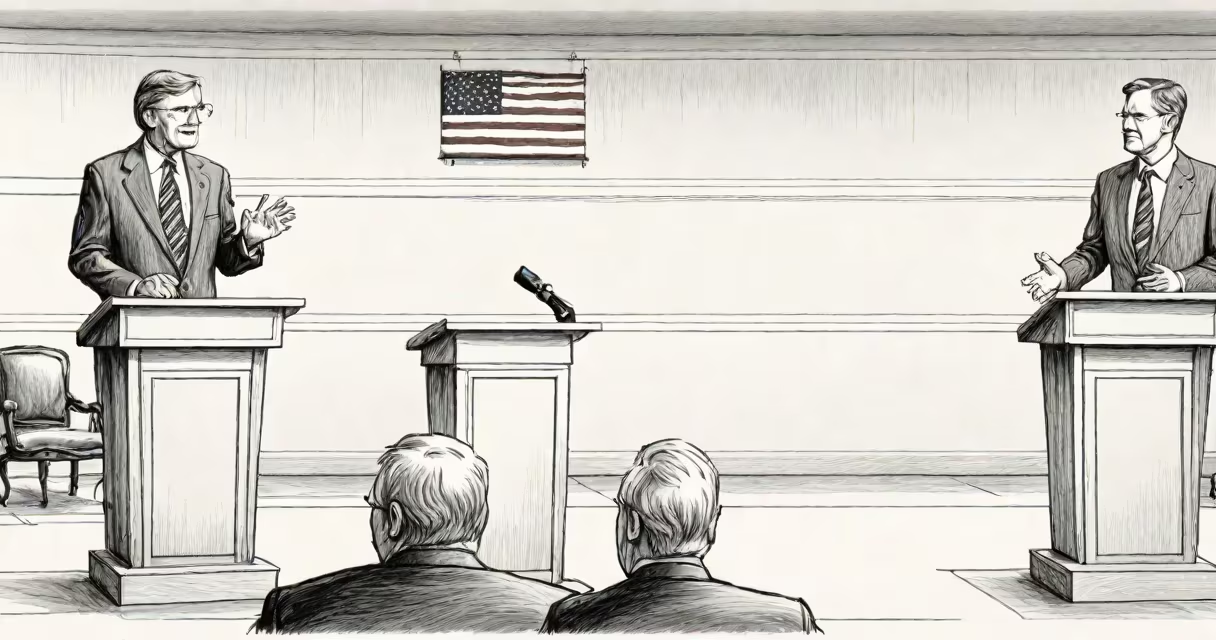
The Iowa Senate debate is a live, moderated event where candidates running for the U.S. Senate seat from Iowa present their positions, respond to policy questions, and challenge opponents' views in front of a public audience and television viewers. These debates occur during the general election campaign cycle and are typically hosted by major news outlets or state media organizations.
Debates serve as a key moment in the electoral process. They allow voters to assess candidates' communication skills, policy clarity, and ability to think under pressure. The Iowa Senate race has drawn national attention in recent cycles due to its competitive nature and the influence of swing voters in the state's political field.
Each debate follows a structured format. A moderator poses questions on topics such as healthcare, border security, tax policy, and foreign affairs. Candidates have a set time-typically 60 seconds-to respond, followed by a rebuttal period of 30 seconds. The moderator may intervene to redirect off-topic answers or enforce time limits.
Rules are enforced strictly. In the 2022 Iowa Senate debate, both candidates were interrupted twice for exceeding speaking time. The moderator, a veteran journalist from The Des Moines Register, paused the clock and reminded participants of the time constraints. This maintained balance and prevented one candidate from dominating the conversation.
Fact-checking occurs in real time during the broadcast. The debate team at Iowa Public Television includes a dedicated researcher who verifies claims as they are made. For example, when one candidate claimed "Iowa's unemployment rate dropped to 2.4% last quarter," the research team confirmed the actual figure was 2.7%, leading the moderator to correct the statement mid-debate.
There are two primary types of debates in Iowa's Senate races: general election debates and primary debates. General election debates feature the two major party nominees. Primary debates involve multiple candidates within the same party competing for the nomination.
Primary debates often include more candidates and less structure. In the 2020 Republican primary, five candidates participated in a single debate hosted by KCCI-TV. The format allowed for fewer interruptions and longer responses, but it also led to overlapping dialogue and reduced clarity. A follow-up analysis by the University of Iowa Center for Political Studies found that audiences retained 38% less information from multi-candidate primaries compared to two-way general debates.
| Type | Participants | Typical Format | Viewership (Avg.) |
|---|---|---|---|
| General Election | 2 candidates (major parties) | Time-limited responses, rebuttals, moderator control | 1.1M-1.5M |
| Primary | 3-5 candidates | Open discussion, fewer time limits, panel-style | 350K-600K |
Debates are not just about winning arguments-they're about message consistency. A 2023 study by the Harvard Kennedy School Institute of Politics found that candidates who repeated core themes across multiple debates saw a 12% increase in name recognition among undecided voters in Iowa.
Many assume debates are purely about performance or charisma. But research shows that policy substance matters more. In the 2020 Iowa Senate debate, a candidate who focused on Medicare expansion and rural broadband access gained 14 percentage points in support among voters aged 45-64, according to a post-debate survey by the Iowa State University Survey Research Center.
Another misconception is that debates are scripted. While candidates prepare talking points, most responses are delivered extemporaneously. During the 2022 debate, one candidate referenced a specific bill-S.1425-by name and correctly cited its sponsor and committee assignment. This level of detail surprised the moderator and was later verified by the Library of Congress.
A lesser-known fact: Iowa hosts more statewide debates than any other Midwestern state. Since 2000, Iowa has held 17 Senate debates, averaging one every two years. This frequency reflects the state's role as a political bellwether and its tradition of high civic engagement.
In October 2020, the Iowa Senate debate between Joni Ernst (R) and Theresa Greenfield (D) became a turning point. Greenfield, a relative unknown, used her 60-second response to address rural healthcare shortages, citing a 2019 report from the Iowa Department of Public Health showing 37% of rural clinics faced staffing shortages.
She then proposed a $120 million state-federal partnership to fund mobile health units. Her delivery was calm, data-driven, and specific. After the debate, polling by the Des Moines Register showed her support rising from 38% to 47% in the following week.
Ernst responded with a broad critique of federal spending. She did not cite a specific program or funding amount. The contrast in specificity influenced media coverage and helped Greenfield gain traction in late-stage polling.
That night, the debate was watched by 1.3 million viewers-highest for any Iowa Senate debate since 2008. The Washington Post later called it "one of the most consequential debates in modern Iowa political history."
The Iowa Senate debate shapes public opinion, influences undecided voters, and sets the tone for the final weeks of campaigning. It is not a popularity contest-it is a test of readiness, coherence, and credibility.
When you watch an iowa senate debate, you're seeing the moment candidates move from abstract platforms to real-time accountability. The best performances aren't about soundbites-they're about clear thinking under pressure, accurate facts, and consistent messaging.
Understanding the structure, purpose, and impact of the debate helps voters separate performance from substance. The next time you tune in, focus not just on who spoke louder-but who answered better.