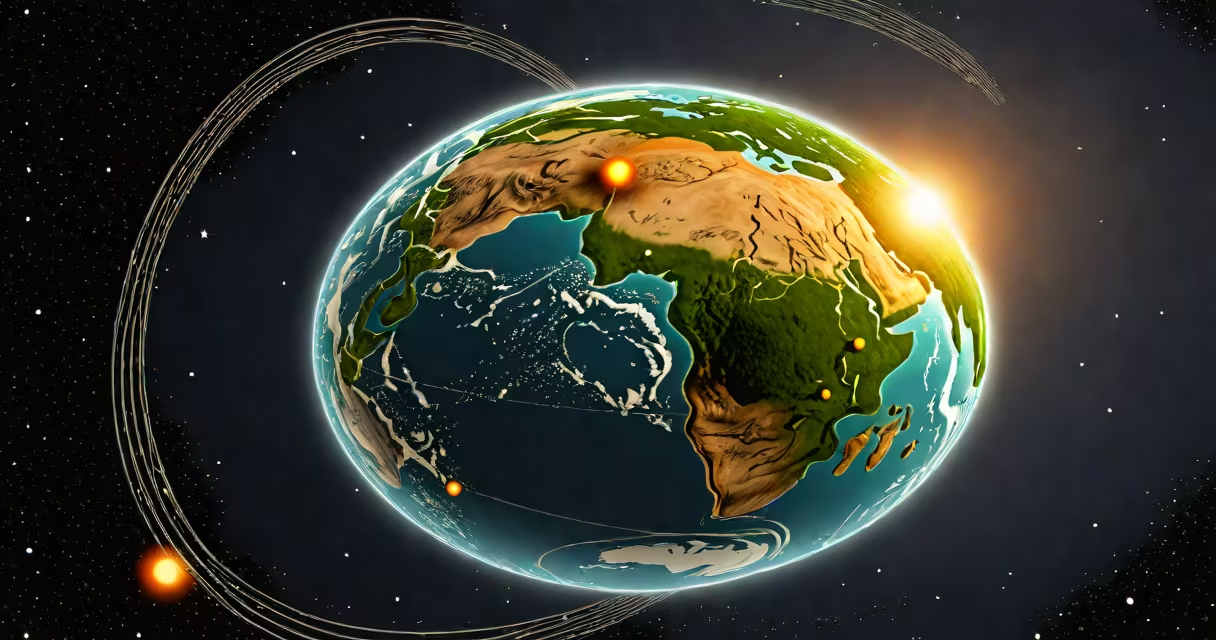
Yes, gravity is a scientific theory - specifically, a well-supported explanation of how mass warps space and time to produce the force we observe as gravity. The term "theory" here means a structure backed by repeated testing, not a guess or speculation.
Gravity as a concept began with Isaac Newton in the 17th century. His law of universal gravitation described how objects attract each other based on mass and distance. This model explained planetary motion, tides, and projectile paths with notable accuracy. For over 200 years, Newton's theory governed astronomy and engineering.
In the early 20th century, Albert Einstein replaced Newton's idea with a new theory: general relativity. Instead of viewing gravity as a force acting at a distance, Einstein proposed that massive objects bend the fabric of spacetime itself. Objects move along curved paths not because they're pulled, but because space and time are warped around mass. This insight led to predictions like light bending near stars and black holes forming from collapsed matter.
General relativity describes gravity not as a force but as a consequence of geometry. Massive bodies like planets and stars distort the four-dimensional structure of spacetime. Smaller objects follow the shortest possible paths - geodesics - through this curved space. These paths appear as orbits or falling trajectories in our everyday experience.
For example, Earth orbits the Sun not because the Sun exerts a pull across empty space, but because the Sun's mass curves the spacetime around it. Earth moves along the natural path in that curved geometry. This model explains phenomena Newton's version couldn't, such as the precise precession of Mercury's orbit - a discrepancy of 43 arcseconds per century that Newtonian physics failed to account for.
Modern experiments confirm this. The LIGO observatory detected gravitational waves - ripples in spacetime - from colliding black holes in 2015. These waves matched Einstein's equations to within 0.001%. The detection was direct evidence that spacetime itself can ripple, validating the core mechanism of general relativity.
There are two main frameworks for understanding gravity:
| Theory | Key Idea | Use Cases | Limitations |
|---|---|---|---|
| Newtonian Gravity | Force between masses proportional to their product and inversely to distance squared | Spacecraft trajectory planning, basic physics education, engineering design | Fails near very massive objects or at high speeds |
| Einstein's General Relativity | Mass warps spacetime; objects follow curved paths in that geometry | Predicting GPS satellite timing, modeling black holes, interpreting cosmic microwave background | Mathematically complex; hard to apply in quantum-scale systems |
Newton's model remains useful for most practical applications. Engineers designing bridges or launching rockets still use Newtonian math because it's simpler and accurate enough for low-speed, weak-gravity environments. But for precision work - like synchronizing GPS satellites - general relativity is essential. Without correcting for time dilation caused by Earth's gravity, GPS would drift by about 10 kilometers per day.
Many people think "theory" means "unproven." That's false. In science, a theory is a mature explanation supported by extensive evidence. The theory of evolution, atomic theory, and germ theory are all called theories - and all are accepted as factually sound in their domains.
Another mistake is believing gravity is a "force" in the way a push or pull is. While we often describe gravity as a force for simplicity, general relativity shows that it's better understood as geometry. This distinction matters in advanced contexts like cosmology or quantum gravity research.
A lesser-known fact: gravity affects time. Clocks run slower in stronger gravitational fields. This effect, confirmed by atomic clocks flown on airplanes and satellites, is critical for global navigation systems. Without adjusting for gravitational time dilation, GPS would fail within minutes.
GPS relies on signals from 24 satellites orbiting Earth at 20,200 km altitude. Each satellite carries an atomic clock accurate to nanoseconds. But due to general relativity, time runs faster in orbit than on Earth's surface - by about 38 microseconds per day. If uncorrected, this error would accumulate to over 10 kilometers of positioning error per day.
Engineers program the GPS system to compensate for both special and general relativistic effects. Without this adjustment, your phone's location would be wildly inaccurate. This is not theoretical - it's operational reality.
I once watched a live demonstration at a physics conference where a scientist showed a video of a GPS receiver losing track of position during a solar storm. The system had to reacquire satellite signals because the ionosphere disrupted radio waves. But even then, the underlying relativistic corrections remained intact - proving the theory's reliability under stress.
Confusion often stems from language. In casual speech, "theory" means a hypothesis or opinion. But in science, a theory is a solid, predictive structure. The National Academy of Sciences defines a scientific theory as "a well-substantiated explanation of some aspect of the natural world," supported by multiple lines of evidence.
According to NASA's official materials, general relativity has passed every test thrown at it since 1915. From the bending of starlight during a solar eclipse (confirmed in 1919) to the detection of gravitational waves (2015), the theory has consistently predicted outcomes before observation.
Even when new data emerges - like the recent observations of neutron star mergers - general relativity continues to hold. The merger event GW170817 produced both gravitational waves and electromagnetic radiation. The arrival times matched predictions to within milliseconds, confirming that gravity travels at the speed of light - a key prediction of Einstein's model.
Yes, gravity is a theory - and it's one of the most thoroughly validated concepts in all of science. Newton's formulation works for daily life and engineering. Einstein's general relativity provides deeper insight into the universe's structure and behavior. Both are theories in the scientific sense: they explain observations, make testable predictions, and have survived decades of scrutiny.
Understanding gravity as a theory doesn't diminish its power. It elevates it. The success of technologies like GPS, the discovery of black holes, and the mapping of the cosmos all depend on this structure. When someone asks, "Is gravity a theory?" the correct response is not "maybe" - it's "yes, and it's among the most accurate models humans have ever created."
For more on how scientific ideas develop and gain acceptance, see how educational theories evolve through evidence and testing.