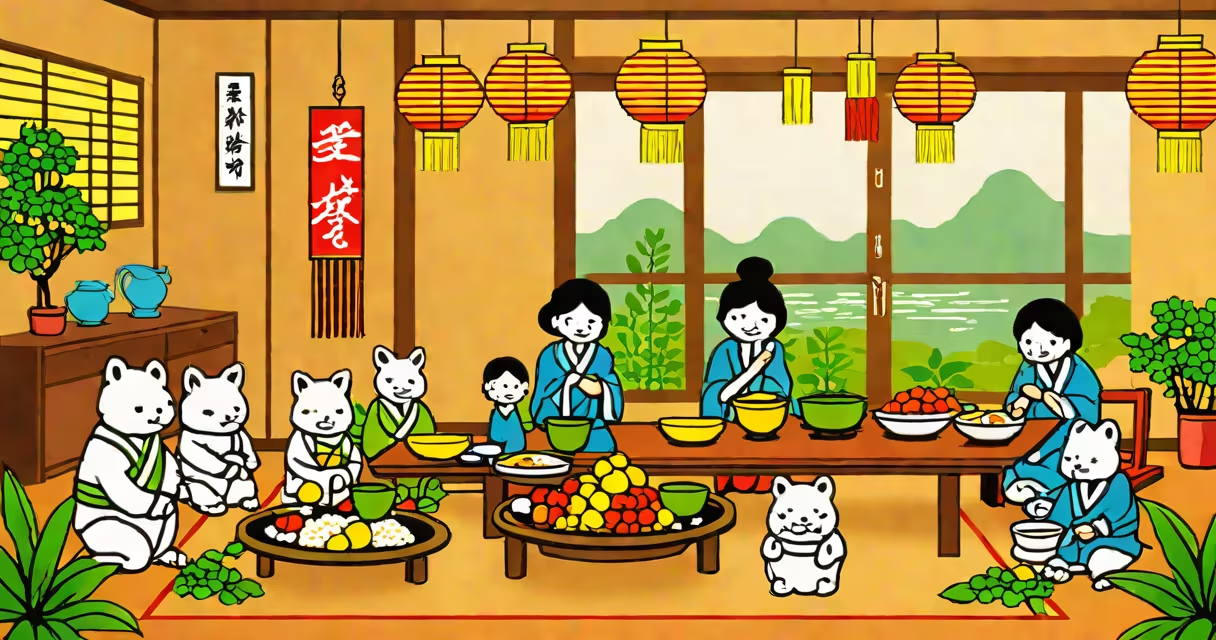
Japanese New Year, known as oshogatsu, is the country's most significant annual celebration, observed from January 1 to January 3 based on the Gregorian calendar. It marks the beginning of the new year and centers on family reunions, ancestral veneration, and ritual purification.
Oshogatsu follows the lunar calendar tradition historically but now aligns with the Gregorian calendar. The holiday begins on January 1 and lasts through January 3, though preparations start weeks earlier. Families clean homes thoroughly, a practice called osechi-mairi, to remove bad spirits and make space for good fortune. This cleaning is not symbolic-it involves scrubbing floors, windows, and even removing tatami mats to sweep under them.
The core of oshogatsu lies in spiritual renewal. People visit shrines (hatsumōde) during the first few days of the year to pray for health, prosperity, and safety. These visits draw millions-over 60 million people attended shrines in 2023, according to the Association of Shinto Shrines. Homes display kadomatsu (bamboo and pine decorations) and shimekazari (rice straw ropes) to welcome kami (spirits) and ward off evil.
Japanese New Year begins at midnight on December 31, when families gather for toshikoshi soba-buckwheat noodles symbolizing the passing of the old year. The meal is eaten before the clock strikes 12, representing the breaking of the old year's hardships. Afterward, many listen to the temple bells toll 108 times at midnight, a Buddhist practice meant to cleanse the 108 human desires.
On January 1, families perform hatsumōde. They wear formal attire-furusato-kimono or yukata-and bring offerings to shrines. Many temples and shrines offer omikuji (fortune slips) and sell amulets (omamori) for protection. The most popular omamori in 2023 were those for academic success and safe travel, reflecting ongoing societal concerns.
January 2 and 3 are reserved for visiting relatives. Children receive otoshidama-red envelopes filled with money-from elders. The amount varies by region and family custom, typically ranging from 500 yen to 10,000 yen. In urban areas, children often receive 1,000 yen or 5,000 yen, while rural households may give higher amounts.
Traditional oshogatsu food is carefully arranged in tiered boxes called jubako. These contain specific dishes with symbolic meanings:
| Dish | Symbolism | Region Example |
|---|---|---|
| Chirashi sushi | Abundance and diversity | Kansai region |
| Seiro (steamed fish) | Longevity and purity | Eastern Japan |
| Okowa (sweet red bean rice) | Health and fertility | Western Japan |
| Mochi (rice cakes) | Long life and resilience | National |
Each dish is prepared in advance and stored in refrigerated boxes to preserve freshness. The presentation is intentional-dishes are placed in order of importance, with the most sacred items at the top. Mochi is especially significant because it is traditionally pounded by hand using a large wooden mallet (usu). This process takes hours and is done only once a year.
Decorations carry meaning beyond aesthetics. Kadomatsu, made of pine and bamboo, represents longevity (pine) and flexibility (bamboo). They are placed at entrances and removed on January 15, a day known as kōhatsu. Shimekazari, the zigzag rope made of rice straw, signifies a boundary between the sacred and mundane. Its knots are tied in a specific way-three loops for the past, present, and future.
Oshogatsu is not just a holiday-it's a national reset. Schools and businesses close for three days. Public transportation runs reduced schedules, and government offices suspend operations. The holiday reflects Japan's deep-rooted animist and Shinto beliefs, where time is cyclical and nature is sacred.
For many, oshogatsu is a rare opportunity to reconnect with extended family. Urban dwellers often travel to hometowns-over 100 million people moved during the 2023 holiday period, according to Japan's Ministry of Land, Infrastructure, and Transport. This migration is comparable to U.S. Thanksgiving travel patterns.
A lesser-known fact: oshogatsu was standardized in 1873 during the Meiji Restoration. Before then, Japan used the lunar calendar, and New Year began in late January or early February. The switch to the Gregorian calendar was part of modernization efforts. Today, the old lunar calendar still influences regional festivals, such as the Gion Matsuri in Kyoto, which occurs in July but traces roots to lunar New Year traditions.
Many assume oshogatsu is similar to Chinese New Year. While both involve ancestral worship and family meals, they differ in timing, symbolism, and food. Chinese New Year follows the lunar calendar and begins in late January or February. It features dragon dances and fireworks. Oshogatsu lacks fireworks and focuses on quiet reflection.
Another misconception: oshogatsu is a Christian-style holiday. It is not. Though some families attend church services, especially in urban areas, the majority of observances are rooted in Shinto and Buddhist practices. Only about 15% of Japanese people identify as religious, yet 90% participate in oshogatsu rituals, according to a 2022 survey by the National Institute of Population and Social Security Research.
Some confuse oshogatsu with the Lunar New Year in Korea (Seollal) or Vietnam (Tết). While all three share the theme of renewal, Korean Seollal includes ancestral rites (charye) and the wearing of hanbok. Vietnamese Tết features spring cleaning, ancestor altars, and the giving of lucky money in red envelopes. Oshogatsu stands apart due to its emphasis on silence, modesty, and the physical act of cleaning.
In 2022, I spent oshogatsu in a small village near Nara. My host family cleaned the house for three days prior, sweeping under the floorboards and replacing tatami mats. On New Year's Eve, we ate toshikoshi soba together. The next morning, we visited a local shrine. The air was still. No music. No crowds. Just the sound of wooden sandals on stone paths and the soft chime of a bell.
At noon, we returned home to eat osechi. The box had seven layers. I was told to eat only the top layer first-the rest would come later. When I asked why, my host grandmother said, "The year is long. You don't eat everything at once." That moment stayed with me. It wasn't about food. It was about patience, respect, and the idea that time must be honored.
Japanese New Year is more than a date on a calendar. It is a structured return to balance, a pause in the rhythm of daily life to honor ancestors, nature, and community. Its customs-cleaning, visiting shrines, eating symbolic foods-are deliberate acts of renewal. Understanding oshogatsu requires seeing it not as a festival, but as a cultural practice embedded in Japan's identity.
For travelers, experiencing oshogatsu offers insight into Japanese values: harmony, humility, and continuity. For locals, it's a rare chance to step away from work and screens. The holiday's endurance-despite modernization-proves its deep relevance. preparing osechi at home, the ritual remains unchanged: begin the year with care, intention, and quiet reverence.