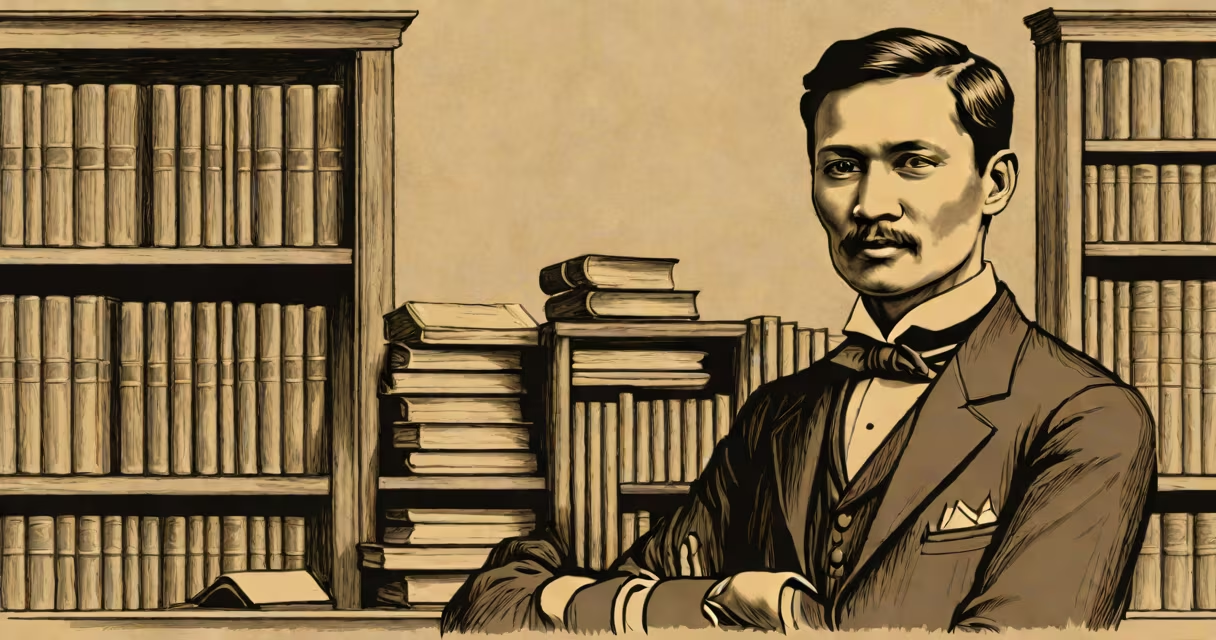
José Rizal was a Filipino nationalist, writer, and polymath whose novels and activism inspired resistance against Spanish colonial rule. Born in 1861 in Calamba, Laguna, he became the country's national hero through his literary works and political awakening.
Rizal's life unfolded during the final decades of Spanish colonization in the Philippines. He studied medicine in Madrid and later in Paris and Heidelberg, earning degrees in ophthalmology and multiple languages. His time abroad exposed him to European Enlightenment ideals, which deeply influenced his worldview and writing.
He returned to the Philippines in 1887 and published *Noli Me Tangere* and *El Filibusterismo*. These novels criticized abuses by Spanish friars and the colonial government. The first novel was banned in the Philippines upon release due to its subversive themes. Rizal was arrested in 1892 under suspicion of inciting rebellion, though he denied involvement in armed revolt.
Rizal's fiction served as both social critique and political education. *Noli Me Tangere* exposed corruption in the Catholic Church and the abuse of power by Spanish officials. The protagonist, Crisostomo Ibarra, represents the educated Filipino who seeks reform through peaceful means-a figure Rizal himself embodied.
His second novel, *El Filibusterismo*, portrayed a darker vision. The character Simoun, a wealthy man seeking revenge, symbolized the consequences of prolonged injustice. The book was interpreted as advocating revolution, though Rizal never supported violence. Still, authorities saw it as dangerous.
Historian Renato Constantino notes that Rizal's writings "created a new consciousness among Filipinos" by showing them their own dignity and potential. His work helped unify diverse regions under a shared identity rooted in language, literature, and historical memory.
Rizal left the Philippines in 1887 after being pressured by colonial authorities. He lived in Europe for nearly five years, studying, writing, and engaging with reformist circles. During this time, he met fellow nationalists like Marcelo H. del Pilar and Graciano López Jaena.
He returned to the Philippines in 1892, briefly joining the reform group La Liga Filipina. The organization was dissolved by Spanish authorities within weeks. Rizal was arrested in June 1892 and exiled to Dapitan, a remote town in Mindanao.
During his four-year exile in Dapitan, Rizal practiced medicine, taught children, designed a water system, and wrote poetry. He also developed a version of the Filipino language called *Súgat ng Súlat*, a precursor to modern Tagalog orthography. His time there was marked by intellectual productivity despite isolation.
Rizal was brought back to Manila in 1896 amid rising revolutionary activity. He was tried by a military tribunal and sentenced to death. The trial was rushed, lacking due process. On December 30, 1896, he was executed at Bagumbayan Field (now Luneta Park).
His last words were reportedly: "My God, my God, why hast thou forsaken me?" Though not recorded in official documents, this quote became part of popular memory. His execution galvanized the Philippine Revolution, turning him into a martyr and symbol of resistance.
Today, Rizal's legacy is institutionalized. December 30 is commemorated annually as Rizal Day. Schools teach his life and works. His face appears on Philippine currency and postage stamps. The National Museum of Fine Arts in Manila houses his personal effects, including his pen and letters.
| Event | Date | Significance |
|---|---|---|
| Born in Calamba, Laguna | June 19, 1861 | First of 11 siblings; showed early talent in art and writing |
| Published Noli Me Tangere | 1887 | Exposed church corruption; banned in the Philippines |
| Exiled to Dapitan | 1892 | Lived in isolation for four years; continued writing and teaching |
| Arrested and charged with sedition | 1896 | Trials held without legal representation; sentenced to death |
| Executed at Bagumbayan | December 30, 1896 | Symbolic death that fueled revolutionary fervor |
Many assume Rizal advocated armed revolution. This is incorrect. He believed in peaceful reform through education and enlightenment. His novels were tools of moral and civic awakening, not calls to arms.
Another myth is that he was a Christian. While he respected religious values, he rejected blind faith. His writings often questioned dogma. He was influenced by humanism and secular ethics, not organized religion.
A lesser-known fact: Rizal wrote *Mi Último Adiós* (My Last Farewell) while imprisoned. The poem was smuggled out and circulated widely after his death. It is now a national treasure, recited at memorials and schools.
In 2019, I visited the Rizal Monument in Rizal Park, Manila. Standing beneath the statue, I read excerpts from *Noli Me Tangere* aloud. A group of students nearby joined in. The act felt less like history and more like living testimony. Rizal's words still resonate with urgency.
His life remains relevant because he modeled intellectual courage. He chose writing over silence, truth over comfort. In an age of misinformation, his commitment to evidence-based reasoning offers a model for civic engagement.
Modern scholars like Ambeth Ocampo have emphasized that Rizal's relevance lies not in his martyrdom but in his method. He analyzed systems, documented injustices, and proposed solutions-all through disciplined inquiry. This approach continues to inform critical thinking in Philippine education.
Understanding jose rizal biography reveals more than a historical figure-it shows how ideas can shape nations. His legacy lives not in statues alone, but in classrooms, courtrooms, and public discourse.