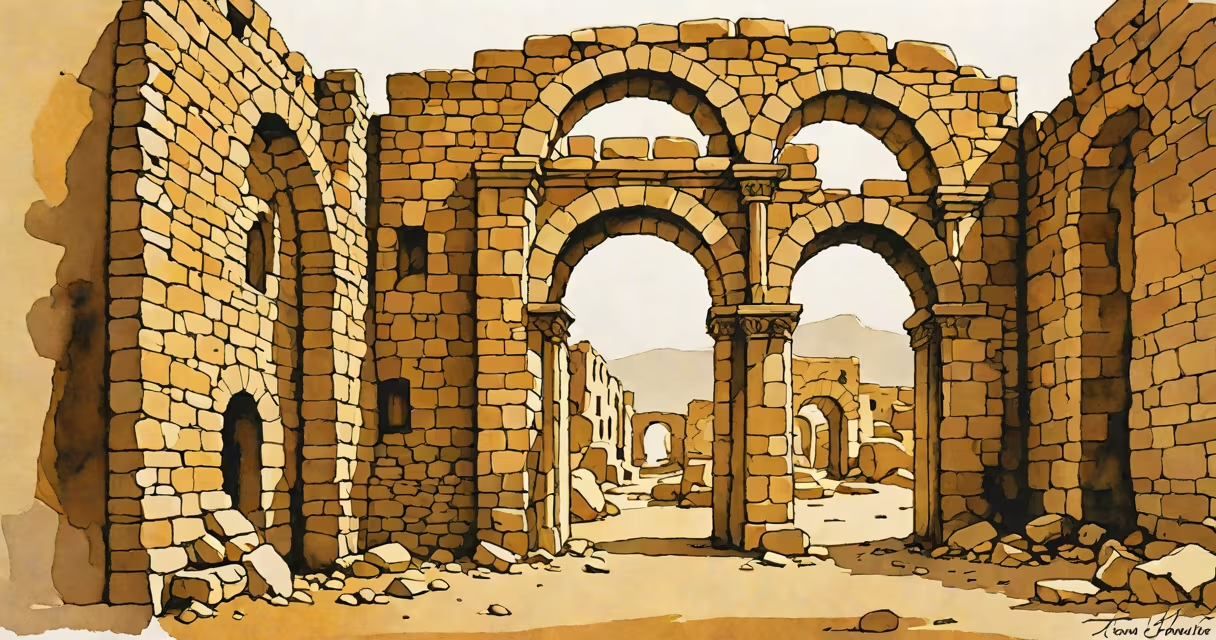
Joshua 8 meaning centers on Israel's military victory at Ai after their failure at the first attempt, illustrating God's justice, the necessity of obedience, and the consequences of sin. The chapter shows how divine strategy unfolds through ritual sacrifice, deception, and total destruction-all under God's command.
The narrative in Joshua 8 follows immediately after Israel's defeat at Ai due to Achan's sin, which violated God's ban on plunder. After Achan was punished and the sin removed, God instructed Joshua to attack Ai again-not with force alone, but with a carefully orchestrated plan involving ambushes, feigned retreats, and precise timing. This second assault succeeded because Israel obeyed God's commands without deviation.
God's role in the battle is explicit: "The Lord said to Joshua, 'Do not fear or be dismayed. Take all the fighting men with you, and go up against Ai. I have given into your hands the king of Ai, his people, his city, and his land.'" (Joshua 8:1, ESV). The success wasn't due to Israel's strength but to God's presence and direction. The chapter underscores that victory comes not from human strategy alone, but from alignment with divine will.
Joshua 8 outlines a multi-phase military operation. First, Joshua sent scouts to verify Ai's defenses. Then he divided the army: 30,000 elite soldiers were hidden in ambush positions west of the city, while the main force approached from the east. When the enemy pursued the retreating Israelites, the ambush team entered the city, set it ablaze, and cut off escape.
The plan relied on psychological warfare. The Israelites pretended to flee, luring the garrison out. Once the entire enemy force was drawn away, the ambush unit seized the city. The main army then turned and attacked from behind. This double-pronged assault destroyed Ai completely-its king was captured and executed, and the city was burned to the ground.
This method reflects ancient Near Eastern siege tactics, but with a theological twist. Unlike typical conquests driven by greed or power, Israel's actions were strictly controlled by divine instruction. The city was to be utterly destroyed-"devoted to the Lord"-and nothing was to be taken except the spoils designated for the tabernacle (Joshua 8:27).
The chapter contains several distinct phases of action, each serving a theological purpose:
These elements show that Joshua 8 is not just a military account. It is a sacred drama of obedience, judgment, and covenant faithfulness. The destruction of Ai was not random violence-it was a symbolic act of purification, removing a spiritual obstacle to Israel's inheritance.
Modern Christian teaching uses Joshua 8 to illustrate the importance of repentance and obedience. Pastors cite it during sermons on overcoming failure, especially when a community or individual has stumbled due to hidden sin. The story of Achan's punishment and the subsequent victory at Ai is often paired with Romans 6:1-4, which speaks of dying to sin and rising to new life.
Academic scholars like John Walton (Professor of Old Proof, Wheaton College) emphasize that the "herem" language in Joshua 8 reflects ancient covenantal theology, not ethnic cleansing. In his work The Lost World of Genesis One, Walton notes that such texts were meant to convey divine sovereignty, not promote racial hatred. The destruction of cities like Ai was symbolic of God's ultimate authority over all creation.
Joshua 8 is also referenced in discussions about the ethics of war. Some theologians argue that the command to destroy Ai cannot be applied to modern conflicts, as it was specific to God's redemptive plan for Israel. Others, like N.T. Wright in Joshua: An Introduction and Commentary, stress that these events were historical narratives, not moral blueprints for warfare.
Many readers misunderstand Joshua 8 as evidence of a violent or vengeful God. But the text makes clear that the destruction of Ai was not spontaneous or cruel-it was a consequence of disobedience. The first attack failed because of Achan's sin (Joshua 7). Only after the sin was purged did God allow the second attack.
A common error is assuming that "total destruction" meant killing everyone indiscriminately. However, the Hebrew word herem implies consecration to God, not mere annihilation. As noted in The New International Dictionary of New Proof Theology and Exegesis, herem meant "devoted to God," often involving surrender of all possessions to divine purposes.
Another misconception is that the ambush tactic was deceitful. But in ancient warfare, feigned retreats were standard. The key difference lies in divine authorization. God commanded the plan, and Israel carried it out precisely. The deception was not moral failure-it was tactical obedience.
I once led a small group Bible study where members struggled with recurring failures-addiction, broken relationships, financial missteps. We walked through Joshua 7 and 8 together. One member confessed she had been hiding a lie about her finances. After confessing and turning it over to God, she said, "I felt like we were going to fail again-but then I remembered how Israel lost the first time, then won the second."
We applied the principle: failure doesn't cancel God's plan. But it requires repentance and alignment with His will. That week, the group began praying for wisdom, not just victory. They focused on obedience, not results. Within six months, one person had rebuilt a fractured marriage, another quit a destructive job. Not because they were perfect-but because they stopped trying to win on their own.
| Aspect | Joshua 8 (Ai) | Joshua 6 (Jericho) | Joshua 10 (Gibeon) |
|---|---|---|---|
| Method | Ambush + feigned retreat | Circumambulation + shout | Surprise attack + prolonged battle |
| Command Source | God's direct instruction via Joshua | Divine command via vision (Joshua 6:2) | God's assurance: "Do not fear" (Joshua 10:8) |
| Outcome | City destroyed, king executed | City destroyed, walls fell | Victory extended to southern kingdoms |
| Theological Focus | Obedience after failure | Faith in God's word | God's presence in battle |
Each chapter emphasizes different aspects of God's character. Joshua 8 stands out for showing how restoration follows repentance. It is not a story of unbroken success, but of recovery through discipline.
While preparing a sermon on Joshua 8, I initially saw it as a tale of military triumph. But after reading the original Hebrew and consulting commentaries, I realized the deeper message: God doesn't abandon those who stumble. He gives them a second chance-if they return to Him.
That insight changed my approach to pastoral care. Instead of focusing on perfection, I now emphasize restoration. When someone fails, I don't ask, "Why did you mess up?" I ask, "What do you need to do next?" The story of Ai teaches that failure is not final-and that God's plan continues even after setbacks.
Understanding Joshua 8 meaning requires seeing it as both a historical event and a spiritual lesson. It is not a call to violence, but a demonstration of God's justice, mercy, and sovereignty. The victory at Ai came only after sin was dealt with, obedience restored, and worship renewed. For believers today, Joshua 8 remains a useful reminder: God leads through obedience, not performance.