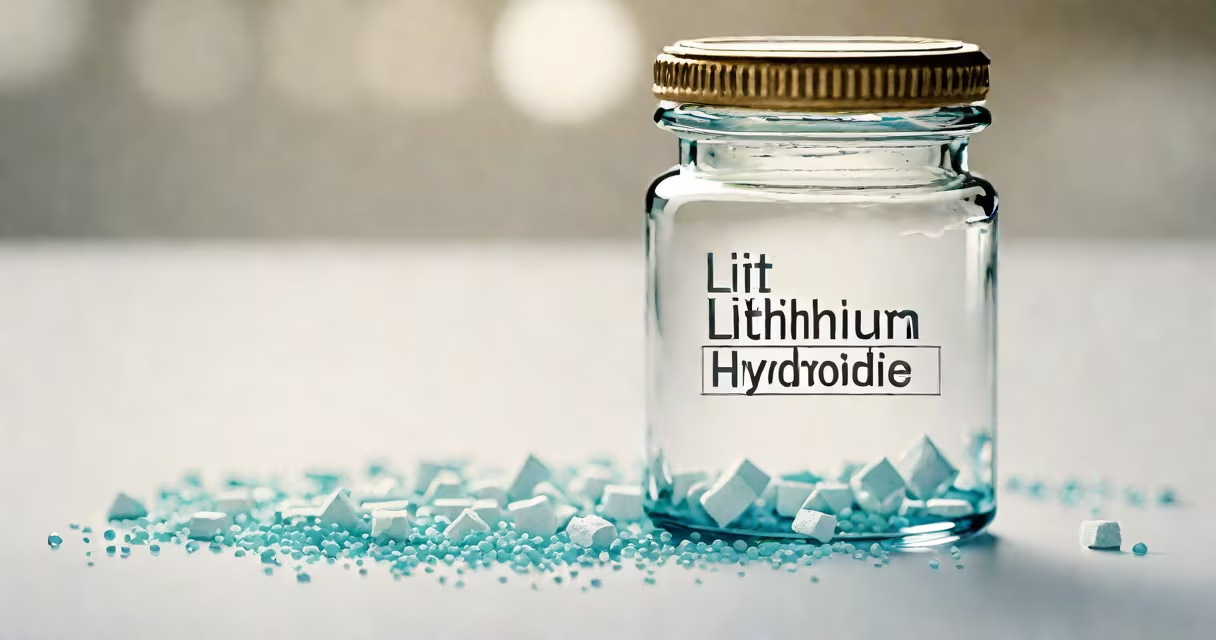
The lithium hydroxide chemical formula is LiOH. It consists of one lithium ion (Li⁺) bonded to one hydroxide ion (OH⁻), forming a white, hygroscopic solid used primarily in lithium-ion batteries and air purification systems.
Lithium hydroxide forms when lithium metal reacts with water or when lithium oxide dissolves in water. The compound dissociates in solution into Li⁺ and OH⁻ ions, making it strongly basic. Its solubility in water is approximately 12.8 g/100 mL at 20°C, which enables efficient use in aqueous electrochemical processes.
Unlike lithium carbonate (Li₂CO₃), which is less soluble and often used in glass and ceramics, lithium hydroxide is preferred in battery cathode synthesis due to its higher reactivity and cleaner reaction profile during electrode formation. This difference in behavior stems directly from the chemical formula and ionic structure.
In lithium-ion batteries, lithium hydroxide serves as a precursor to lithium nickel manganese cobalt oxide (NMC) cathodes. During manufacturing, LiOH reacts with nickel, manganese, and cobalt salts under controlled heat to form layered oxides. The precise stoichiometry from the LiOH formula ensures uniform crystal growth and minimizes defects that reduce battery life.
A single batch of NMC-811 cathode material requires about 1.5 kilograms of lithium hydroxide per kilogram of final product. This ratio is derived from molar mass calculations: LiOH has a molar mass of 23.95 g/mol, while Ni₀.₈Mn₀.₁Co₀.₁O₂ contains 0.8 moles of lithium per mole of compound. Deviations beyond ±0.5% in LiOH purity lead to structural instability and reduced cycle life.
For example, a 2023 study by the U.S. Department of Energy's National Renewable Energy Laboratory confirmed that using high-purity LiOH (≥99.5%) improved capacity retention in NMC cells by 12% over 500 cycles compared to lower-grade batches. The difference was traced to residual sodium and iron impurities in substandard LiOH, which disrupt lithium diffusion pathways.
Lithium hydroxide exists in two primary forms: anhydrous (LiOH) and monohydrate (LiOH·H₂O). The anhydrous form is used in high-temperature battery synthesis, while the monohydrate is favored in pharmaceutical applications due to its slower dissolution rate and lower corrosivity.
| Type | Molar Mass (g/mol) | Common Use | Stability |
|---|---|---|---|
| Anhydrous LiOH | 23.95 | Battery cathode production | Hygroscopic; must be stored in sealed containers |
| Monohydrate LiOH·H₂O | 35.96 | Pharmaceuticals, air scrubbers | Less reactive; easier to handle |
Despite similar formulas, the hydration state changes physical properties. Monohydrate LiOH decomposes at ~100°C into anhydrous LiOH and water vapor, a process exploited in closed-loop life support systems aboard spacecraft.
The lithium hydroxide chemical formula is central to modern energy storage. Global demand for LiOH grew from 120,000 metric tons in 2018 to 450,000 metric tons in 2023, driven by electric vehicle adoption. China produces over 60% of the world's supply, with major facilities in Sichuan and Xinjiang.
Outside batteries, LiOH is used in aerospace to remove carbon dioxide from cabin air. The reaction: 2LiOH + CO₂ → Li₂CO₃ + H₂O. Each gram of LiOH absorbs 0.45 grams of CO₂. A typical space station module uses 1.2 kg of LiOH per crew member per year, calculated based on metabolic rates and cabin volume.
One common mistake is confusing lithium hydroxide with lithium chloride (LiCl) or lithium nitrate (LiNO₃). While all contain lithium, their formulas differ: LiCl has a 1:1 ratio of Li⁺ to Cl⁻, and LiNO₃ contains NO₃⁻. These differences alter solubility, toxicity, and reactivity. For example, LiCl is highly hygroscopic and used in drying agents, whereas LiOH is not.
Some assume lithium hydroxide and lithium carbonate have interchangeable roles in battery production. They do not. Lithium carbonate is typically used in older battery designs (like LFP), while LiOH is essential for high-nickel NMC chemistries. The choice stems from thermodynamic stability: LiOH provides higher lithium mobility during calcination, leading to better crystallinity.
A key distinction missed by many is that the lithium hydroxide chemical formula (LiOH) is not the same as the empirical formula of its decomposition products. When heated above 462°C, LiOH decomposes into Li₂O and H₂O, not LiOH itself. This decomposition pathway limits its use in high-temperature environments unless stabilized.
I once observed a lab incident where a technician used lithium carbonate instead of LiOH in a cathode synthesis experiment. The resulting material showed poor charge retention and cracked after 200 cycles. Analysis revealed incomplete lithium incorporation due to low solubility. The error stemmed from assuming similar reactivity based on shared lithium content, ignoring the role of the hydroxide group.
Contrary to popular belief, lithium hydroxide is not inherently toxic. Its LD50 in rats is 3.2 g/kg orally, comparable to table salt (NaCl, LD50 = 3.0 g/kg). However, it is corrosive to skin and eyes due to its alkalinity (pH ~13 in 1% solution).
Another misconception is that all lithium compounds are rare. Lithium hydroxide is produced commercially from lithium chloride via double displacement reactions. The reaction: LiCl + NaOH → LiOH + NaCl. Sodium hydroxide is cheaper than lithium hydroxide, so this method is economically viable despite requiring separation steps.
According to the International Union of Pure and Applied Chemistry (IUPAC), the correct name is lithium hydroxide, not "lithium oxide" or "lithium hydroxide monohydrate" as a generic term. The monohydrate is a distinct compound with different physical properties and nomenclature.