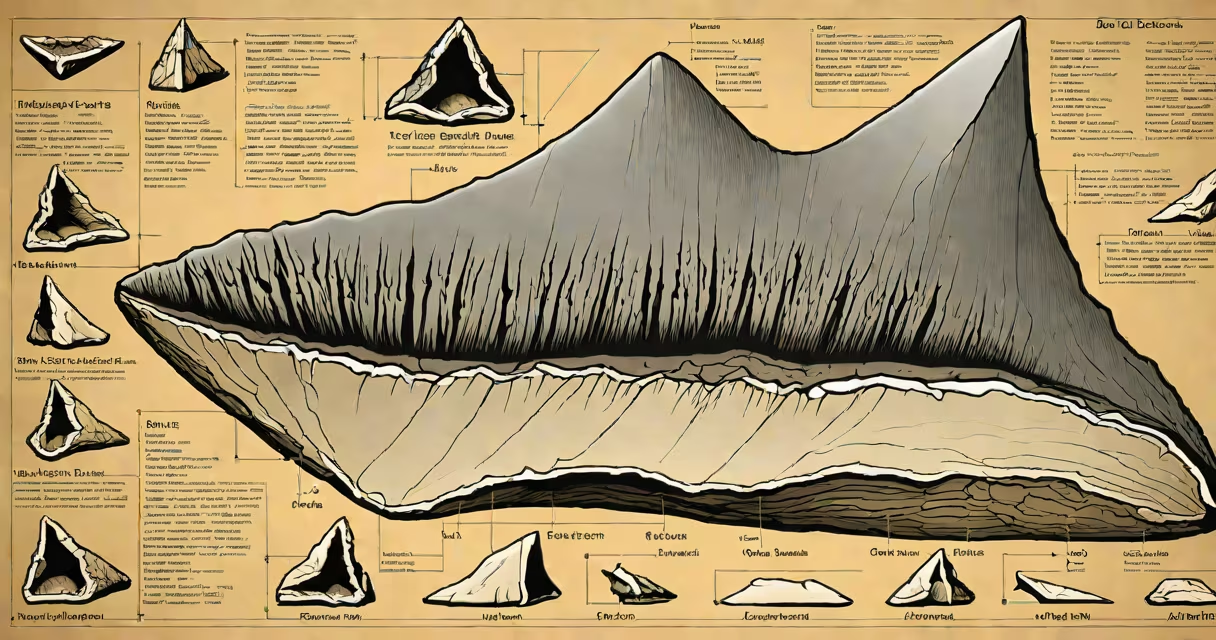
A megalodon shark tooth is a fossilized dental structure from Otodus megalodon, a prehistoric shark that ruled oceans between 23 and 3.6 million years ago. These teeth, often exceeding 7 inches in length, are the most commonly found remains of the species due to their dense enamel and frequent shedding during feeding.
Megalodon sharks were apex predators, estimated to reach lengths of 50 feet and weigh up to 50 tons. Their teeth evolved for slicing through thick marine mammal flesh, particularly whales. The fossil record shows these teeth were shed regularly-up to 15 per year-making them abundant in coastal sediments worldwide.
Modern paleontologists identify megalodon shark teeth by their broad, triangular shape, pronounced serrations along the edges, and a distinct root base. They differ from other large fossil teeth such as those of the great white shark (Carcharodon carcharias), which are narrower and have less pronounced serrations. A single megalodon tooth can weigh over 1 pound and display wear patterns consistent with biting through bone.
When a megalodon shed a tooth, it fell to the seafloor. Over time, minerals in seawater replaced organic material in the tooth's structure, preserving its shape and microstructure. This process, known as permineralization, occurs over thousands to millions of years. The resulting fossil retains fine details such as enamel ridges and root fissures.
Fossilization requires specific conditions: low oxygen levels to prevent decay, rapid burial under sediment, and mineral-rich groundwater. Coastal regions with ancient marine deposits-such as North Carolina's phosphate beds or South Carolina's riverbanks-are prime locations for finding megalodon shark teeth. These areas were submerged during the Miocene and Pliocene epochs, when megalodon thrived.
One study published in Paleobiology analyzed over 1,200 fossil shark teeth from the Calvert Cliffs in Maryland. Researchers confirmed that 27% of the large teeth recovered belonged to megalodon, confirming the species' dominance in regional food webs. The study also documented wear patterns indicating the teeth were used to shear through blubber and muscle tissue.
Not all megalodon shark teeth are equal. Size, preservation, and geographic origin affect both scientific value and market price. Teeth are categorized by size, condition, and provenance.
| Size Range | Typical Length | Estimated Weight | Common Origin |
|---|---|---|---|
| Small | 1-2 inches | 0.5-1 oz | Coastal riverbeds, shallow marine deposits |
| Medium | 2.5-4 inches | 1-3 oz | North Carolina, South Carolina, Florida |
| Large | 4.5-6 inches | 4-8 oz | Calvert Cliffs, Maryland; Georgia coast |
| Extra Large | 6.5-7.5 inches | 1-1.5 lbs | Rare finds; often museum specimens |
Teeth over 5 inches are exceptionally rare. The largest scientifically verified megalodon tooth measures 7.2 inches and was discovered in a South Carolina riverbed in 2018. It is now housed at the University of Florida's Florida Museum of Natural History.
Preservation quality varies. Teeth with minimal erosion, intact serrations, and no cracks command higher prices. Some collectors prefer teeth with natural polish from water transport, while others favor teeth with original root structure and enamel detail.
Recreational fossil hunters collect megalodon shark teeth primarily in the southeastern United States. North Carolina's Blackwater River and South Carolina's Cooper River are popular sites. These rivers erode ancient marine sediments, exposing fossils washed downstream over millennia.
Commercial fossil dealers sell megalodon shark teeth internationally. Prices range from $20 for small, worn specimens to over $10,000 for large, well-preserved teeth. A 6-inch tooth with full serration and minimal damage sold for $12,500 at a 2022 auction in New York.
Scientific institutions use these teeth to reconstruct megalodon's diet, growth rates, and extinction timeline. A 2020 study in Nature Communications used stable isotope analysis on megalodon teeth to estimate their metabolic rate. Results showed they maintained high body temperatures, suggesting endothermic metabolism-a trait shared with modern great whites.
Many confuse megalodon shark teeth with those of the great white shark. While both have serrated edges, megalodon teeth are wider at the base and have deeper roots. Great white teeth taper more sharply toward the tip and are typically thinner in cross-section.
Another misconception is that megalodon teeth are always black or dark gray. In reality, color depends on mineral content and exposure. Common hues include brown, yellow, and dark gray. Some teeth show faint banding from seasonal growth layers, similar to tree rings.
One non-obvious fact: megalodon teeth do not contain DNA. Despite their age, the organic components degrade completely over time. Any genetic material would have broken down within 100,000 years. Therefore, no living megalodon can be resurrected using fossil teeth, regardless of media portrayals.
I once spent a weekend sifting through sediment at a riverbank in South Carolina. After hours of scanning the gravel, I found a 4.2-inch tooth with sharp serrations and a clean root. It was partially embedded in a layer of compacted clay. The find felt like holding a piece of ancient ocean power-something that once tore through whale flesh and shaped the fate of marine ecosystems.
For anyone interested in identifying a potential megalodon shark tooth, start with size and shape. Look for a broad, triangular form with multiple serrations along the edge. Avoid teeth that are too thin or lack root structure. Use reference guides from museums like the Smithsonian or the American Museum of Natural History for comparison.
Understanding a megalodon shark tooth means recognizing it as a remnant of a creature that dominated Earth's oceans for nearly 20 million years. Its fossilized teeth are not just curiosities-they are physical evidence of a lost world where giants ruled the seas.