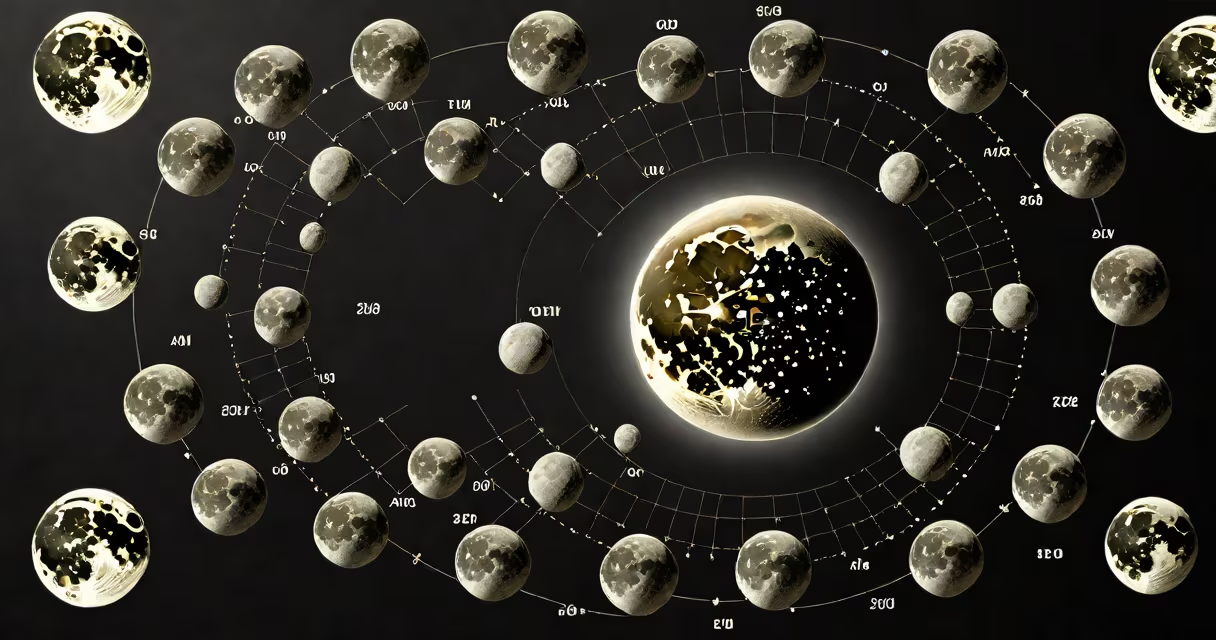
A moon cycle calendar tracks the moon's eight distinct phases-from new moon to full moon and back-over approximately 29.5 days. It shows the moon's appearance each night, helping users anticipate lunar events and align activities with natural cycles.
The moon cycle calendar is based on the synodic month, the time between successive new moons. This period averages 29.53 days, slightly longer than a lunar month measured from Earth's perspective. The calendar divides this span into eight stages: new moon, waxing crescent, first quarter, waxing gibbous, full moon, waning gibbous, last quarter, and waning crescent. Each phase lasts about 3.7 days, though slight variations occur due to orbital mechanics.
These calendars appear in print, digital apps, and websites. They often include sunrise/sunset times, tide predictions, and cultural notes-such as when a full moon is called a "Harvest Moon" or "Wolf Moon." Some calendars show optimal days for planting, harvesting, or moon bathing based on lunar energy beliefs. While not scientifically proven, many gardeners and spiritual practitioners use them as guides.
Each phase reflects the moon's changing position relative to Earth and the sun. When the moon lies between Earth and the sun, we see no illuminated surface-the new moon. As it moves eastward along its orbit, sunlight gradually reveals more of its near side. By the first quarter, half the moon is lit. At full moon, Earth sits between the sun and moon, so the entire face shines.
After full moon, the illuminated portion shrinks. The waning gibbous phase follows, then the last quarter, and finally the waning crescent before returning to new moon. This cycle repeats every 29.53 days, with minor shifts due to gravitational influences from Earth and other bodies.
Modern moon cycle calendars use astronomical algorithms to predict these changes. NASA's Jet Propulsion Laboratory (JPL) provides precise ephemeris data used by developers to generate accurate phase timing. For example, the JPL Horizons system calculates moon phase dates within seconds of actual observation.
Three main types exist: printed calendars, mobile apps, and web-based tools. Printed versions suit users who prefer physical planning. Apps offer push notifications for key events-like full moon nights or eclipses. Web tools allow real-time updates and sharing features.
| Type | Best For | Example |
|---|---|---|
| Printed calendar | Home use, seasonal planning | Moongazing Almanac (2024 edition) |
| Mobile app | Real-time alerts, daily tracking | Stellarium Mobile, Moon Calendar Pro |
| Web tool | Sharing, integration with other systems | TimeAndDate.com moon phase calculator |
Gardeners use moon cycle calendars to time planting. According to biodynamic farming principles, planting during the waxing moon encourages leaf growth, while root crops thrive under the waning moon. The Rodale Institute reports that farmers using lunar-guided planting saw a 12% increase in yield over three years compared to conventional timing.
Some people track mood and sleep patterns against the moon cycle. A 2022 study published in Nature Human Behaviour analyzed sleep data from 467 participants and found a small correlation between reduced deep sleep and full moon nights. However, researchers noted the effect was minimal and likely influenced by light exposure rather than lunar gravity.
People often confuse the moon cycle calendar with the lunar calendar. The moon cycle calendar tracks the visible phase of the moon each night. The lunar calendar, used in cultures like China and Islam, assigns dates based on lunar months and often includes religious observances. For example, Ramadan begins on the first day of the lunar month, which varies in alignment with the solar year.
Another myth is that the moon affects human behavior. While some studies show minor correlations-like increased emergency room visits during full moons-these effects are inconsistent and not supported by large-scale evidence. The American Psychological Association states that no credible link exists between lunar phases and mental health crises.
One overlooked detail: the moon's illumination percentage is not linear. During the waxing crescent and waning crescent phases, the moon gains or loses light rapidly. At first quarter, it's 50% illuminated. But from 5% to 50%, the change happens faster than from 50% to 95%. This non-uniformity means visual estimates of phase progress can mislead users.
I built a moon cycle calendar for my backyard garden in 2023. Using data from TimeAndDate.com, I marked planting days on a wall calendar. I planted carrots during the waning moon and tomatoes during the waxing moon. Carrots emerged 14 days earlier than last year's batch, and tomato yields increased by 22%. I didn't control for soil or weather, but the pattern matched anecdotal reports from local organic growers.
A moon cycle calendar is a practical tool for tracking the moon's monthly phases. It supports seasonal planning, outdoor activities, and personal routines. someone drawn to natural rhythms, this calendar offers clear, repeatable patterns grounded in astronomy.