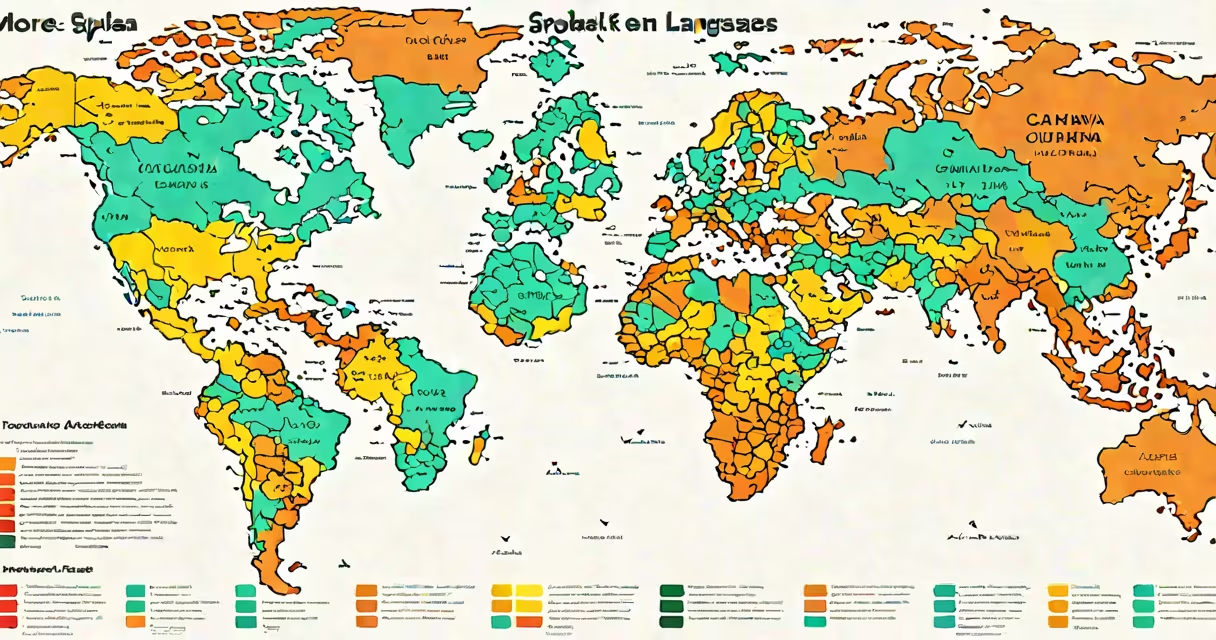
More spoken languages in the world exceeds 7,000 distinct human languages, according to UNESCO and the Ethnologue database. These languages vary widely in speaker numbers, geographic spread, and official recognition. The term refers to the total number of unique languages used by communities globally, not just those with large populations.
Each language represents a system of communication with its own grammar, vocabulary, and cultural context. They emerge through centuries of social development, migration, and isolation. For example, the Aka-Bea language of Cameroon has fewer than 100 speakers but functions fully within its community. This illustrates that language survival depends less on global reach and more on intergenerational transmission.
UNESCO estimates that about 40% of the world's languages are endangered, meaning they are no longer being learned by children. This includes many indigenous languages spoken in remote areas. The loss of a single language erases centuries of oral history, ecological knowledge, and worldview. The rate of extinction is accelerating due to urbanization and dominant language policies.
Counting more spoken languages in the world relies on fieldwork, linguistic surveys, and database curation. Ethnologue, maintained by SIL International, catalogs over 7,000 living languages. Its methodology distinguishes between languages and dialects based on mutual intelligibility-whether speakers of two varieties can understand each other without prior study.
For example, Hindi and Urdu share a common base in Hindustani but differ in script and formal usage. Because speakers of standard Hindi cannot always understand standard Urdu without exposure, they are classified as separate languages. Similarly, Mandarin Chinese dialects like Shanghainese and Cantonese are mutually unintelligible, so they are counted separately despite shared roots.
A key distinction often missed is that a language with millions of speakers may still be considered one language even if it contains multiple dialects. English, for instance, includes American, British, Australian, and Indian variants-but all are grouped under a single language due to shared core grammar and mutual comprehension among educated users.
Most spoken languages in the world cluster in specific regions. Papua New Guinea alone hosts over 800 languages, making it the most linguistically diverse country. The high mountain ranges and isolated valleys have preserved distinct speech systems for millennia. In contrast, Europe has around 200 languages across 50 countries, with many belonging to the Indo-European family.
| Region | Number of Languages | Key Characteristics |
|---|---|---|
| Papua New Guinea | 839 | High density, many endangered, small communities |
| India | 432 | Officially recognized 22 languages; many tribal tongues |
| Sub-Saharan Africa | 1,500+ | Large number of Niger-Congo and Nilo-Saharan languages |
| Europe | 230 | Many Germanic, Romance, Slavic, and Uralic languages |
Language diversity is not evenly distributed. The Amazon Basin, Indonesia, and parts of Central Asia host hundreds of languages per 100,000 square kilometers. In comparison, nations like Japan and South Korea have only one dominant language, though regional dialects persist.
Non-native speakers often assume that a language must be widespread to be significant. But a language with 50 speakers in a village in the Andes holds equal legitimacy in linguistic science as one spoken by 100 million people. The value lies in function-not scale.
One persistent myth is that "more spoken languages in the world" refers to the number of people who speak multiple languages. That's incorrect. The term counts distinct languages, not multilingual individuals. A person fluent in Spanish, French, and Swahili speaks three languages but contributes to only three entries in the global tally.
Another error is equating "spoken" with "official." Many languages are used daily in homes, markets, and ceremonies but lack government recognition. For example, the Koro language in India was discovered in 2008 and had only 100 speakers. It was never written down and had no official status-but it was fully functional in daily life.
Some assume that internet use correlates with language survival. While digital platforms have expanded access to minority languages, they don't prevent decline. In fact, online presence often favors dominant languages. Only 1% of Wikipedia articles are in languages with fewer than 100,000 speakers, despite their cultural significance.
Nahuatl, the language of the Aztecs, persists in central Mexico. It has over 1.5 million speakers today, primarily in rural towns. Despite colonial suppression and decades of marginalization, Nahuatl remains a living language passed.
Yet, it is not taught in most public schools. Official documents are issued only in Spanish. Still, communities maintain oral traditions, produce local radio programs, and publish books in Nahuatl. This demonstrates that more spoken languages in the world survive not because of state support, but through grassroots effort.
In 2018, a Nahuatl-speaking teacher in Puebla recorded students reciting poems in their native tongue. The audio was uploaded to a local archive. Within a year, 12,000 views came from people across Latin America seeking connection to ancestral roots. This moment shows how language preservation thrives outside institutional frameworks.
Understanding more spoken languages in the world reveals the depth of human expression. Each language encodes unique ways of understanding time, nature, kinship, and identity. When a language disappears, so does a way of thinking.
Efforts to document and revitalize endangered languages are underway. Projects like the Endangered Languages Project and the Living Tongues Institute work with communities to record speech, create dictionaries, and develop teaching materials. These initiatives do not aim to make all languages globally dominant-they aim to preserve them as part of humanity's shared heritage.
Recognizing the full scope of more spoken languages in the world challenges assumptions about what constitutes a "major" or "important" language. The most widely spoken language is not necessarily the most valuable. A language's worth lies in its role within a community, not in its global reach.