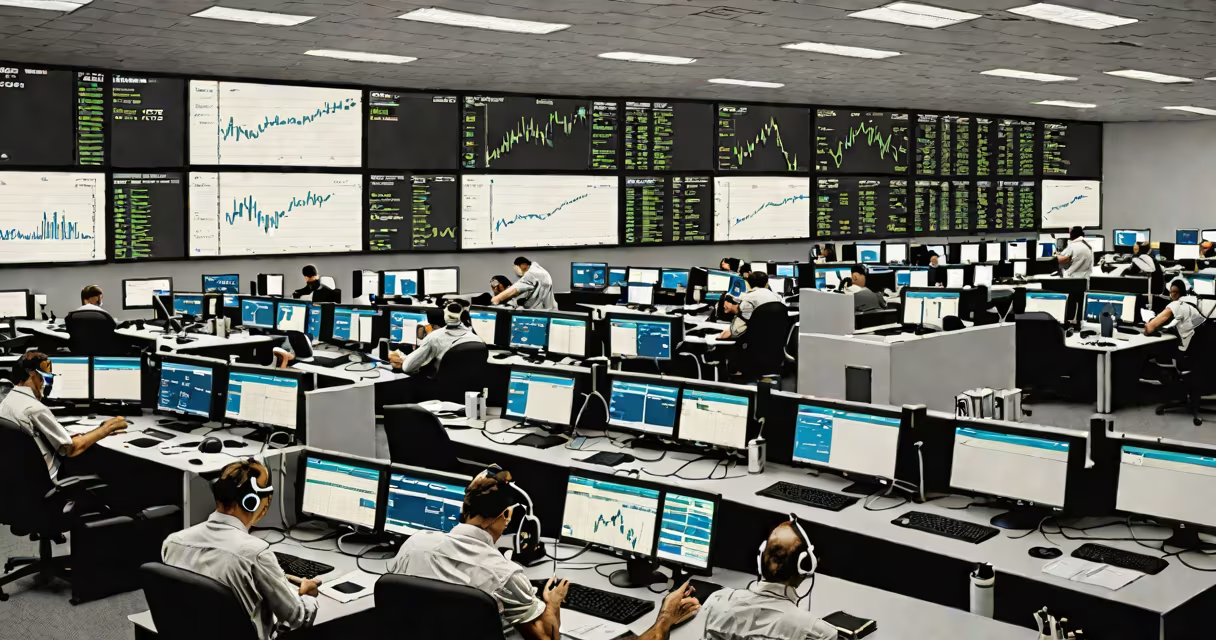
The most traded futures contracts are standardized agreements to buy or sell an underlying asset at a predetermined price on a set future date. These contracts dominate global derivatives markets due to high volume, tight spreads, and broad institutional participation. The S&P 500 E-mini, crude oil (WTI), and gold futures lead in daily turnover.
Futures contracts derive their value from assets such as commodities, indices, interest rates, or currencies. When traders enter a contract, they agree to deliver or take delivery of the asset-or settle in cash-on the expiration date. Most positions are closed before maturity through offsetting trades, avoiding physical delivery.
Trading occurs on regulated exchanges like the CME Group's Chicago Mercantile Exchange (CME), ICE Futures U.S., and Eurex. These platforms enforce margin requirements, standardize contract sizes, and provide transparent pricing. The most actively traded contracts feature deep liquidity, meaning buyers and sellers meet easily at stable prices.
Each contract specifies the quantity, quality, delivery location, and settlement method for the underlying asset. For example, one E-mini S&P 500 futures contract represents $50 times the index value. A single trade affects $50,000 worth of exposure when the S&P 500 is at 1,000.
Market participants use these contracts for risk management. A farmer might sell wheat futures to lock in a price and avoid losses if harvest yields drop. A pension fund may buy Treasury bond futures to hedge against rising interest rates. Speculators profit from directional bets on price movements.
Settlement happens either physically (delivering the actual commodity) or via cash (settling differences in cash). Most popular contracts, including equity and interest rate futures, use cash settlement. This avoids logistical complexity and enables faster trading cycles.
Contracts fall into four main categories based on underlying assets:
| Type | Examples | Daily Volume (2023 avg) | Primary Exchange |
|---|---|---|---|
| Equity Index | S&P 500 E-mini, Nasdaq-100, DJIA | ~1.2 million contracts | CME Group |
| Commodity | Crude Oil (WTI), Natural Gas, Gold, Corn | ~600,000 contracts (WTI) | NYMEX (CME) |
| Interest Rate | 3-Month Eurodollar, 10-Year Treasury Note | ~1.8 million contracts | CBOT (CME) |
| Currency | EUR/USD, USD/JPY, GBP/USD | ~350,000 contracts | Eurex, CME |
Among these, the S&P 500 E-mini futures account for roughly 30% of all U.S. futures volume. Their popularity stems from low margin requirements, high use, and alignment with broad market sentiment. A single contract moves about $125 for every 0.1-point change in the index.
Crude oil futures (CL futures on NYMEX) are critical for energy markets. They reflect supply-demand imbalances, geopolitical tensions, and inventory levels reported by the U.S. Energy Information Administration (EIA). A 1% move in WTI crude translates to ~$10,000 in P&L for a single contract.
Gold futures (GC) serve as a proxy for inflation expectations and safe-haven demand. During periods of economic uncertainty, such as the 2020 pandemic lockdowns, gold futures surged 22% in three months. This volatility attracts both long-term investors and short-term traders.
Many assume futures are only for large institutions. In reality, retail traders access them through brokers offering leveraged accounts. The CME Group reports that individual traders accounted for 18% of all E-mini S&P 500 volume in 2023-up from 12% in 2018.
Another confusion: futures vs. options. While both are derivatives, futures obligate parties to fulfill the contract. Options give the right-but not the obligation-to buy or sell. A trader buying a call option on crude oil pays a premium for the chance to profit if prices rise. A futures buyer must deliver or take delivery unless they close the position early.
A lesser-known fact: most traded futures contracts are not held to expiry. Over 98% of positions are closed before maturity. This reduces counterparty risk and avoids physical delivery logistics. For example, a trader who buys a December crude oil contract in June typically sells it before the last trading day.
In March 2020, global oil demand collapsed during the early stages of the pandemic. WTI crude futures dropped below $0, reaching negative prices on April 20. This occurred because storage capacity was exhausted, and producers had no place to store excess supply.
Traders holding long positions faced massive losses. One investor who bought 100 contracts at $50 per barrel lost $500,000 when prices fell to -$37.13. This event demonstrated how extreme market conditions can affect even the most liquid contracts.
Conversely, those who shorted futures profited. A trader who sold 50 contracts at $50 and covered at $10 made $2 million in profit. This illustrates how use amplifies gains and losses-each $1 move in WTI equals $10,000 per contract.
These contracts form the core of global risk transfer. According to the Bank for International Settlements (BIS), over $1.2 quadrillion in notional value of derivatives were outstanding in 2022, with futures accounting for nearly half. The most traded contracts enable price discovery, reduce volatility, and support efficient capital allocation.
For example, airlines use fuel hedging via crude oil futures to manage jet fuel costs. A Delta Air Lines report from 2022 showed that using futures reduced fuel expenses by 14% compared to spot purchases during volatile periods.
As a former trader, I witnessed how rapidly news impacts futures. In 2022, when Russia invaded Ukraine, Brent crude futures spiked 12% in one session. Within hours, traders adjusted positions across multiple exchanges. The speed of execution and transparency in pricing prevented prolonged dislocations.
Understanding the most traded futures contracts helps investors assess market sentiment, time entries, and manage exposure. These instruments are not speculative toys-they are tools used by central banks, corporations, and pension funds to stabilize economies.