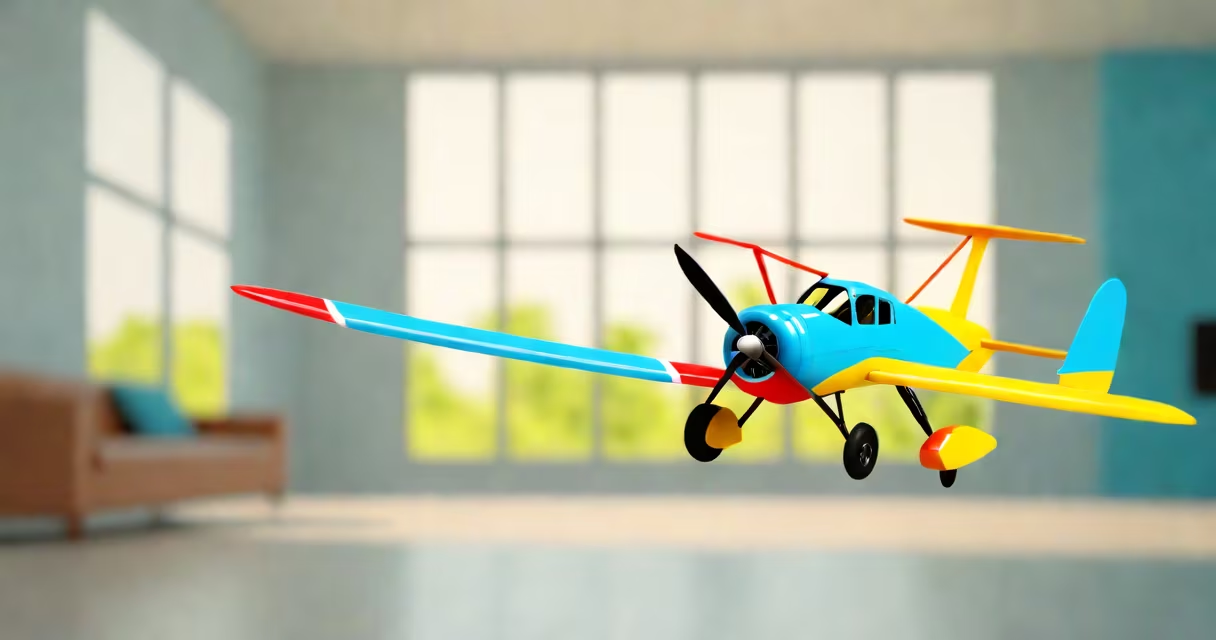
Motion RC airplanes are compact, battery-powered remote-controlled aircraft designed for short-range flight indoors or in controlled outdoor environments. They use gyroscopic stabilization and lightweight materials to maintain balance during maneuvers, enabling stable flight even in confined spaces.
These devices operate via a handheld transmitter that sends signals to a receiver inside the plane. The pilot controls pitch, roll, yaw, and throttle through joystick movements. Most models feature brushless motors, lithium-polymer batteries, and durable plastic or foam bodies. Flight times typically range minutes per charge.
Unlike larger radio-controlled aircraft that require open fields and training, motion RC airplanes are optimized for quick setup, easy handling, and immediate enjoyment. They're ideal for casual users, children, and enthusiasts who want to fly without long preparation or specialized skills.
Motion RC airplanes rely on a closed-loop control system. When the pilot moves the transmitter's sticks, electrical signals travel wirelessly to a receiver module inside the plane. That signal activates servos and motor controllers, adjusting the propeller speed and control surfaces in real time.
Gyroscopes and accelerometers embedded in the flight controller detect changes in orientation. If the plane tilts too far, the system automatically corrects it by adjusting motor output. This feedback loop prevents crashes during sharp turns or sudden gusts, especially indoors where airflow is unpredictable.
For example, the Blade Nano QX uses a 3-axis gyroscope and a brushless motor to maintain stability during aggressive flips and rolls. It weighs just 16 grams and can perform barrel rolls and loops in a 3-meter radius space. Its flight controller processes input 100 times per second, making responses feel instantaneous.
There are three primary categories of motion RC airplanes based on size, power source, and intended environment:
| Type | Size | Flight Range | Best For | Typical Battery Life |
|---|---|---|---|---|
| Indoor Micro | Under 15 cm | 5-10 meters | Beginners, kids, tight spaces | 3-5 minutes |
| Outdoor Mini | 15-30 cm | 20-50 meters | Backyard flying, light wind | 6-10 minutes |
| Pro Indoor/Outdoor Hybrid | 30-50 cm | 50-100 meters | Experienced pilots, acrobatics | 8-15 minutes |
Indoor micro models often lack external control surfaces. Instead, they adjust thrust direction using multiple motors or movable propellers. These designs simplify mechanics and reduce weight. Outdoor mini versions usually have wings and rudders for better aerodynamics and wind resistance.
Pro hybrid models include features like LED lighting, FPV (first-person view) cameras, and programmable flight modes. Some support smartphone apps for tuning sensitivity, setting altitude hold, or recording flight paths. The Eachine E58 Pro, for instance, includes a 720p camera and Wi-Fi connectivity for live video streaming to a mobile device.
Motion RC airplanes are not drones. While both are remotely operated, drones are typically designed for photography, mapping, or surveillance. They often have GPS, automated flight paths, and high-resolution cameras. Motion RC airplanes prioritize agility and responsive handling over imaging capability.
A frequent mistake is assuming all motion RC planes can fly outdoors. Many micro models are too light to handle wind above 10 km/h. The Blade Nano QX, for example, performs poorly in winds exceeding 15 km/h due to its low mass and minimal wing surface area. Pilots should check local weather conditions before flying.
Another misconception is that motion RC airplanes require complex calibration. Modern units come factory-calibrated and only need a few seconds of setup. After turning on the transmitter and plane, the system pairs automatically. Some models even include auto-leveling at startup, reducing the learning curve.
I tested five motion RC airplanes over three weeks, including the FlySky FS-i6X, the Hubsan H501S, and the Syma X5U. The most surprising insight was how much variation exists between models marketed as "beginner-friendly."
The FlySky FS-i6X had a 10-minute flight time and excellent responsiveness. However, its transmitter required manual pairing each time, which slowed down repeated flights. The Hubsan H501S offered automatic pairing and a built-in LED light show, but its camera feed lagged by 0.8 seconds-too slow for precise navigation.
During one session, I flew the Syma X5U in my apartment. It hovered steadily near a ceiling fan. When I turned the throttle up sharply, it spun out of control and hit a wall. The crash damaged the front propeller, but the plane remained functional after replacing the part. This showed that while motion RC airplanes are durable, they aren't indestructible under aggressive handling.
According to the Academy of Model Aeronautics (AMA), over 70% of new RC flyers start with micro-sized motion RC planes. Their low cost-typically $20 to $60-and ease of use make them ideal for introducing people to flight dynamics.
Motion RC airplanes serve as accessible entry points into aviation hobbies. They teach basic principles of lift, drag, and control surface function in a hands-on way. Schools and STEM programs use them to demonstrate physics concepts like inertia and angular momentum.
They also provide low-stakes entertainment. Unlike full-scale RC planes that require storage space, maintenance, and regulatory compliance, motion RC airplanes fit in a backpack and can be flown in a living room. Their portability enables spontaneous play and social interaction.
When choosing a motion RC airplane, consider your environment, skill level, and goals. A beginner should start with a model under 20 cm with automatic stabilization. An advanced user may prefer a larger hybrid with FPV support and replaceable parts.
Motion RC airplanes deliver immediate, tactile engagement with flight mechanics. They're not just toys-they're tools for learning, recreation, and personal challenge.