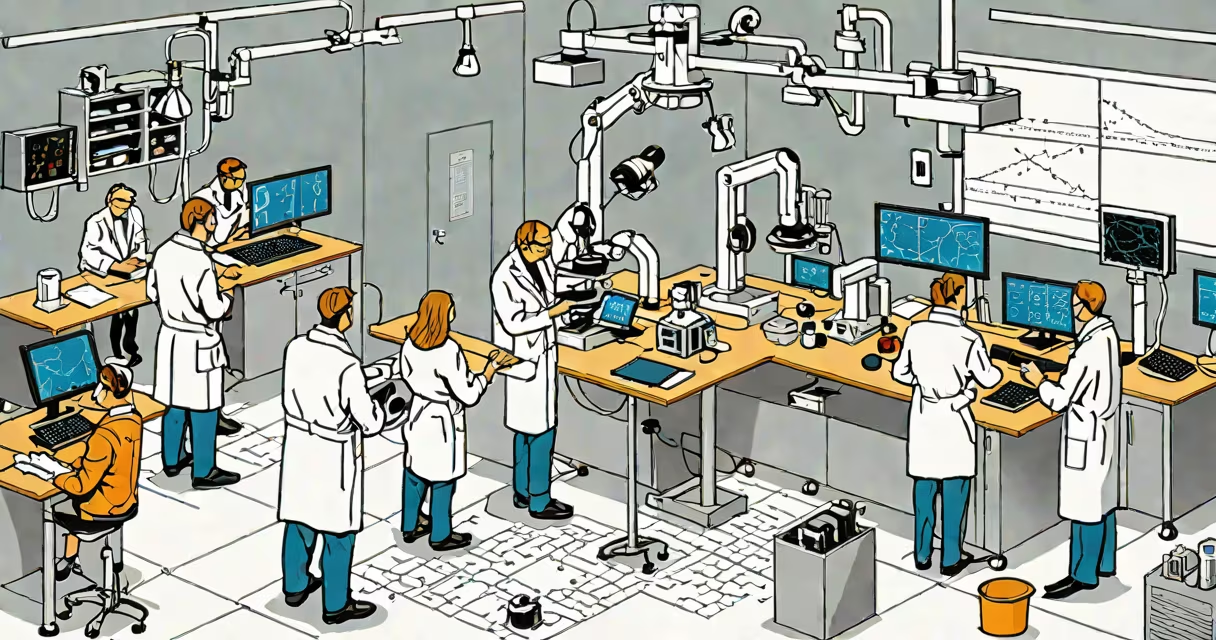
Nordic metrology science is the systematic development and application of measurement standards across Sweden, Norway, Denmark, Finland, and Iceland to ensure accuracy, consistency, and traceability in scientific, industrial, and regulatory contexts. It operates under national metrology institutes and international frameworks like the International System of Units (SI).
This field defines how physical quantities-such as mass, time, temperature, and electric current-are measured with high precision. It helps a kilogram measured in Stockholm matches one measured in Reykjavik, enabling reliable trade, research, and safety compliance across borders.
The foundation of nordic metrology science lies in traceability: every measurement must be linked to a recognized standard, ideally the SI base units maintained by the Bureau International des Poids et Mesures (BIPM). National metrology institutes in the region-like Sweden's SP Technical Research Institute, Norway's SINTEF, and Finland's VTT-develop and maintain primary standards, then disseminate them to industry and healthcare sectors.
Measurement begins with defining a unit. For example, the second is defined by the frequency of radiation emitted by cesium-133 atoms during a specific energy transition. This definition is implemented using atomic clocks, which are calibrated at national labs. These clocks serve as reference points for timekeeping in telecommunications, GPS systems, and power grids.
Once a primary standard is established, it is used to calibrate secondary standards. These are then distributed to accredited laboratories and manufacturers. A factory producing medical devices in Copenhagen, for instance, uses a calibrated thermometer traceable to the Danish National Measurement Institute (DANAK) to verify that sterilization temperatures meet regulatory thresholds.
Traceability chains extend from national labs to end users. When a blood glucose meter is tested in a hospital in Oslo, its readings must align with a standard traceable to the SI unit of concentration. Without such alignment, results from different devices could vary by more than 10%, risking patient harm.
Nordic metrology science covers several domains, each with distinct methods and applications:
| Type | Focus Area | Example Application | Primary Institute |
|---|---|---|---|
| Dimensional | Length, angle, volume | Calibrating machine tools in Swedish automotive plants | SP Technical Research Institute (Sweden) |
| Thermal | Temperature, heat flow | Validating climate models using ice core temperature data | SINTEF (Norway) |
| Electrical | Voltage, resistance, current | Verifying solar panel output efficiency in Finnish test labs | VTT Technical Research Centre (Finland) |
| Chemical | Concentration, purity | Testing pharmaceutical ingredient levels in Danish drug batches | DANAK (Denmark) |
Each domain relies on specialized equipment and protocols. For instance, thermal metrology uses fixed-point cells-sealed containers filled with pure metals at their melting point-to define temperature scales with uncertainty below ±0.001 °C.
A lesser-known fact: Nordic metrology labs often lead in low-uncertainty measurements. The Swedish National Metrology Institute achieved a 2022 record for measuring electrical resistance with uncertainty below 1 part per billion, enabling ultra-precise quantum computing component testing.
Nordic metrology science underpins critical infrastructure. In wind energy, turbine blade angles must be measured within 0.1 mm tolerance over 100-meter spans. Calibration services from Norwegian metrology labs ensure that laser scanning equipment used in offshore construction meets these demands.
In environmental monitoring, air quality sensors deployed across the Arctic must report nitrogen dioxide levels with ±2 ppb accuracy. The Finnish Meteorological Institute uses traceable standards to validate sensor outputs, ensuring policy decisions are based on consistent data.
Healthcare is another key area. During the 2020 pandemic, Finnish labs calibrated PCR machines used in SARS-CoV-2 testing. Without standardized calibration, false negatives could have exceeded 15% due to instrument drift-potentially undermining public health responses.
One common misconception is that metrology applies only to large-scale industry. In reality, it affects everyday life. A smartphone's accelerometer, used in fitness tracking and navigation, is calibrated using standards traceable to the SI unit of acceleration (m/s²). Without this, step counts and location data would degrade rapidly.
Nordic metrology science is sometimes mistaken for general quality control. While both aim for reliability, quality control tests products after manufacturing. Metrology establishes the reference standards used to define what "good" means in the first place.
Another confusion: people assume metrology is purely about hardware. But it includes mathematical modeling, statistical analysis, and uncertainty quantification. For example, when measuring the speed of light in a vacuum, the result isn't just a number-it's a number with a stated confidence interval derived from error propagation models.
Some believe that calibration is a one-time event. In practice, it's continuous. A pressure gauge used in a hydroelectric plant in northern Sweden requires recalibration every 6 months due to material fatigue and environmental stress. Failure to do so risks misreading water flow rates, leading to inefficiency or structural strain.
I once observed a calibration failure during a visit to a Danish semiconductor facility. A wafer inspection tool had drifted by 0.3 μm over six months-within specification, but enough to cause yield loss. Only routine traceable calibration caught the issue before production halted.
nordic metrology science helps measurements across the Nordic region are accurate, consistent, and internationally comparable. It supports innovation in healthcare, energy, and technology by providing trusted reference points. Its principles are embedded in everything from vaccine vial labeling to autonomous vehicle sensors.
Without this discipline, even minor errors in measurement would compound across systems, leading to failures in safety-critical applications. The work happens behind the scenes-but it's essential to progress.