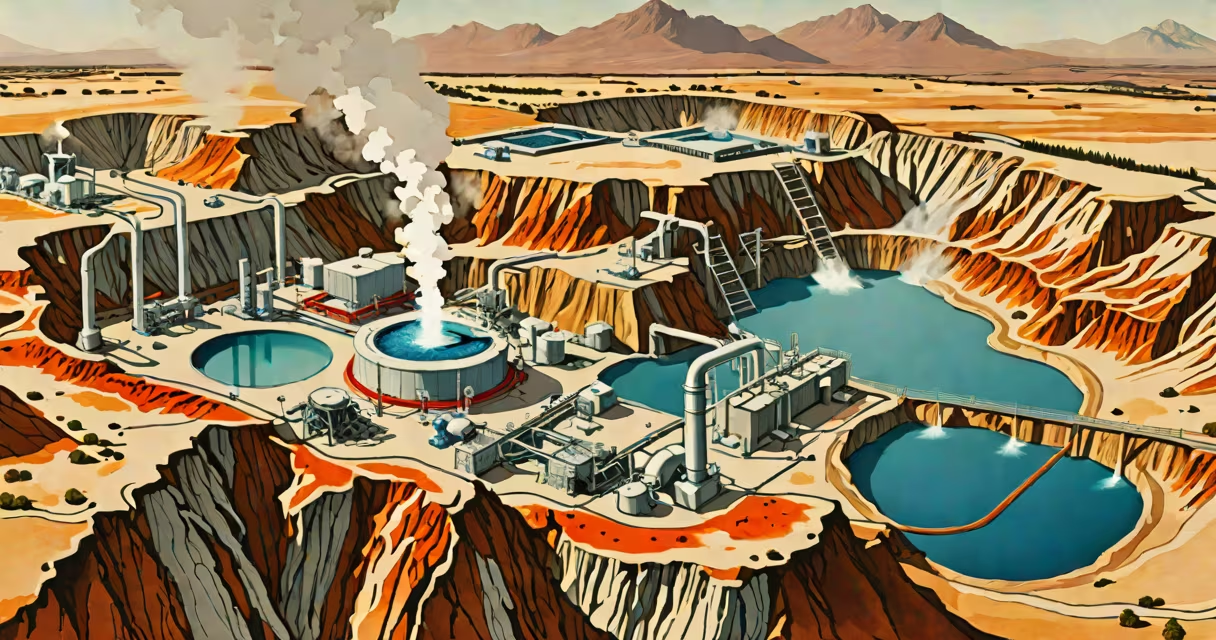
Other renewable energy sources are natural energy flows that replenish faster than they're consumed and do not rely on fossil fuels. They include geothermal, biomass, tidal, and wave energy. These sources provide clean power with minimal greenhouse gas emissions and are increasingly deployed worldwide.
Unlike solar and wind-commonly cited renewables-other renewable energy sources often operate continuously or predictably. They are not dependent on weather patterns or daylight cycles. Instead, they draw from Earth's internal heat, organic matter, ocean movements, or gravitational forces. These systems are especially valuable in regions where sunlight or consistent wind is limited.
For example, Iceland generates nearly 100% of its electricity from renewables, primarily geothermal and hydropower. The country taps into underground magma chambers to produce steam that drives turbines. This system delivers stable baseload power year-round, unlike intermittent solar or wind installations.
Each source converts a natural process into usable electricity or heat. Geothermal systems drill deep into the Earth's crust to access hot rock formations. Water injected into these zones turns to steam, which powers turbines. This method produces electricity with near-zero emissions and low land use compared to solar farms.
Biomass energy burns organic materials such as wood chips, crop residues, or municipal waste. The heat released creates steam to drive generators. Modern biomass plants capture carbon dioxide during combustion and store it underground, reducing net emissions. The U.S. Department of Energy reports that biomass accounted for 5% of U.S. electricity generation in 2022, mostly from wood and waste-to-energy facilities.
Tidal and wave energy systems use the movement of seawater. Tidal barrages trap water at high tide and release it through turbines at low tide. Wave energy converters use floating buoys that rise and fall with swells, driving hydraulic pumps. Both technologies remain in early deployment stages due to high installation costs and harsh marine conditions.
The following table outlines key types of other renewable energy sources, their operational principles, and current global deployment levels.
| Type | Energy Source | Primary Use | Global Capacity (2023) | Key Countries |
|---|---|---|---|---|
| Geothermal | Earth's internal heat | Electricity and heating | 16 GW | Iceland, Philippines, Indonesia |
| Biomass | Organic matter (wood, crops, waste) | Heat, electricity, biofuels | 130 GW | United States, Brazil, Germany |
| Tidal | Gravitational pull of moon and sun | Electricity via tidal barrages | 0.6 GW | France, UK, Canada |
| Wave | Ocean surface motion | Electricity via floating devices | 0.1 GW | Portugal, Scotland, Australia |
Geothermal energy is the most mature among these options. The Global Geothermal Alliance reports that over 80 countries have active geothermal projects, with Indonesia leading in new capacity additions. Biomass is widely used in residential heating across Europe and North America, though sustainability concerns arise when forests are harvested for fuel.
Wave and tidal energy remain experimental. The European Marine Energy Centre (EMEC) in Orkney, Scotland, hosts pilot testing sites for wave energy converters. One device, the Pelamis P2, generated 1 MW of power during trials but was decommissioned in 2014 due to cost and durability issues. Current research focuses on modular designs using durable composites and AI-driven maintenance scheduling.
Many assume that "renewable" means "zero environmental impact." That is incorrect. Biomass combustion releases CO₂, nitrogen oxides, and particulates. When forests are clear-cut for fuel, carbon sequestration is lost for decades. The Intergovernmental Panel on Climate Change (IPCC) notes that biomass energy must be sourced sustainably to avoid increasing net emissions.
Another misconception is that tidal energy is equivalent to offshore wind. While both use marine environments, tidal systems rely on predictable water flow driven by lunar cycles. Offshore wind depends on variable wind speeds. Tidal energy offers higher capacity factors-averaging 40-50%-compared to offshore wind's 35-45%. This makes tidal more suitable for grid stability.
A lesser-known fact: geothermal plants emit less CO₂ per kWh than natural gas plants. According to the U.S. Environmental Protection Agency, average emissions from geothermal facilities are 38 grams of CO₂ per kWh, compared to 490 grams for natural gas. This makes geothermal one of the lowest-emission energy sources available.
In 2021, the city of Reykjavík, Iceland, expanded its district heating network to cover 98% of homes. The system uses geothermal water heated to 90°C from boreholes drilled into volcanic rock. The water circulates through underground pipes, transferring heat to buildings. Cold water returns to the ground to be reheated-creating a closed-loop system.
This setup reduced the city's reliance on imported oil by 70% over ten years. Maintenance costs were 30% lower than comparable gas-based systems. The project demonstrated that other renewable energy sources can deliver long-term savings and resilience, even in cold climates.
While solar and wind dominate headlines, other renewable energy sources offer critical diversity. They provide dispatchable power-meaning they can be turned on when needed-unlike solar, which stops at night. This complements grid integration and reduces the need for battery storage.
For example, the California Independent System Operator (CAISO) reported that integrating geothermal into the state's grid lowered peak load stress during summer months. In 2022, geothermal contributed 1.2% of California's electricity mix, but its availability during heatwaves helped prevent rolling blackouts.
These sources also support rural electrification. In Kenya, small-scale geothermal plants in the Rift Valley now power schools and clinics. One 5 MW plant in Olkaria supplies 12,000 households and runs entirely on local labor and maintenance.
Understanding other renewable energy sources helps clarify the full spectrum of clean energy options. They are not niche alternatives-they are proven, scalable, and essential components of a decarbonized future.