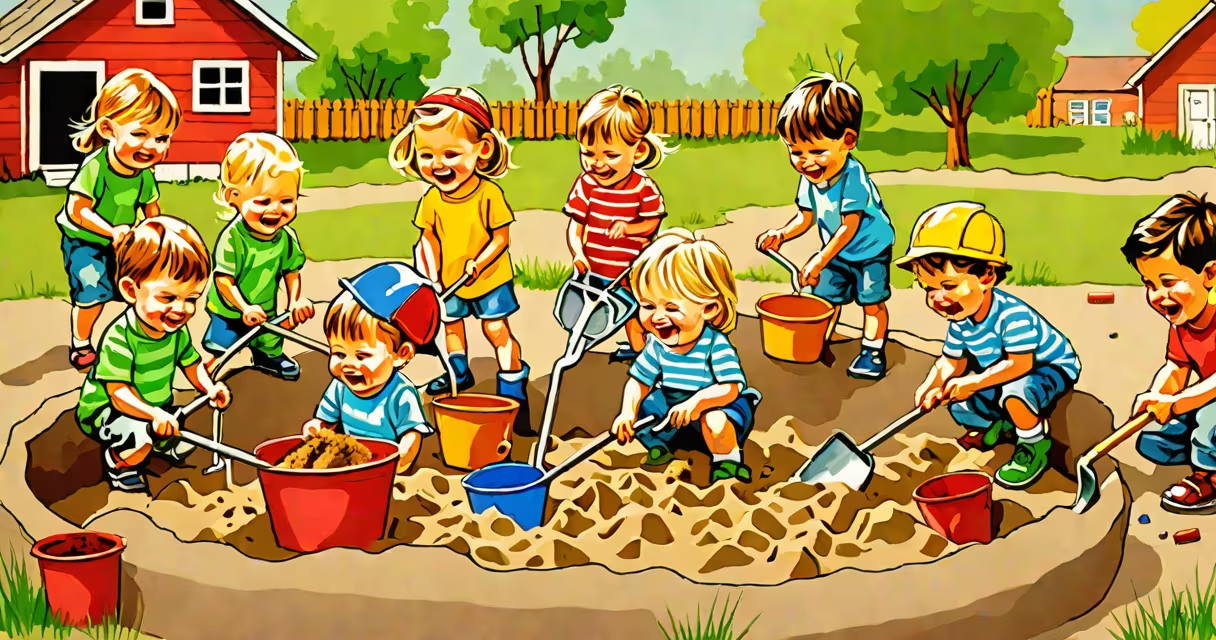
Outdoor activities for preschoolers are structured or free-form physical and sensory experiences designed for children aged 3 to 5 that take place outside, using natural elements like grass, dirt, water, and plants to support development.
These activities promote gross motor skills, emotional regulation, problem-solving, and early science observation. They're not just play-they're foundational learning moments shaped by movement, touch, and exploration.
Research from the American Academy of Pediatrics confirms that unstructured outdoor play improves attention, reduces symptoms of ADHD, and supports social-emotional growth in young children. The National Association for Sport and Physical Education notes that children under six need at least 60 minutes of active play daily, much of which should happen outdoors.
Children learn through doing. When a preschooler runs through a sprinkler, they're not just cooling off-they're testing gravity, balance, and cause-and-effect. When they dig in soil, they're exploring texture, weight, and transformation. These interactions build neural pathways linked to memory, language, and reasoning.
Outdoor settings offer variable environments-uneven ground, wind, sunlight shifts-that challenge coordination and spatial awareness. Unlike indoor spaces with predictable surfaces, outdoor terrain requires constant micro-adjustments, improving proprioception and motor control.
A study published in *Frontiers in Psychology* (2021) found that preschoolers who spent 30 minutes daily in green spaces showed higher levels of executive function compared to peers in indoor-only programs. This includes better focus, impulse control, and task-switching ability.
Not all outdoor time counts equally. Activities fall into three core categories based on developmental goals:
| Type | Focus Area | Examples | Duration |
|---|---|---|---|
| Gross motor | Movement, strength, coordination | Jumping over sticks, balancing on logs, chasing bubbles | 10-15 min |
| Sensory exploration | Touch, smell, sight, sound | Feeling bark, listening to birds, smelling flowers | 5-10 min |
| Nature-based inquiry | Curiosity, observation, early science | Bug hunts, leaf sorting, tracking animal prints | 15-20 min |
Each type serves a different purpose. Gross motor play develops large muscle groups and confidence. Sensory exploration builds neural connections through tactile input. Nature-based inquiry nurtures scientific thinking by encouraging questions like "Why do leaves fall?" or "Where did the ants go?"
One common mistake is assuming all outdoor time qualifies. A child sitting on a bench watching others run doesn't engage the same cognitive or physical benefits as actively moving through a garden or climbing a small hill.
Many adults assume outdoor activities for preschoolers must be planned or structured. But research shows that unstructured free play leads to deeper engagement and longer attention spans. According to the Child Mind Institute, children in free play environments demonstrate greater creativity and persistence in tasks.
Another myth is that outdoor time must involve equipment. While toys like balls or hoops help, natural materials-sticks, stones, pinecones-are often more engaging. A 2020 study in *Early Childhood Research Quarterly* found that children spent 40% more time playing with loose parts (like rocks and branches) than with manufactured toys during outdoor sessions.
Parents also worry about mess. But exposure to dirt and mud isn't harmful-it strengthens immune systems. The "hygiene hypothesis" suggests early contact with microbes reduces later risks of asthma and allergies. A 2018 study in *The Lancet* found children raised in rural areas with regular outdoor exposure had lower rates of autoimmune conditions.
On a spring morning, a group of 20 preschoolers gathered near a mulched trail at a city park. Their teacher handed out magnifying glasses and small plastic containers. The goal: find insects and describe them.
One child spotted a ladybug and said, "It's red and has spots." Another counted legs and said, "Six! Like my shoes." A third tried to catch a beetle and failed-but laughed when it crawled away.
After 15 minutes, the group returned to a shaded area. Children drew their bugs in notebooks. The teacher asked, "What did you notice? Where did you look?" Responses included "Under the log," "In the grass," and "By the water."
This session combined sensory exploration (touching leaves, seeing movement), gross motor skills (crouching, bending), and early science (observation, classification). It required no special tools-just curiosity and space.
I led a similar activity at a community garden last summer. One boy brought his own notebook and drew a "flying ant" he'd never seen before. He insisted it was "a new kind." We didn't correct him. Instead, we added it to our "mystery creature" board. That moment sparked weeks of follow-up questions and drawings.
Not all outdoor time supports development. Avoid activities that prioritize adult control over child agency. For example, forcing a child to walk in a straight line through a field may improve obedience but reduces autonomy and creativity.
Also avoid over-scheduling. A 2022 report from the American Academy of Pediatrics warns that excessive structured activities reduce intrinsic motivation. Children need time to wander, pause, and explore at their own pace.
And don't assume all outdoor spaces are equal. A manicured lawn offers less stimulation than a wooded path with fallen branches, moss patches, and bird nests. Seek out natural variation-even urban parks with trees, soil beds, and water features provide richer experiences.
Outdoor activities for preschoolers aren't just recreation-they're essential developmental tools. They build physical strength, emotional resilience, and early scientific thinking. The most effective ones are child-led, open-ended, and rooted in real-world interaction.
Start small: take a 10-minute walk and ask, "What do you hear?" or "Can you find something round?" Let children lead the discovery. You'll see their eyes light up-not because of a prize, but because they've noticed something new.