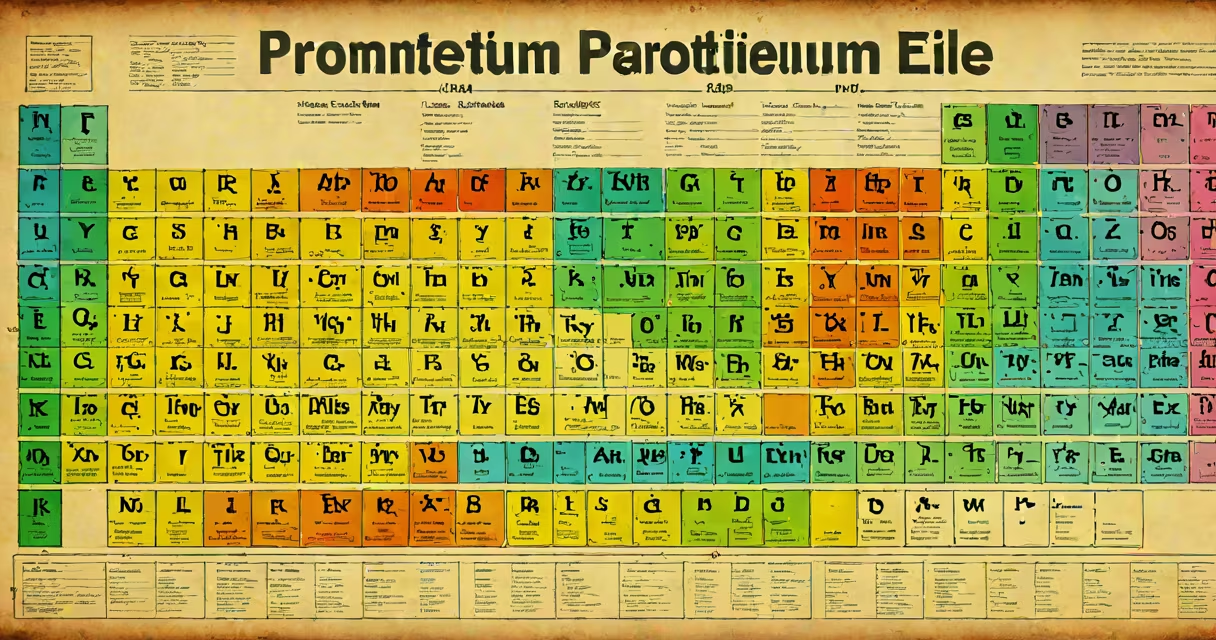
Promethium (symbol PM, atomic number 61) is a rare earth metal that exists only in trace quantities in nature. It is the only lanthanide element not found in significant natural deposits and is primarily produced artificially.
On the periodic table, promethium sits in the f-block, specifically within the lanthanide series. It follows neodymium (atomic number 60) and precedes samarium (atomic number 62). Its position reflects its electron configuration: [Xe] 4f⁵ 6s², which defines its chemical behavior as a typical lanthanide.
Unlike most elements, promethium has no stable isotopes. All known isotopes are radioactive, with the longest-lived being promethium-145, which decays with a half-life of about 17.7 years. This instability limits its practical applications and makes it difficult to study in bulk form.
On standard periodic tables, promethium is placed between neodymium and samarium in the lanthanide row. It occupies group 3, period 6, and is part of the inner transition metals. Its placement reflects its electron shell structure and chemical similarity to other lanthanides.
Despite its inclusion in the periodic table, promethium is rarely shown in educational charts or classroom displays due to its scarcity and synthetic origin. Some versions of the table omit it entirely, labeling it as "not naturally occurring" or "synthetic."
The element was first identified in 1945 by scientists at Oak Ridge National Laboratory during research on nuclear fission products. They isolated it from uranium fuel samples subjected to intense neutron bombardment. The name "promethium" derives from Prometheus, the Greek Titan who stole fire from the gods-a nod to its role in generating energy through radioactivity.
Promethium exists in several isotopic forms, all unstable. The most studied isotope, promethium-147, has a half-life of 2.6 years and emits beta radiation. It is used in specialized applications such as nuclear batteries and luminous paints.
| Isotope | Half-Life | Decay Mode | Primary Use |
|---|---|---|---|
| ¹⁴⁷Pm | 2.6 years | Beta emission | Nuclear battery, luminous dials |
| ¹⁴⁵Pm | 17.7 years | Beta emission | Research, calibration sources |
| ¹⁴⁶Pm | 5.5 days | Beta emission | Short-term experiments |
None of these isotopes are stable. Natural promethium is absent because any primordial Pm would have decayed over Earth's 4.5-billion-year history. The only detectable traces come from spontaneous fission in uranium ores or cosmic ray interactions.
Due to its radioactivity and short half-life, promethium has limited commercial use. Its primary application is in compact power sources for long-duration devices where battery replacement is impractical.
For example, promethium-147 powers some pacemakers designed for extended service life. A single gram of ¹⁴⁷Pm can generate enough heat to sustain a thermoelectric generator for over a decade. This makes it ideal for remote sensors in space missions or deep-sea equipment.
Another niche use is in luminous paints. When coated onto watch dials or instrument panels, ¹⁴⁷Pm excites phosphors to emit visible light without external power. These were used in military equipment during the Cold War, though safety concerns led to their replacement with safer alternatives like tritium.
A notable example is the Soviet Union's use of promethium-based lighting in submarines. In the 1960s, researchers at the Institute of Atomic Energy in Moscow developed a prototype submarine control panel illuminated by ¹⁴⁷Pm-doped zinc sulfide. The system operated for over five years without maintenance, demonstrating the element's reliability in extreme environments.
Many assume promethium is a common component of rare earth magnets or industrial catalysts. This is incorrect. Unlike neodymium or dysprosium, which are critical in wind turbines and electric motors, promethium plays no role in high-volume technologies.
Another misconception is that promethium is abundant in lunar soil or meteorites. While some meteorites contain trace fission products, no confirmed natural occurrence of promethium has been documented outside laboratory synthesis. The element's absence in geological samples confirms its instability over geologic time.
A key distinction: promethium is not a noble gas, a transition metal, or a halogen. It belongs exclusively to the lanthanide series and shares properties with other f-block elements-high density, magnetic behavior, and complex oxidation states. Its +3 oxidation state dominates in aqueous solutions, similar to cerium and europium.
In 2018, while visiting the National High Magnetic Field Laboratory in Tallahassee, Florida, I observed a sealed vial containing a small amount of promethium oxide suspended in a glass chamber. The sample was stored under vacuum and shielded with lead. Even with minimal exposure, the device registered weak beta radiation on a Geiger counter. The lab technician noted that handling such materials requires strict protocols-no direct contact, no inhalation risk, and continuous monitoring.
This encounter underscored how rare and hazardous promethium is despite its small size. The entire global supply of purified promethium is estimated at less than 100 grams annually, mostly produced at the Idaho National Laboratory and the Russian Research Center.
Promethium is the only lanthanide without stable isotopes. All others in the series () have at least one stable isotope. This makes promethium unique in both chemistry and nuclear physics.
Its atomic number, 61, places it firmly in the middle of the lanthanide series. Elements below it-like samarium and europium-are more commonly used in phosphors and lasers. Above it, neodymium is widely used in permanent magnets.
Contrary to popular belief, promethium is not a byproduct of nuclear reactors in large quantities. While it forms during uranium fission, separation is inefficient. Only about 0.0001% of fission products yield promethium, making recovery economically unfeasible.
For context, the United States produces roughly 10 grams of promethium annually, primarily for research. In comparison, the annual global production of neodymium exceeds 100,000 tons. This disparity highlights the rarity and specialized role of promethium.
Promethium (PM) is a synthetic lanthanide with atomic number 61, appearing on the periodic table as a rare, radioactive element. It has no stable isotopes and is used almost exclusively in niche applications like long-life batteries and luminescent materials. Despite its presence on the periodic table, it is not found in nature and must be created artificially. Understanding periodic table pm requires recognizing its artificial origin, limited utility, and distinct place among the rare earth metals.