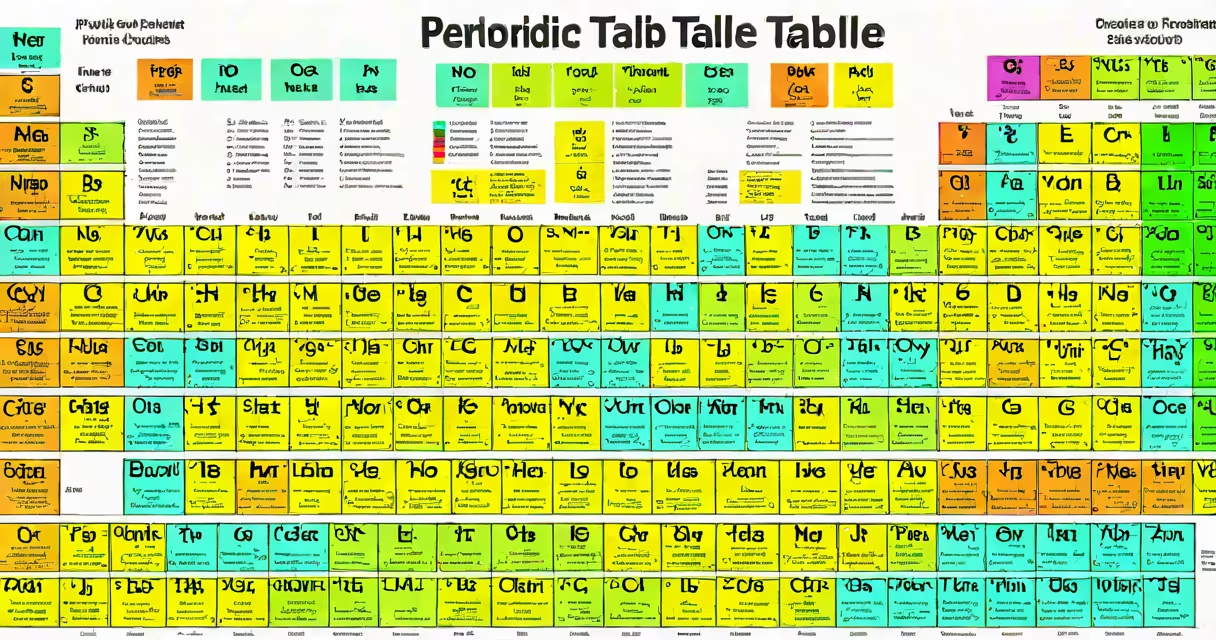
A printable periodic table with names lists all 118 chemical elements by symbol, atomic number, and full name, formatted for easy printing and use in classrooms, labs, or study sessions.
This version includes every element recognized by the International Union of Pure and Applied Chemistry (IUPAC), from hydrogen (H, atomic number 1) to oganesson (Og, atomic number 118). Unlike simplified charts, it displays full names such as "sodium" instead of abbreviations, making it ideal for students learning elemental nomenclature.
Printed versions typically use standard paper sizes like A4 or US Letter. Most include borders, grid lines, and color-coded blocks for metals, nonmetals, and metalloids. The layout follows the standard 18-column format established by Dmitri Mendeleev's original design, updated with modern discoveries.
The periodic table organizes elements by increasing atomic number-the number of protons in an atom's nucleus. Each row (period) corresponds to electron shell levels, while columns (groups) reflect similar chemical behavior due to shared valence electrons.
For example, Group 1 contains alkali metals: lithium (Li), sodium (Na), potassium (K), rubidium (Rb), cesium (Cs), and francium (Fr). These elements all react vigorously with water and form +1 ions. Their placement in the same column reflects this pattern.
Each cell contains the element's symbol, atomic number, atomic weight, and full name. For instance, iron is listed as Fe, 26, 55.845, and "iron." This structure allows quick lookup during exams or lab work.
Printable tables come in several formats based on purpose and detail level:
| Type | Use Case | Detail Level | Best For |
|---|---|---|---|
| Full 118-element table | Classroom instruction, university labs | High: includes all known elements | Students studying advanced chemistry |
| Element names only (no atomic weights) | Memory drills, flashcards | Medium: focuses on naming | High school biology or introductory science |
| Color-coded by category | Visual learning, teaching groups | High: uses color to show metals, nonmetals, etc. | Teachers preparing lesson materials |
| Minimalist black-and-white | Low-ink printing, exam settings | Low: removes color, reduces ink usage | Students needing a no-frills reference |
Some versions include additional data like electron configurations or melting points. However, these increase file size and reduce printability on basic printers.
One non-obvious feature: many printable tables exclude elements with no confirmed synthesis, even though they appear in theoretical models. For example, ununennium (element 119) is not included because it has not been synthesized or officially named.
Many users assume the periodic table is static. It is not. New elements are added periodically. The most recent additions-nihonium (Nh), moscovium (Mc), tennessine (Ts), and oganesson (Og)-were confirmed in 2015 and officially named in 2016 by IUPAC.
Another misconception: the table is purely alphabetical. It is not. Elements are ordered by atomic number, not name. Oxygen (O) appears before fluorine (F), even though "fluorine" comes before "oxygen" alphabetically.
Also, the term "periodic table with names printable" often gets mixed with "periodic table with symbols only." The latter omits full names and may omit atomic weights. This limits usefulness for beginners who need to learn correct spelling and pronunciation.
Science educators use the periodic table with names printable in middle school through college-level courses. It supports curriculum standards such as NGSS (Next Generation Science Standards) and Common Core science benchmarks.
Laboratories rely on printed tables for quick reference during experiments. A research assistant at MIT used a wall-mounted version during a project on rare-earth element extraction. The full names helped prevent mislabeling samples, which had previously caused contamination issues.
Home learners and hobbyists also benefit. I once printed a full-color version for my daughter's science fair project on the history of element discovery. She used it to trace the timeline of element identification-from oxygen (discovered 1774) to tennessine (synthesized 2010).
Unlike older versions, modern printable tables include all 118 elements. The last addition, oganesson (Og), was officially named in 2016 after being synthesized at the Joint Institute for Nuclear Research in Russia and Dubna, Russia.
According to the Royal Society of Chemistry, the periodic table is "the most important single diagram in chemistry." Its structure enables prediction of unknown properties-Mendeleev left gaps for elements later discovered as gallium, germanium, and scandium.
One underappreciated fact: the table's layout reflects quantum mechanics. The arrangement of periods and groups aligns with electron orbital filling sequences (s, p, d, f blocks). This explains why transition metals occupy the d-block and lanthanides/actinides fill the f-block.
When selecting a printable periodic table with names, verify that it includes all current IUPAC-approved elements and uses standardized naming conventions. Avoid outdated versions that list elements by old names (e.g., "wolfram" instead of "tungsten").
Always double-check the file format-PDF is preferred for consistent rendering across devices. Avoid image-only files unless you're embedding them in documents where resolution won't degrade.
Using a periodic table with names printable supports deeper understanding of chemistry fundamentals. It's not just a reference-it's a foundation for scientific literacy.