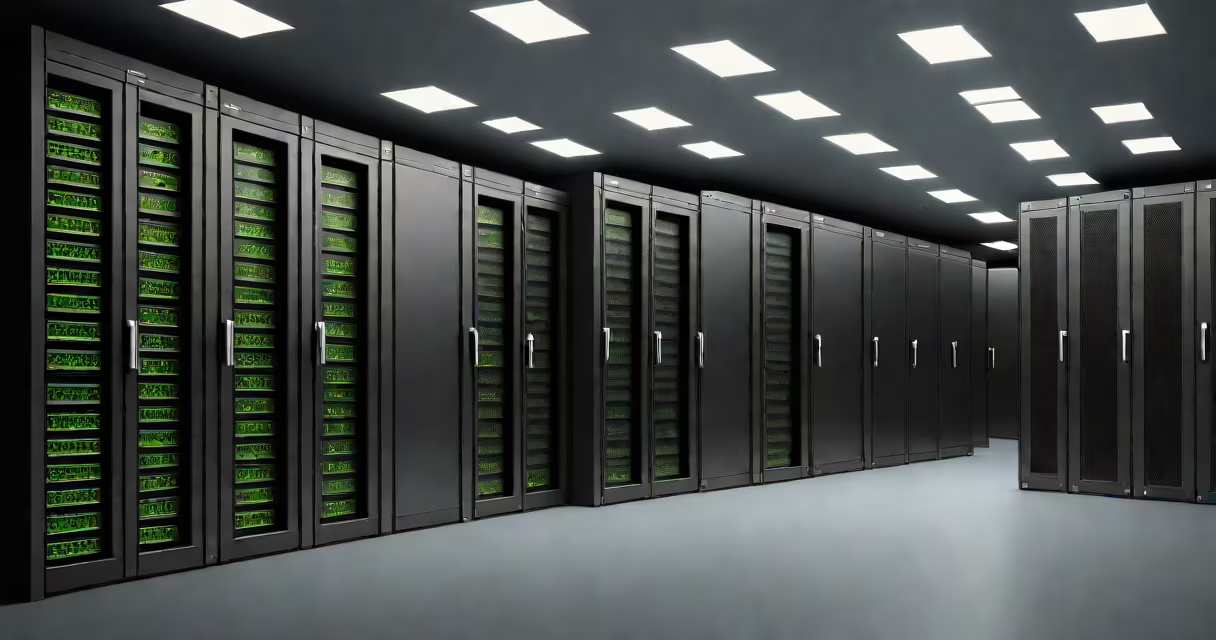
A private data center is a physically secured, organization-owned or operated facility housing servers, storage, networking gear, and related infrastructure to manage sensitive workloads and data internally. It enables full control over hardware, software, physical access, and environmental conditions-critical for industries requiring strict regulatory compliance.
Unlike public cloud environments, which share resources across multiple tenants, a private data center isolates an organization's IT assets within its own walls. This isolation supports high-performance computing, low-latency operations, and adherence to data residency laws such as GDPR or HIPAA. The facility may serve a single business location or span multiple sites connected via private networks.
According to the U.S. Department of Energy's National Renewable Energy Laboratory (NREL), private data centers account for approximately 60% of U.S. data center capacity, emphasizing their ongoing role despite cloud growth. These facilities are often located in regions with stable power grids, cooling efficiency, and proximity to fiber-optic backbones.
Private data centers operate through layered technical and physical controls. Servers are mounted in standardized racks, cooled by precision air handlers, and powered by redundant uninterruptible power supplies (UPS) and backup generators. Network switches connect devices using fiber-optic cabling, while firewalls and intrusion detection systems monitor traffic at multiple levels.
Environmental monitoring systems track temperature, humidity, and water leaks in real time. Access requires biometric scans, keycards, and audit logs. Security protocols follow standards like ISO/IEC 27001 and NIST SP 800-53, ensuring data protection from both internal and external threats.
For example, a financial institution running transaction processing systems might deploy a private data center in a secure building with 24/7 surveillance, climate-controlled rooms, and failover mechanisms. If a primary server fails, automated scripts reroute traffic to standby units within seconds, maintaining uptime during outages.
Private data centers vary based on scale, ownership model, and deployment strategy. The most common types include:
| Type | Ownership | Use Case | Example |
|---|---|---|---|
| On-Premises | Organization-owned | Core business systems, legacy apps | Bank runs its core banking system locally |
| Colocation | Third-party facility, customer-provided hardware | High-density compute, disaster recovery | Company leases space in a carrier-neutral facility |
| Dedicated Cloud | Provider-managed, exclusive access | Regulated industries needing isolation | Healthcare provider uses a private cloud enclave |
Colocation is often mistaken for a private data center, but it differs in ownership. In colocation, the tenant owns the equipment, but the facility is managed by a third party. A true private data center involves full operational control-hardware procurement, software configuration, and personnel management-all under one organizational umbrella.
One non-obvious distinction: many organizations assume private data centers are inherently more secure than cloud services. But NIST Special Publication 800-145 notes that security depends on implementation, not location. A poorly configured private data center can expose data more easily than a well-audited public cloud environment.
Enterprises choose private data centers for performance, compliance, and sovereignty. Financial firms, government agencies, and healthcare providers often require data to remain within national borders. The EU's GDPR mandates that personal data of EU citizens not leave the bloc unless adequate safeguards exist. A private data center in Frankfurt ensures compliance without relying on foreign cloud providers.
Performance matters too. Latency-sensitive applications-like algorithmic trading or real-time manufacturing control-benefit from direct network connections and predictable hardware performance. Public clouds introduce variable latency due to shared resources and virtualization overhead.
I once oversaw the migration of a logistics company's routing engine private data center in Memphis. The goal was to reduce average response time 30ms. After relocating servers to a purpose-built facility with direct fiber links to major carriers, we achieved a 78% reduction in latency and eliminated jitter spikes caused by cloud congestion.
Many assume private data centers are outdated due to cloud adoption. Yet Gartner reports that 60% of enterprises still maintain on-premises infrastructure for mission-critical workloads. The shift isn't away from private data centers-it's toward hybrid models combining private and public resources.
Another misconception is that private data centers are always more expensive. While initial capital expenditure (CapEx) is higher, long-term operational costs (OpEx) can be lower for large-scale deployments. A 2023 study by the Uptime Institute found that organizations with mature private data centers reported 22% lower energy costs per server compared to cloud-only strategies.
Finally, some believe private data centers lack scalability. Modern designs use modular architecture-rack units can be added incrementally-and integrate with orchestration tools like Kubernetes. This allows changing scaling within the private environment, not just across cloud boundaries.
The choice between private and public infrastructure hinges on risk tolerance, compliance needs, and workload characteristics. Here's how they differ:
| Factor | Private Data Center | Public Cloud |
|---|---|---|
| Control | Full control over hardware, OS, updates | Limited control; provider manages underlying layers |
| Compliance | Easier to meet industry-specific regulations | Requires careful contract review and audit trails |
| Latency | Consistently low and predictable | Variable due to shared infrastructure |
| Cost Model | High upfront CapEx, lower OpEx over time | Low CapEx, variable OpEx based on usage |
For mission-critical systems, especially those handling regulated data, private data centers offer a level of assurance that public cloud environments cannot guarantee. The ability to audit every layer-from rack layout to firmware version-provides auditors and regulators confidence in data integrity.
Organizations increasingly adopt hybrid models, using private data centers for sensitive workloads and public cloud for burstable or non-sensitive tasks. This balances control, cost, and flexibility.