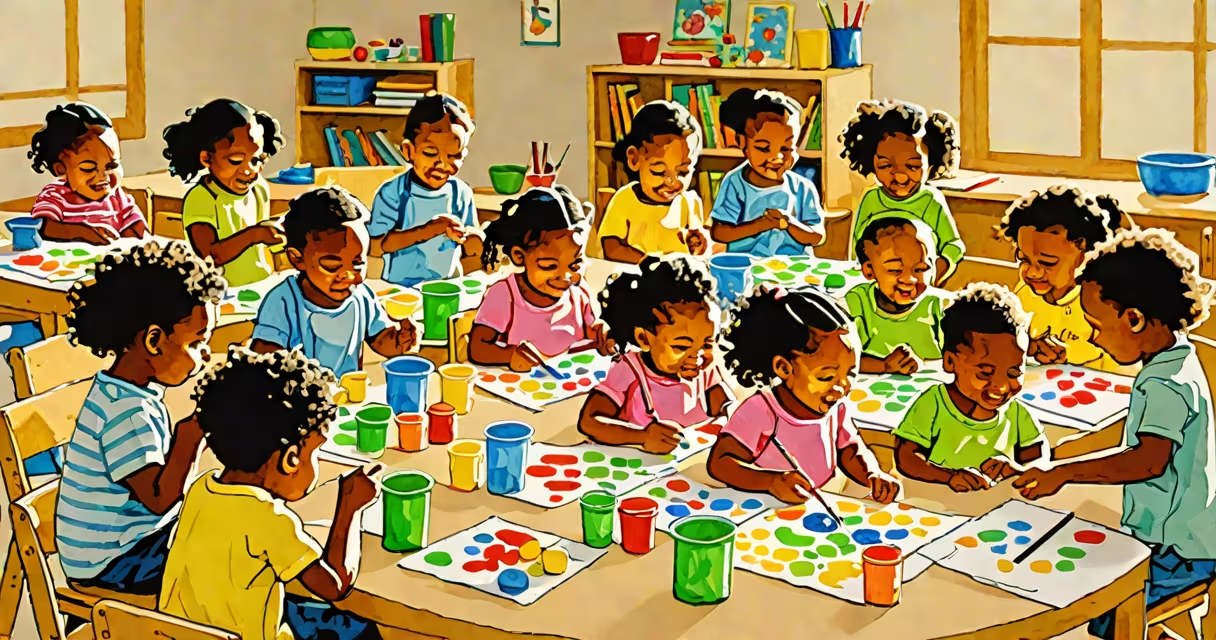
Preschool developmental milestones are observable behaviors and abilities that indicate a child's progress in physical, cognitive, language, social, and emotional development between ages 3 and 5. These benchmarks help caregivers and professionals assess whether a child is developing within expected ranges.
Children grow at different rates, but most follow a predictable sequence of development. Milestones are not rigid checkpoints, but rather reference points that show typical achievements. For example, by age 4, most children can hop on one foot, name common colors, and engage in pretend play involving roles like doctor or teacher.
These milestones serve as tools for early identification of delays. The American Academy of Pediatrics (AAP) recommends routine developmental screening during well-child visits at 9, 18, and 24 months, and again at 36 months. While formal screening may stop after age 3, understanding milestones remains essential for recognizing red flags such as persistent lack of speech, difficulty following instructions, or withdrawal from interaction.
Milestones are grouped into domains: gross motor, fine motor, language and communication, cognitive, social-emotional, and adaptive skills. Each domain tracks specific capabilities that emerge in stages. A child who can stack 10 blocks by age 4 demonstrates fine motor coordination. One who can recite their full name and address shows emerging cognitive and language skills.
Development is cumulative. Skills build on earlier ones. A child must typically master walking before they can run. They must understand basic concepts like "big" and "small" before comparing sizes. Delayed achievement in one area may signal broader concerns, especially if multiple domains are affected.
Screening tools like the Ages and Stages Questionnaire (ASQ) and the Denver Developmental Screening Test II (DDST-II) are validated instruments used by pediatricians and early educators. These tools rely on parent-reported observations and direct assessment, providing objective data to inform referrals when needed.
The following table outlines major milestones across core domains for children aged 3 to 5 years. These reflect national averages based on CDC and AAP guidelines.
| Domain | Age 3 Typical Achievement | Age 4 Typical Achievement | Age 5 Typical Achievement |
|---|---|---|---|
| Gross Motor | Jump with both feet, walk backward | Hop on one foot, ride a tricycle | Balance on one foot for 5 seconds, skip |
| Fine Motor | Use scissors with guidance, copy a circle | Draw a person with 4 parts, cut along lines | Write name, draw complex shapes |
| Language & Communication | Speak in 3-4 word sentences, tell simple stories | Use past tense, ask "why" questions | Follow 3-step instructions, retell events |
| Cognitive | Count to 10, recognize letters and numbers | Sort by color/shape, understand time concepts | Play board games, solve simple puzzles |
| Social-Emotional | Share toys, show empathy | Play cooperatively, handle frustration | Take turns, express emotions verbally |
Not every child hits every milestone at the same time. Variability is normal. A child who speaks in full sentences at 3 but struggles with sharing may still be within the healthy range. What matters is consistency over time and progression.
One non-obvious point often missed: milestones are not binary. A child doesn't suddenly "master" a skill. Progress happens in increments. For example, a 4-year-old may begin to write their name with shaky lines, then improve over weeks. This gradual improvement is developmentally accurate and should not be misinterpreted as delay.
Parents sometimes mistake delayed milestones for laziness or defiance. A 4-year-old who avoids eye contact or doesn't respond to their name may not be ignoring adults-they may have a hearing issue or autism spectrum traits. Early intervention improves outcomes.
Another misconception is that all children should reach milestones in the same order. Some children develop language before motor skills. Others excel socially while lagging in self-regulation. The CDC notes that gender differences exist-girls tend to develop language slightly earlier, boys slightly earlier in gross motor skills-but these gaps are small and do not predict long-term ability.
Red flags include regression-losing previously acquired skills-and persistent failure to meet milestones across multiple domains. For example, a child who stops using words they once knew, avoids interaction, and cannot follow simple commands may need evaluation for developmental delay or autism. The AAP advises seeking professional assessment if concerns persist beyond a few months.
I once observed a 4-year-old in a classroom who could not identify basic colors despite consistent instruction. After a referral to a speech and language therapist, it was discovered he had auditory processing disorder. Once supported with targeted exercises, his color recognition improved within six weeks. This case illustrates how subtle deficits can go unnoticed without structured observation.
Teachers use milestones to design age-appropriate curricula. A kindergarten class focusing on letter recognition assumes students can identify letters by age 5. Without this foundation, instruction becomes ineffective. Similarly, playground safety relies on knowing that most 4-year-olds can balance on one foot for 5 seconds-this informs equipment design.
At home, parents can support development through daily routines. Reading aloud to a 3-year-old builds vocabulary. Playing matching games strengthens memory. Asking open-ended questions like "What happened next?" enhances narrative thinking.
Tracking milestones doesn't require formal testing. Simple observation during meals, playtime, or car rides reveals patterns. If a child consistently avoids pointing to objects or uses only single words at age 4, it's worth discussing with a pediatrician.
Understanding preschool developmental milestones allows caregivers to support growth, recognize when help is needed, and celebrate progress. These milestones are not about perfection-they're about progress, individuality, and early intervention when needed.