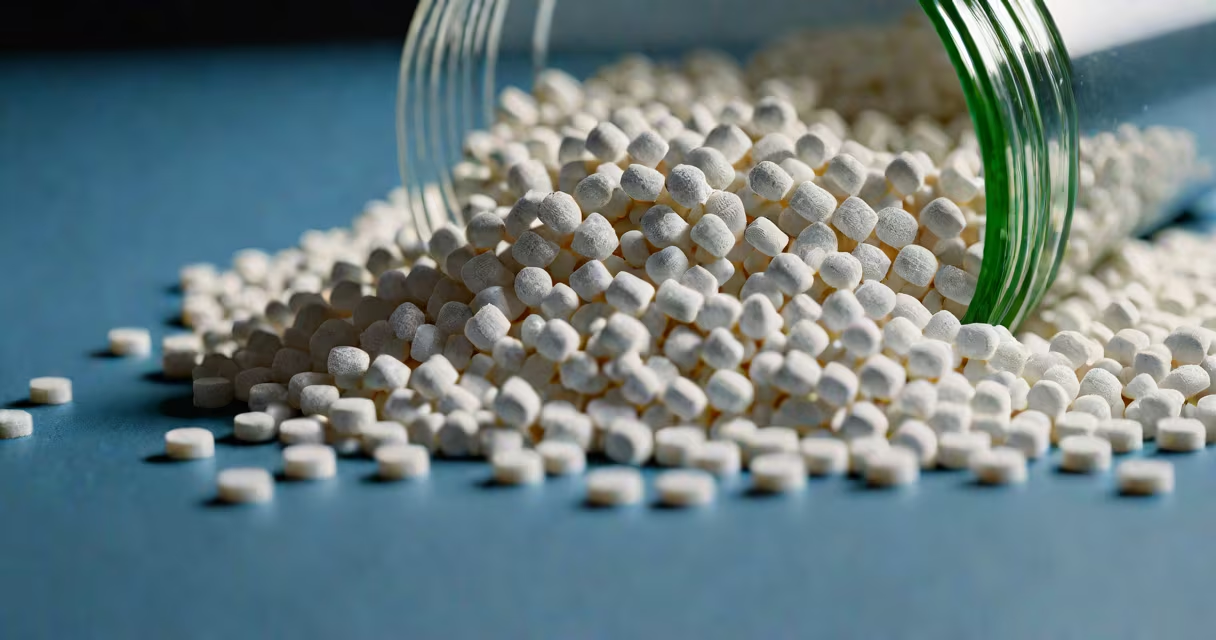
Pure sodium hydroxide is a white, odorless solid composed of NaOH with minimal impurities. It dissolves readily in water to form a strongly alkaline solution. This compound is used in industrial processes requiring high-purity base chemistry.
Pure sodium hydroxide exists as flakes, pellets, or granules. It is produced through the chloralkali process, where electrolysis splits sodium chloride brine into chlorine gas, hydrogen gas, and sodium hydroxide. The resulting product is purified to remove residual salts and moisture.
It has a molecular weight of 39.997 g/mol and a melting point of 318°C. In aqueous solution, it dissociates completely into Na⁺ and OH⁻ ions, giving it a pH above 14. Its high reactivity makes it effective in neutralizing acids and saponifying fats.
The compound functions by donating hydroxide ions (OH⁻) in solution. These ions attack acidic protons or ester bonds in organic compounds. For example, in saponification, OH⁻ cleaves triglycerides into glycerol and fatty acid salts-soaps.
In industrial settings, pure sodium hydroxide is used in pulp and paper production. It breaks down lignin in wood chips during the kraft process, separating cellulose fibers. A typical digester operates at 160°C with 18-20% NaOH by weight to achieve efficient delignification.
It also serves in aluminum refining. Bauxite ore is dissolved in hot NaOH to extract alumina (Al₂O₃), leaving behind iron and silica residues. The reaction: Al₂O₃ + 2NaOH → 2NaAlO₂ + H₂O.
Pure sodium hydroxide is available in several forms based on purity and application:
| Type | Purity | Common Uses | Form |
|---|---|---|---|
| Technical grade | 85-95% | Water treatment, textile processing | Flakes or pellets |
| Reagent grade | ≥99% | Laboratory synthesis, analytical standards | Crystalline pellets |
| Food-grade | ≥99% | Processing of cocoa, olives, pretzels | Pellets or solutions |
Reagent-grade sodium hydroxide is certified by the American Chemical Society (ACS) for purity and consistency. It must meet specifications such as ≤0.005% chloride and ≤0.01% sulfate content.
Food-grade NaOH is regulated by the FDA under 21 CFR §184.1104. It is used in limited quantities to adjust pH during food processing. For example, pretzels are dipped in a 1-2% NaOH bath before baking to develop their characteristic crust.
Pure sodium hydroxide is often confused with commercial lye, which contains impurities like sodium carbonate and sodium chloride. Lye used in home soap-making may be 70-80% NaOH, whereas pure sodium hydroxide exceeds 99% purity.
It is not safe for direct skin contact. A 10% solution causes severe burns within minutes. The National Institute for Occupational Safety and Health (NIOSH) classifies it as a corrosive substance. Exposure requires immediate rinsing with water for at least 15 minutes.
A common error is assuming all NaOH is interchangeable. Using technical grade in a lab experiment can skew results due to trace metal contaminants. Reagent-grade material ensures reproducibility in titrations and synthesis reactions.
To illustrate, consider making 1 kg of soap using 100% pure sodium hydroxide. The recipe calls for 150 grams of coconut oil and 35 grams of NaOH. The saponification value of coconut oil is 258 mg KOH/g. Converting to NaOH: 258 × 0.4 = 103.2 mg NaOH per gram of oil.
For 150 g oil: 150 × 103.2 = 15,480 mg = 15.48 g NaOH. Adding a 5% excess for completeness: 15.48 × 1.05 = 16.25 g. Using pure NaOH ensures accurate reaction stoichiometry and avoids incomplete saponification.
I once used technical-grade NaOH in a small-scale experiment and observed inconsistent gel formation. Switching to reagent-grade material resolved the issue. Impurities altered the viscosity and reaction rate.
Pure sodium hydroxide reacts violently with ammonium chloride. The reaction produces ammonia gas: NaOH + NH₄Cl → NaCl + NH₃ + H₂O. This mixture is hazardous in enclosed spaces and must be handled in fume hoods.
When storing, keep it in sealed, corrosion-resistant containers. Polyethylene-lined steel drums are standard. Exposure to air causes it to absorb moisture and carbon dioxide, forming sodium carbonate. This reduces effectiveness and can clog dispensing systems.
For household cleaning, sodium hydroxide for cleaning is typically diluted to 1-5%. Pure sodium hydroxide is never used directly on surfaces. Dilution reduces risk and maintains cleaning efficacy.
Understanding pure sodium hydroxide is critical for safe handling and precise applications. It is not a substitute for lower-purity forms in sensitive work. Always verify purity and intended use before selecting a grade.
See how sodium hydroxide is produced industrially.