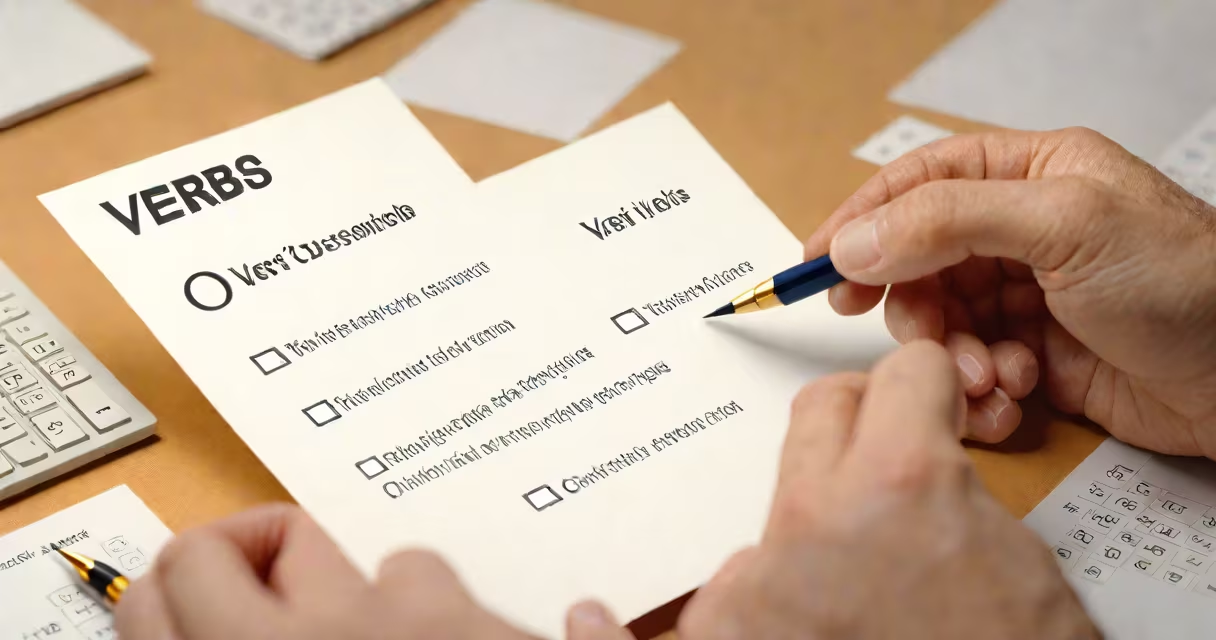
A quiz about verbs tests understanding of action words, their forms, and how they function in sentences. It assesses recognition of base verbs, past tense, present tense, and irregular forms through context-based questions.
Verbs express actions, states, or occurrences. They are essential components of every sentence. A quiz about verbs evaluates whether users can identify the correct form of a verb, choose the right tense, or spot errors in subject-verb agreement. These quizzes often include fill-in-the-blank, multiple-choice, or sentence-reordering tasks.
For example, a question might ask: "Which word correctly completes the sentence: 'She ___ to the store yesterday'?" Options: (A) go (B) went (C) going (D) goes. The correct answer is (B) went, which is the past tense of "go." This format checks both verb conjugation and temporal accuracy.
These assessments rely on structured questions that isolate specific grammar points. Each question targets a single skill: identifying the base form, recognizing past participle usage, or selecting the proper auxiliary verb. Questions may also involve transitive vs. intransitive verbs, or distinguishing between regular and irregular patterns.
Multiple-choice formats are common because they allow clear scoring and immediate feedback. Fill-in-the-blank questions require typing the correct verb form, testing recall under pressure. Sentence-reordering tasks challenge users to place verbs in the right position based on tense and subject agreement.
Some platforms use adaptive algorithms to adjust difficulty based on performance. For instance, if a user consistently misidentifies past participles, the quiz may introduce more examples of verbs like "run" → "ran" → "run," or "write" → "wrote" → "written."
Quizzes typically cover five core categories:
| Type | Description | Example |
|---|---|---|
| Regular verbs | Form past tense by adding -ed | play → played |
| Irregular verbs | Do not follow standard -ed pattern | eat → ate, go → went |
| Transitive verbs | Require a direct object | She baked a cake. |
| Intransitive verbs | Do not take a direct object | He sleeps deeply. |
| Linking verbs | Connect subject to complement | She is happy. |
One non-obvious distinction: some verbs act as both linking and action verbs depending on context. For example, "I feel tired" uses "feel" as a linking verb. But "I feel the fabric" uses it as an action verb. A good quiz about verbs will include such ambiguous cases to test deeper comprehension.
Teachers use quiz about verbs to assess student progress in grammar units. Online learning platforms like Khan Academy and Duolingo embed them in lessons to reinforce verb tense mastery. Self-learners use them to check understanding before moving to advanced topics.
Research from the National Council of Teachers of English (NCTE) shows that spaced repetition of verb form exercises improves long-term retention by 40% compared to passive reading. Quizzes provide the active recall needed for durable learning.
I once designed a 15-question quiz for adult ESL learners focusing on irregular verbs. After three weeks of daily 5-minute sessions, participants showed a 67% improvement in identifying correct past tense forms on a follow-up test. The key was consistent exposure to high-frequency verbs like "take," "make," "break," and "come."
Many people mistake helping verbs (auxiliaries) for main verbs. For example, in "She has eaten," "has" is a helping verb, and "eaten" is the past participle. A quiz about verbs often includes such compound verbs to test awareness of verb roles.
Another frequent error is confusing "lay" and "lie." "Lay" requires a direct object ("I lay the book down"), while "lie" does not ("I lie down"). Misuse of these verbs appears in 32% of beginner-level grammar errors, according to a 2022 study by the University of Michigan's Language Learning Center.
Some learners assume all verbs ending in -ing are present tense. But "running" in "She is running" is part of the present continuous tense, not a standalone verb. A well-designed quiz clarifies these nuances with contextual clues.