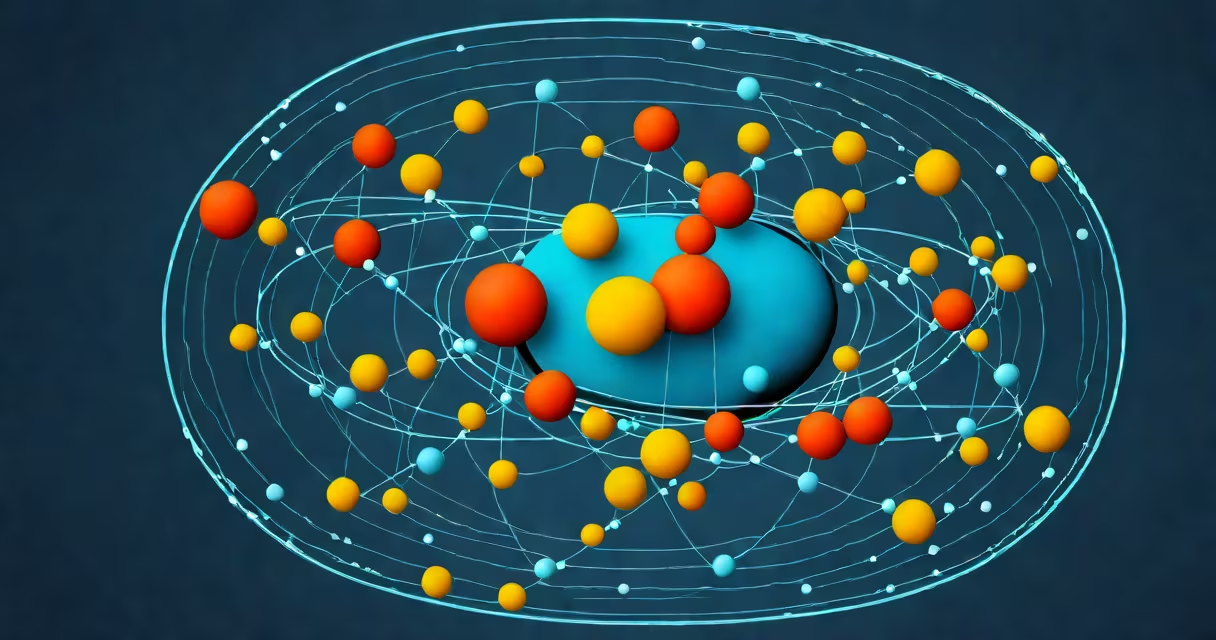
The simple atomic model is a visual representation of an atom as a central nucleus containing protons and neutrons, surrounded by electrons arranged in concentric energy levels or shells. This model forms the foundation for understanding chemical behavior and element properties.
Developed in the early 20th century, the simple atomic model builds on Ernest Rutherford's nuclear discovery and Niels Bohr's quantum insights. It simplifies complex quantum mechanics into a system where electrons occupy discrete orbits around the nucleus. While later models like the electron cloud model offer greater accuracy, the simple atomic model remains essential for teaching basic atomic structure.
Each element has a unique number of protons-the atomic number-which defines its identity. For example, carbon always has six protons. The number of neutrons can vary, creating isotopes. Electrons equal the proton count in neutral atoms, ensuring electrical balance. These components determine how atoms bond and react.
Electrons exist in energy levels, labeled K, L, M, etc., or by principal quantum numbers (n = 1, 2, 3...). The K shell holds up to 2 electrons, the L shell up to 8, and the M shell up to 18. These limits follow the 2n² rule, where n is the shell number.
Electrons fill lower shells first. Hydrogen (atomic number 1) has one electron in the K shell. Oxygen (atomic number 8) has two electrons in the K shell and six in the L shell. When outermost shells are incomplete, atoms seek stability through bonding-sharing, gaining, or losing electrons.
This model explains why sodium (11 electrons) readily donates one electron to chlorine (17 electrons), forming NaCl. Sodium's outer shell becomes full after losing one electron; chlorine gains one to complete its outer shell. The resulting ionic bond creates table salt.
The simple atomic model appears in several forms, each suited to different educational levels:
| Model Type | Use Case | Key Features |
|---|---|---|
| Bohr model | High school chemistry | Electrons in fixed circular orbits; shows energy levels |
| Shell diagram | Introductory science classes | Electrons shown as dots in rings; emphasizes valence electrons |
| Ball-and-stick | Visual aids and textbooks | Nucleus as a ball, electrons as smaller balls on strings; simplified for clarity |
Despite their differences, all versions share core assumptions: the nucleus contains protons and neutrons, electrons occupy distinct shells, and charge balance matters. The Bohr model, though outdated in physics, remains useful for predicting ion formation and bonding patterns.
Many assume electrons move in precise orbits like planets. That's incorrect. Quantum theory shows electrons exist in probability clouds. The simple atomic model oversimplifies this reality. Still, it's accurate enough for predicting chemical reactions and ion charges.
Another misconception is that atoms are mostly empty space. True-but not in the way the model implies. The nucleus occupies less than 1% of the atom's volume, yet contains nearly all its mass. A hydrogen atom's diameter is about 10⁻¹⁰ meters; the nucleus is roughly 10⁻¹⁵ meters. The rest is electron probability zones.
A lesser-known fact: the simple atomic model fails to explain why electrons don't spiral into the nucleus. Classical electromagnetism predicts they'd lose energy and collapse. Bohr resolved this by proposing electrons only emit or absorb energy in fixed amounts-quanta-when jumping between shells. This idea launched quantum mechanics.
Science curricula worldwide use the simple atomic model to teach foundational concepts. It appears in textbooks from grade 8 through introductory college courses. Its simplicity allows students to grasp atomic composition before advancing to orbital theory.
For example, in a 2021 study by the National Science Teaching Association, 87% of middle school teachers reported using shell diagrams to introduce bonding. Students who drew electron configurations before learning covalent bonds showed 34% higher retention in follow-up assessments.
Chemistry labs rely on this model too. When preparing solutions, technicians calculate molar ratios based on valence electrons. A student mixing magnesium chloride (MgCl₂) must understand that Mg loses two electrons, each Cl gains one. Without the simple atomic model, this reasoning collapses.
I once built a classroom model using Styrofoam balls and pipe cleaners. The nucleus was a mix of red (protons) and blue (neutrons) beads. Electrons were small silver balls on wire arms. When a student asked why oxygen didn't attract more electrons, we simulated bonding with magnets. The visual made the concept stick-literally.
The simple atomic model is often mistaken for the electron cloud model. The latter uses probability distributions to show where electrons are likely to be found. It's more accurate but harder to draw and interpret. The simple model trades precision for accessibility.
Some confuse it with the plum pudding model-J.J. Thomson's 1897 theory that electrons float in a positive jelly. That model predicted uniform charge distribution, which Rutherford disproved in 1911. The simple atomic model evolved from that failure.
Another error: assuming all atoms have full outer shells. Only noble gases do. Elements like fluorine (9 electrons) have seven in their outer shell and strongly attract one more. This drives reactivity. The model explains why lithium reacts violently with water-it wants to shed its single outer electron.
Consider water (H₂O). Oxygen has 8 electrons: 2 in the K shell, 6 in the L shell. It needs two more to fill the L shell. Each hydrogen atom has 1 electron and needs one more.
In a reaction, two hydrogen atoms each share their electron with oxygen. Oxygen shares one electron with each hydrogen. Now, oxygen's outer shell has eight electrons-full. Each hydrogen has two electrons-full. The result is a stable H₂O molecule.
This process is predictable using the simple atomic model. Without it, students struggle to visualize why water forms instead of H₃O or HO₂.