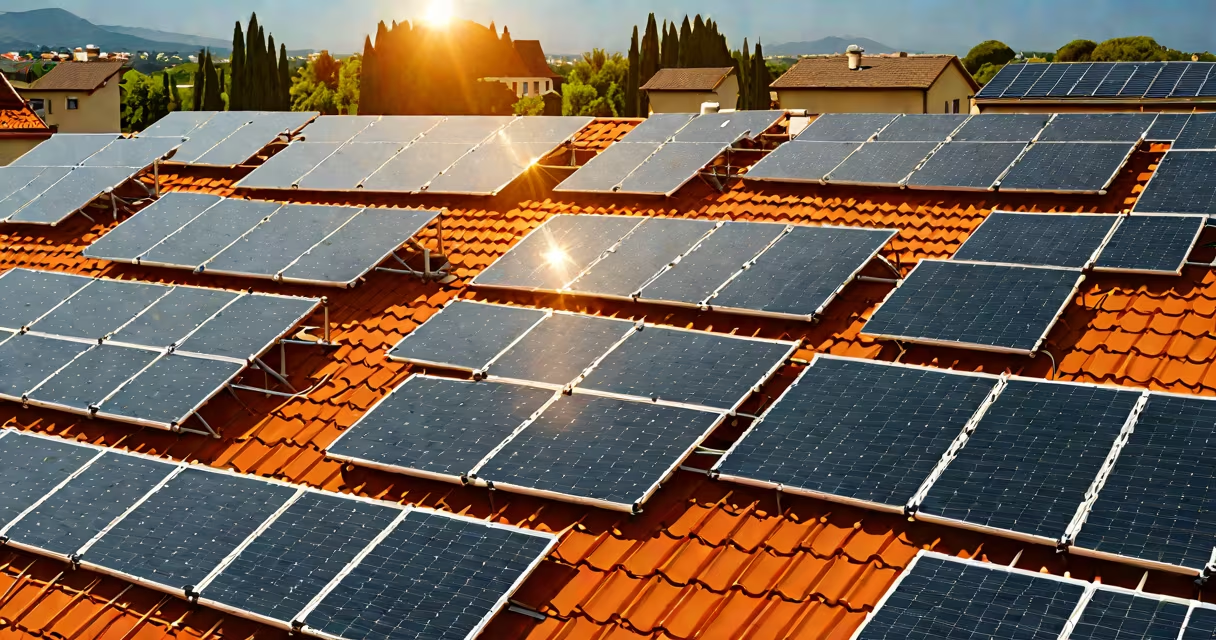
Solar PV tech uses semiconductor materials, typically silicon, to convert sunlight directly into electricity through the photovoltaic effect. This process generates clean, on-site power without moving parts or emissions.
The core of solar PV tech lies in individual solar cells, which are combined into modules-commonly called solar panels. These panels are wired together into arrays that feed electricity into inverters, converting direct current (DC) into alternating current (AC) usable by homes and the grid. Modern systems integrate monitoring software and battery storage for optimized performance.
Most residential and commercial installations use crystalline silicon cells, which account for over 95% of global production. Thin-film technologies like cadmium telluride (CdTe) and copper indium gallium selenide (CIGS) offer lower efficiency but flexibility and lower manufacturing costs. Perovskite-based cells are emerging with lab efficiencies exceeding 26%, though durability remains a challenge.
When photons from sunlight strike a solar cell's semiconductor layer, they transfer energy to electrons. This excites electrons, freeing them from their atomic bonds and creating electron-hole pairs. An internal electric field-formed by doping silicon with boron and phosphorus-pushes electrons toward one side of the cell and holes toward the other. Metal contacts collect these charges, generating a flow of DC electricity.
For practical use, multiple cells are connected in series within a panel. A typical 60-cell panel produces around 300-400 watts under standard test conditions (STC). Arrays scale to kilowatt (kW) or megawatt (MW) levels depending on site size and energy demand.
Once generated, DC power passes through an inverter. Grid-tied systems synchronize output with utility frequency and voltage. Off-grid setups pair with batteries to store excess energy for nighttime or cloudy days. Net metering allows surplus power to be credited against future usage.
Different materials and structures define the major categories of solar PV tech:
| Type | Efficiency Range | Cost per Watt | Use Cases |
|---|---|---|---|
| Monocrystalline Silicon | 18-24% | $0.35-$0.50 | Residential rooftops, space-constrained areas |
| Poly Crystalline Silicon | 15-18% | $0.25-$0.35 | Commercial buildings, large-scale projects |
| Cadmium Telluride (CdTe) | 10-12% | $0.20-$0.30 | Utility-scale solar farms, flexible mounting |
| Copper Indium Gallium Selenide (CIGS) | 12-15% | $0.30-$0.45 | Building-integrated photovoltaics (BIPV), curved surfaces |
| Perovskite (Experimental) | 26% (lab), ~15-20% (prototype) | Not yet commercialized | Next-gen research, tandem cells with silicon |
Monocrystalline panels have higher efficiency due to uniform crystal structure. Poly-crystalline cells are cheaper but less efficient and show a blue hue. CdTe and CIGS thin films are deposited on glass or metal substrates, enabling lightweight, flexible designs ideal for non-traditional roofs.
A key distinction often missed: not all solar panels are equal. Efficiency ratings depend on STC-1000 W/m² irradiance, 25°C cell temperature, and air mass 1.5 spectrum. Real-world performance drops under high heat or partial shading. For example, a panel rated at 400 W may produce only 340 W on a hot summer day.
Global solar PV capacity reached 1.5 terawatts (TW) by 2023, according to the International Energy Agency (IEA). The United States, China, India, Germany, and Japan lead deployment. Rooftop systems dominate residential markets; utility-scale plants cover hundreds of acres in deserts and arid zones.
India's Bhadla Solar Park in Rajasthan spans 14,000 acres and hosts over 2.5 GW of installed capacity. It supplies power to 1 million homes annually. In California, solar PV accounts for nearly 25% of electricity generation during peak daylight hours.
Off-grid applications rely on solar PV tech in remote villages, mobile units, and disaster relief. The World Bank reports that solar microgrids provide electricity to over 100 million people in Sub-Saharan Africa and South Asia who lack access to centralized grids.
One non-obvious fact: solar PV tech doesn't require direct sunlight to function. Panels generate power on cloudy days-about 10-25% of rated output. Snow-covered panels still produce energy when sunlight penetrates snow layers, especially if the surface is sloped.
Many assume solar PV tech is inefficient or unreliable. But modern panels degrade at less than 0.5% per year, guaranteeing 80-90% output after 25 years. The U.S. Department of Energy's National Renewable Energy Laboratory (NREL) confirms that average system lifespans exceed 30 years with proper maintenance.
Another confusion: solar PV vs. solar thermal. Solar thermal uses mirrors or collectors to heat fluid for steam turbines. It's used in large power stations like Spain's Andasol plant. Solar PV generates electricity directly from light-no heat transfer step involved.
I once observed a rooftop installation in Austin, Texas, where a homeowner replaced a 20-year-old system with new monocrystalline panels. The old system produced 3.2 kW; the new one, despite covering less area, delivered 4.8 kW due to improved efficiency and better orientation. The upgrade reduced payback time years.
For context, a 5-kW solar PV system in a sunny region like Phoenix, Arizona, generates about 7,500 kWh annually-enough to offset 80% of a typical household's electricity use. Adding a 10 kWh battery increases self-consumption to over 90%.
Research focuses on tandem cells combining silicon with perovskite layers. NREL reported a 33.9% efficiency in a lab-scale tandem cell in 2023, surpassing single-junction limits. Commercialization is expected by 2027.
Smart inverters now support grid stability functions like reactive power control and voltage regulation. These features help prevent blackouts during high solar penetration, as seen in Hawaii's grid management program.
Integration with building materials is growing. BIPV windows and roofing tiles allow solar generation without adding external panels. Companies like Tesla and Sistine Solar offer integrated solutions that blend aesthetics with performance.
Understanding solar PV tech begins with knowing it's not just about panels-it's a system involving materials science, electrical engineering, and energy policy. As solar PV tech evolves, it becomes central to decarbonizing power systems globally.