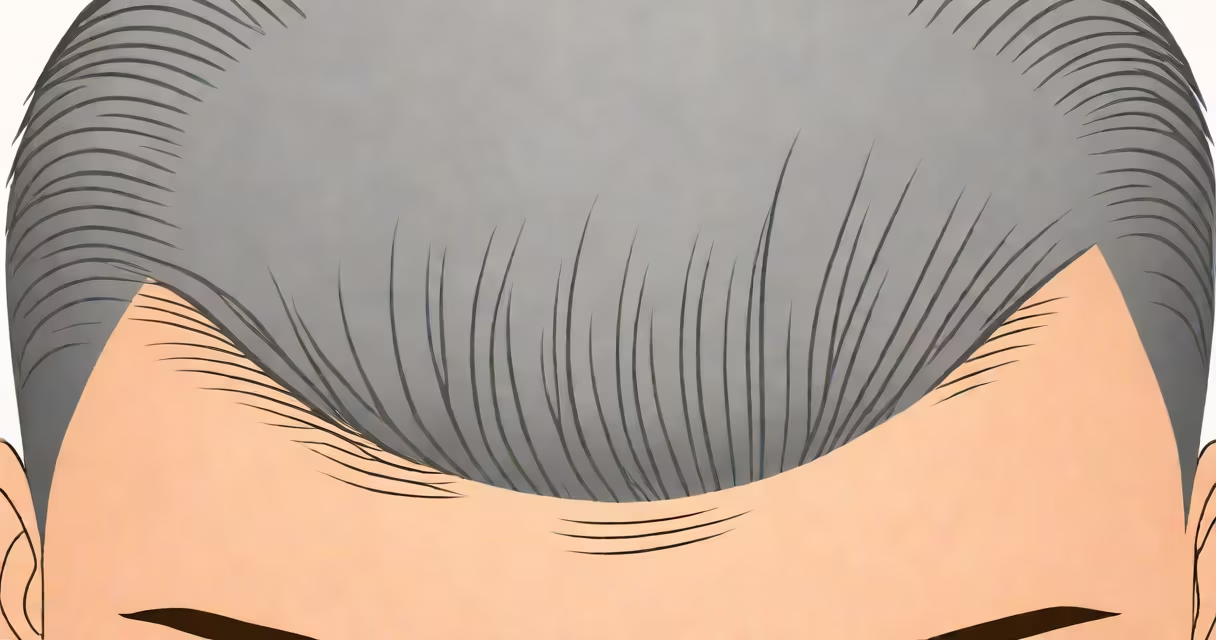
Testosterone and hair describes the biological relationship between the hormone testosterone and its metabolite dihydrotestosterone (DHT), which regulate hair growth patterns, particularly in genetically predisposed individuals. Elevated DHT levels shrink hair follicles on the scalp, leading to miniaturization and eventual hair loss, especially in men with androgenetic alopecia.
Testosterone itself is not directly responsible for hair loss. Instead, it converts into DHT via the enzyme 5-alpha-reductase. DHT binds strongly to androgen receptors in scalp hair follicles, shortening the growth phase (anagen) and causing follicles to shrink over time. This process leads to finer, shorter hairs and eventually complete cessation of visible hair growth.
Men typically experience this pattern in a receding hairline and thinning crown. Women may develop similar symptoms due to elevated androgens, often linked to conditions like polycystic ovary syndrome (PCOS), though their pattern tends to be diffuse thinning across the scalp rather than a distinct receding hairline.
The mechanism begins with genetic sensitivity. Individuals inherit follicles that are vulnerable to DHT's effects. When DHT binds to receptors in the dermal papilla cells at the base of the follicle, it disrupts normal signaling. This causes the follicle to enter a prolonged resting phase (telogen), reducing the number of hairs in active growth.
Over time, the cycle shortens. What was once a 3-year growth phase may drop to 3 months. The resulting hair becomes vellus-like-fine, colorless, and barely visible. Eventually, the follicle may remain dormant indefinitely, leading to permanent hair loss if untreated.
A 2021 study published in JAMA Dermatology confirmed that men with higher serum DHT levels had greater hair density reduction over five years compared to those with lower levels, even when total testosterone remained within normal ranges.
Different hormonal profiles produce distinct hair patterns. The most common types are:
| Type | Primary Hormone Involved | Common Pattern | Typical Population |
|---|---|---|---|
| Androgenetic Alopecia (Male Pattern) | DHT | Receding hairline, thinning crown | Men with genetic sensitivity |
| Female Pattern Hair Loss | Free testosterone & DHT | Diffuse thinning, widened part | Women with PCOS or hyperandrogenism |
| Postpartum Hair Shedding | Drop in estrogen, relative rise in androgens | Generalized shedding 3-6 months post-birth | Recent mothers |
Not all hair loss caused by testosterone is permanent. Early-stage androgenetic alopecia responds well to treatments that block DHT, such as finasteride or topical minoxidil.
Many assume that high testosterone levels always cause hair loss. That's incorrect. Total testosterone levels don't correlate directly with hair loss risk. Instead, it's the local conversion of testosterone to DHT in scalp tissue that matters. Some men have high total testosterone but low DHT and no hair loss.
Another misconception is that hair loss from testosterone is reversible only through surgery. While hair transplants restore coverage, medical interventions can halt progression and regrow hair in early stages. Finasteride reduces DHT by 70% in men, slowing or reversing hair loss in about 65% of users according to a 2019 review in Clinical Interventions in Aging.
Some people believe that shaving the head stops hair loss. This is false. Shaving removes visible hair but does nothing to stop DHT from attacking follicles beneath the skin. The underlying biology continues unchanged.
In 2020, a 34-year-old man presented with a 4-year history of gradual hair thinning at the temples and vertex. His total testosterone was 620 ng/dL (within normal range), but his free testosterone and DHT were elevated. A scalp biopsy revealed miniaturized follicles consistent with androgenetic alopecia.
He began a regimen of 1 mg daily finasteride and 5% topical minoxidil. After 12 months, he reported visible regrowth in the frontal area and stabilization of crown thinning. A follow-up scan showed increased follicular density in treated zones by 38%, confirming that targeting DHT reversed early-stage hair loss.
If hair loss begins before age 30, progresses rapidly, or occurs alongside other signs of hormonal imbalance-such as acne, increased body hair, or irregular periods-it warrants testing. Blood work should assess total and free testosterone, DHT, SHBG, and thyroid function.
For women experiencing hair thinning, testing for hyperandrogenism is essential. Up to 15% of women with unexplained hair loss have undiagnosed PCOS, according to the American Society for Reproductive Medicine.
Men with sudden or patchy hair loss should rule out autoimmune conditions like alopecia areata, which can mimic androgenetic patterns but require different treatment.
Testosterone and hair loss is not about testosterone levels alone-it's about DHT's effect on sensitive follicles. Early intervention with DHT-blocking medications or topical agents can prevent progression and support regrowth. Understanding this distinction separates effective management from ineffective self-treatment.