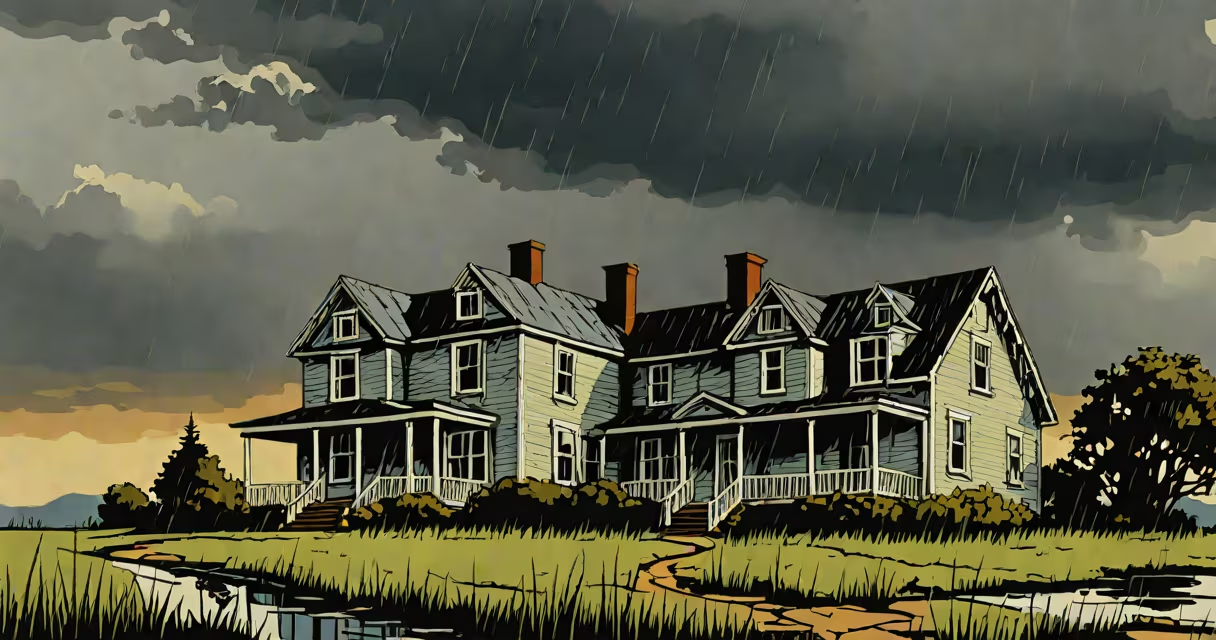
"The Sentence Is Death" is a standalone crime novel by British author Anthony Horowitz, published in 2015. It follows Detective Inspector Daniel Hawthorne as he investigates a murder at a secluded country house during a violent storm. The story combines classic whodunit mechanics with psychological depth, set against a backdrop of isolation and suspicion.
Hawthorne is a fictional detective created by Horowitz, distinct from his popular character Alex Rider. He appears in a series of novels beginning with "The Word is Murder" (2017), though "The Sentence Is Death" was written earlier and released before the others. The book functions as a self-contained mystery, requiring no prior knowledge of Horowitz's other works.
The narrative unfolds through a dual timeline: the investigation takes place in real time during a single weekend, while flashbacks reveal the victim's past actions and relationships. This structure allows readers to piece together clues alongside Hawthorne, who relies on logic, observation, and a sharp eye for contradictions.
The murder occurs at Blackheath Hall, a decaying manor in rural England. A group of five guests arrives for a weekend retreat hosted by a reclusive businessman, Charles Bannister. Within hours, Bannister is found dead in his study, locked from the inside, with a single gunshot wound. The storm cuts off all communication with the outside world.
Hawthorne arrives the next morning. He quickly identifies the key suspects: Bannister's estranged daughter, a former lover, a business partner with a hidden agenda, and a family friend with a history of mental illness. Each character has motive, opportunity, and a plausible alibi-but none fully explain the locked-room aspect.
Horowitz uses misdirection and red herrings common in Golden Age mysteries. For example, a letter found in the victim's desk seems to implicate one suspect, but the handwriting analysis reveals it was forged. The real twist lies in the timing of events and the interpretation of physical evidence-such as the position of the gun and the absence of powder burns.
The novel adheres to the conventions of the detective genre: a closed circle of suspects, a mysterious death, and a final revelation that recontextualizes everything. But Horowitz subverts expectations by making the solution less about who did it and more about why it mattered.
Unlike many modern thrillers that rely on action sequences or high-stakes chases, "The Sentence Is Death" centers on dialogue, behavior, and forensic detail. The investigation proceeds through interviews, document review, and spatial reasoning. Hawthorne often pauses to reflect on human nature, stating: "People lie not because they want to deceive, but because they cannot bear the truth."
A non-obvious fact: the title refers not to the moment of death, but to the final verdict. In the courtroom scene near the end, the prosecutor delivers a closing argument that ends with the phrase "the sentence is death." This line echoes throughout the narrative, appearing in letters, dreams, and even a child's drawing. It's a thematic device, not a literal prediction.
Horowitz employs several narrative techniques to maintain tension:
These devices mirror those used by Agatha Christie and Arthur Conan Doyle, but with a contemporary edge. Horowitz avoids supernatural explanations. All answers are grounded in human behavior and physical evidence.
Many readers assume "The Sentence Is Death" is part of the Alex Rider series due to Horowitz's fame with that franchise. It is not. Alex Rider is a teenage spy with a government agency affiliation. Hawthorne is a middle-aged detective working independently, with a troubled personal life and a dry wit.
Another misconception is that the novel is a sequel to "The Word is Murder." While both feature Hawthorne, "The Sentence Is Death" was written earlier and published first. The chronological order of the series is: "The Sentence Is Death," then "The Word is Murder," followed by "All the Devils Are Here."
A third error: some believe the murderer is revealed early. The novel deliberately delays the identity until the final chapter. Even experienced mystery readers may misattribute guilt based on early dialogue cues. Horowitz includes a deliberate misdirection involving a hidden diary entry that appears to name the killer-until the final page.
Consider the central locked-room puzzle. The study door was locked from the inside using a bolt mechanism. No fingerprints were found on the handle. The window was sealed shut. The only exit was the door.
At first glance, this suggests either a ghost or a hidden passage. But Hawthorne notices something small: the floorboards near the door are slightly warped. He removes a loose plank and finds a metal rod embedded in the gap between the floor and wall. The rod had been used to hold the bolt in place from the outside.
When the storm caused a power surge, the heating system's fan kicked on, vibrating the house. The vibration loosened the rod, allowing the bolt to disengage. The killer had slipped the rod into place before leaving, then returned later to remove it-after the storm had passed and the house was quiet.
This solution requires attention to environmental details, not just clues. It reflects Horowitz's belief that "the most dangerous lies are told by silence."
Anthony Horowitz was born in London in 1955. He began writing for television in the 1980s, creating shows like "Midsomer Murders" and "Foyle's War." His work in crime drama influenced his prose style-tight pacing, precise dialogue, and a focus on atmosphere.
Horowitz cites P.D. James, Agatha Christie, and Raymond Chandler as literary influences. He studied at Oxford and trained as a screenwriter before turning to novels. His ability to blend traditional mystery tropes with modern psychology sets him apart from contemporaries.
According to the BBC Culture, "Horowitz revives the tradition of the fair-play puzzle" by ensuring all clues are visible to the reader. "There is no cheating," the article states. "Every solution is logically traceable."
His success with "The Sentence Is Death" led to a new series of detective novels. The book received critical acclaim from The Guardian, which called it "a masterclass in suspense construction."
While many current thrillers emphasize plot twists and shock endings, "The Sentence Is Death" prioritizes intellectual satisfaction. The resolution doesn't rely on a surprise revelation-it builds toward inevitability. Readers who solve the mystery before the final pages report a sense of clarity, not confusion.
One reader, after finishing the book, wrote on Goodreads: "I thought I knew who did it halfway through. Then I realized I'd missed the real clue-the way the victim's shoes were placed under the desk." That detail, mentioned in passing, becomes critical when Hawthorne points out that the victim was left-handed and would have stood on the right side of the desk.
For fans of classic mystery, the novel offers a satisfying return to form. For newcomers, it serves as an accessible introduction to the genre's core principles: fairness, logic, and restraint.