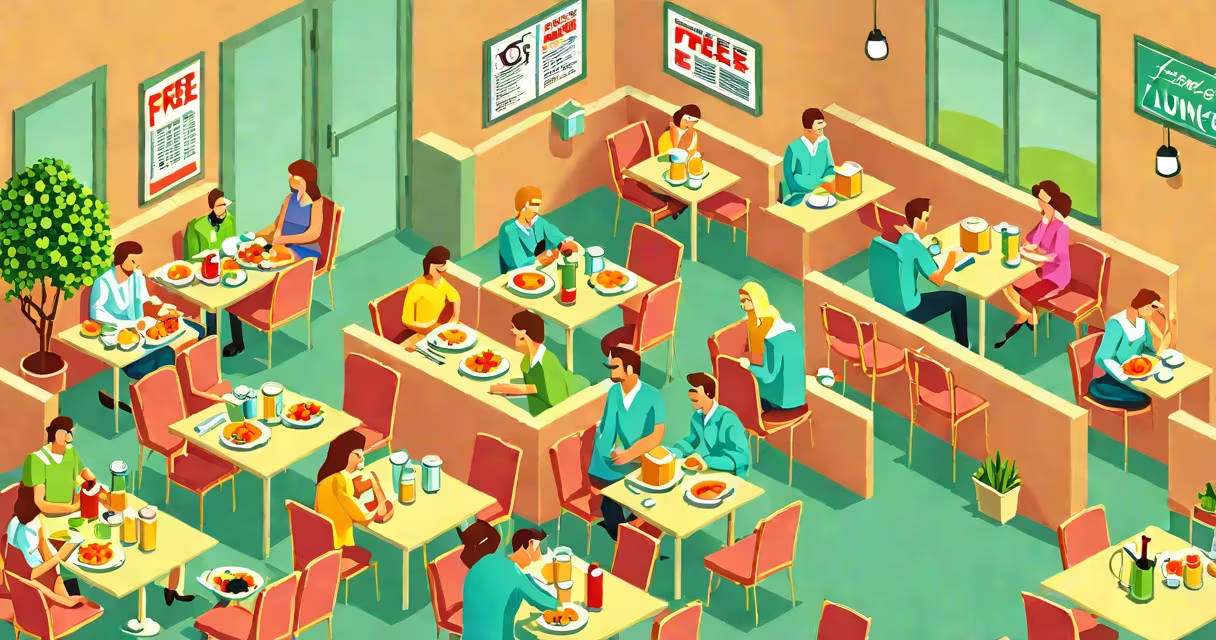
The phrase "there is no free lunch" expresses the economic reality that every benefit requires a trade-off-someone pays, directly or indirectly. Resources are limited, so obtaining something valuable always involves giving up something else. This principle underlies decision-making in personal finance, business strategy, and public policy.
At its core, "there is no free lunch" reflects opportunity cost-the value of the next best alternative forgone when making a choice. For example, choosing to spend $10 on a movie ticket means you cannot use that money for dinner, gas, or savings. The cost isn't just the price tag-it's what you give up to afford it.
This concept was popularized by economist Milton Friedman, who used it to argue against government programs that appear to offer benefits without cost. He emphasized that even if a service is labeled "free," taxpayers or future generations bear the burden through taxes, inflation, or reduced public spending elsewhere. The U.S. Federal Reserve confirms that all government spending involves trade-offs, whether visible or delayed.
When a company offers a "free" software tool, users typically exchange data, attention, or access to their behavior patterns. Facebook, for example, provides a free social network-but monetizes user engagement through targeted advertising. The cost isn't in the fee; it's in the personal information shared and the time spent on the platform.
Similarly, a gym offering a "free month" often requires a long-term contract. The initial month may have no direct charge, but the customer commits to paying for 12 months afterward. The true cost emerges only after signing up. A 2022 study by the Consumer Financial Protection Bureau found that 68% of consumers who signed up for free trials ended up paying for subscriptions they didn't initially plan to keep.
Even natural resources aren't truly free. Water from a tap appears costless, but municipal systems require infrastructure investment, maintenance, and energy use-all funded through property taxes or utility bills. The absence of a direct payment doesn't eliminate the underlying expense.
Not all trade-offs are financial. Time, privacy, convenience, and long-term consequences can represent significant opportunity costs. The table below outlines common forms of indirect costs tied to "free" offerings.
| Type of Cost | Example | Source of Burden |
|---|---|---|
| Time | Free app with ads that interrupt usage | User loses 15 minutes per day |
| Data | Free email service scanning messages for ads | Personal information shared with third parties |
| Future Access | Free cloud storage with mandatory upgrade | Users locked into paid plans after 15GB limit |
| Opportunity | Free course requiring 10 hours/week | Time not spent working or resting |
These examples show that "free" rarely means zero cost. Instead, it shifts the burden to less obvious forms of value exchange.
Many people assume "free" means no sacrifice. But economists define free only for price-not value. A product priced at $0 still carries opportunity cost. When you choose a free meal at a conference, you're trading your time and attention for the event's marketing goals.
Another misconception is that free services don't affect markets. In reality, subsidized offerings distort competition. For example, when a tech firm gives away messaging apps at no cost, smaller rivals can't compete on price-even if their products are better. This leads to market concentration, reducing innovation over time.
A lesser-known fact: the principle applies even to altruism. A charity providing free meals during a crisis still uses donated funds, volunteer labor, and infrastructure. The act isn't free-it's funded by others' contributions. As the World Bank notes, aid programs rely on donor countries' budgets, which are constrained by national fiscal policies.
Consider a city installing free Wi-Fi in parks. On the surface, this seems beneficial. But the cost isn't eliminated-it's deferred. The city must fund installation, maintenance, and security. These expenses come from tax revenues or redirected funds from other projects, such as park repairs or youth programs.
I once observed this in action while visiting a downtown plaza in Portland. The free Wi-Fi was advertised as "complimentary." After using it for two weeks, I noticed a new city budget proposal allocating $120,000 annually to maintain the system. That amount came center funding. The "free" service shifted costs to another public program.
Similarly, businesses offering free Wi-Fi attract customers-but often collect location data, browsing habits, and device identifiers. A 2021 report by the Electronic Frontier Foundation found that 73% of public Wi-Fi networks collected user data without clear consent. The price of free access is often personal information.
Recognizing "there is no free lunch" prevents poor choices based on false assumptions. When evaluating offers-especially online-you should ask: Who pays? What do I give up? How is the cost measured?
Understanding this principle sharpens judgment. It helps avoid scams, reduce overspending, and improve long-term planning. As economist Paul Samuelson wrote, "The art of economics is to see not only what is, but what is not." Recognizing hidden costs is part of seeing what's really there.
"There is no free lunch" remains a foundational idea in economics. It reminds us that value creation always involves trade-offs-whether monetary, temporal, or social. No benefit comes without a cost, even when the price tag is zero.