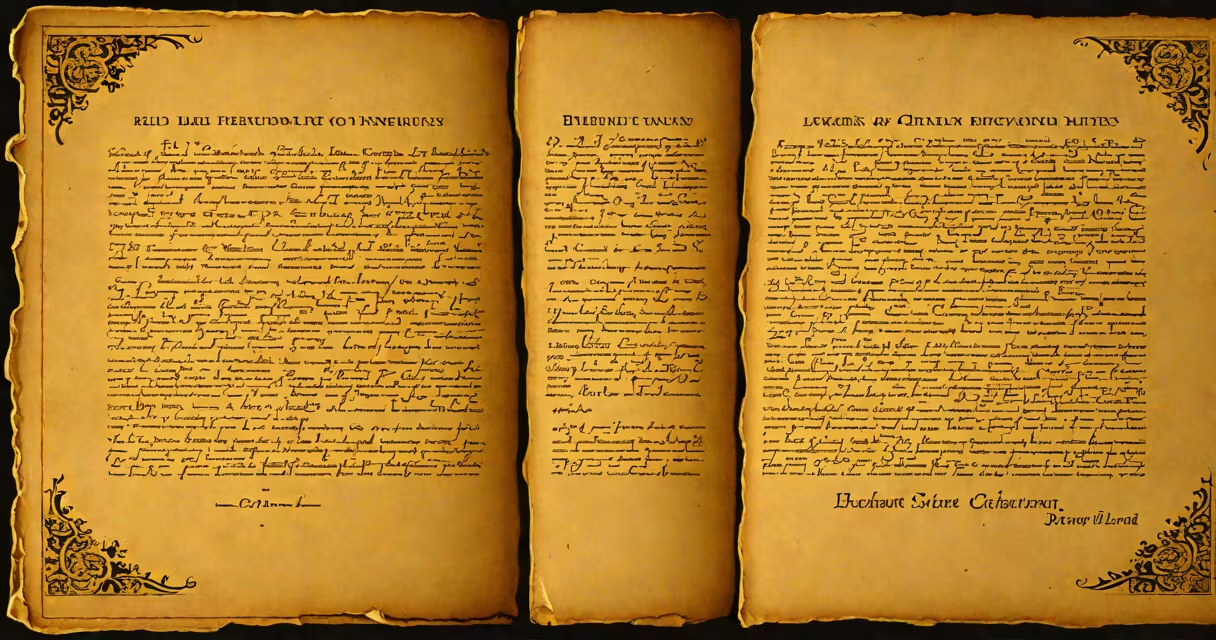
The text of the Bill of Rights consists of the first ten amendments to the United States Constitution, ratified in 1791. These amendments define core individual liberties and limit government power over citizens.
These amendments were drafted in response to concerns that the original Constitution did not sufficiently protect personal freedoms. James Madison introduced them in Congress in 1789, and they were approved by the states by December 15, 1791. The language is precise, rooted in legal tradition, and designed to be enforceable through courts.
Each amendment addresses a specific area of protection: freedom of expression, religious practice, fair trial procedures, and limits on military authority. They form the foundation of American civil rights and have been cited in thousands of court rulings since their adoption.
The text operates as a legal constraint on federal power. When a law or government action infringes on a right listed in the Bill of Rights, individuals can challenge it in court. Courts interpret the wording using historical context, precedent, and legislative intent.
For example, the First Amendment's protection of free speech has been applied to protests, political advertising, and even symbolic acts like flag burning. The Supreme Court ruled in Texas v. Johnson (1989) that burning the American flag is protected speech under the First Amendment, citing the principle that government cannot suppress expression simply because it finds it offensive.
Amendments are not absolute. The Supreme Court has consistently upheld that rights may be limited when necessary to serve a compelling government interest. In Schenck v. United States (1919), Justice Oliver Wendell Holmes Jr. established the "clear and present danger" test, allowing restrictions on speech that poses immediate threats to national security.
The text is written in formal legal English, based on British common law traditions and Enlightenment philosophy. It uses clear, declarative language without metaphor or emotional appeal. Each amendment begins with a capital letter and ends with a period, following standard legislative syntax.
There are ten amendments. They are numbered sequentially but do not appear in chronological order within the Constitution. The original draft had twelve proposed amendments; two were rejected-one related to congressional pay, the other to representation. The remaining ten became the Bill of Rights.
| Amendment | Key Right Protected | Common Misconception |
|---|---|---|
| 1 | Freedom of speech, religion, press, assembly, petition | Applies only to federal government (not state laws until later incorporation) |
| 2 | Right to keep and bear arms | Interpreted differently in modern gun policy debates |
| 3 | No quartering of soldiers in private homes | Often misunderstood as a privacy right, but it was about wartime military control |
| 4 | Protection against unreasonable searches and seizures | Does not ban all searches-only those without warrants or probable cause |
| 5 | Due process, double jeopardy, self-incrimination | "I plead the Fifth" applies only to criminal cases, not civil matters |
A non-obvious fact: the Third Amendment was rarely invoked in court until the 20th century. It was not cited in a major Supreme Court decision until 1952, when the Court reviewed a case involving military housing near a civilian airport. The ruling emphasized that the amendment protects property rights during peacetime, not just wartime.
The text is used daily in federal and state courts, law enforcement procedures, and public policy debates. It appears in textbooks, school curricula, and citizenship exams. The Pledge of Allegiance references "liberty and justice for all," a concept grounded in the Bill of Rights.
Law enforcement agencies train officers on Fourth Amendment standards. Police must obtain search warrants or establish exceptions like exigent circumstances before entering a home. Failure to follow these rules can result in evidence being excluded under the exclusionary rule, established in Mapp v. Ohio (1961).
During the 2020 protests following George Floyd's death, activists cited the First and Fourth Amendments to challenge police conduct. Legal challenges focused on excessive force and unlawful detentions, arguing violations of constitutional protections against unreasonable seizure and the right to peaceful assembly.
It is often mistaken for a list of "rights" granted by the government. In reality, the amendments assert that certain freedoms exist independently of government permission. The Founders believed these rights were natural and pre-existing, not bestowed by legislation.
Another confusion arises between the Bill of Rights and the Declaration of Independence. The Declaration announces principles like "all men are created equal." The Bill of Rights operationalizes those ideals into enforceable legal protections. One sets moral direction; the other creates legal mechanisms.
The text of the Bill of Rights is also sometimes conflated with the airline bill of rights-a separate set of consumer protections enacted in 1990. That document guarantees compensation for flight delays, denied boarding, and lost baggage. It is unrelated to constitutional law and does not carry the same legal weight.
I once attended a high school civics class where students debated whether social media posts violated the First Amendment. A student argued that posting hate speech online should be illegal. The teacher clarified that while the government can't punish speech based on content, it can regulate time, place, and manner. The classroom discussion reinforced that the text of the Bill of Rights is not a blanket license to say anything anywhere-it defines boundaries, not unlimited freedom.
The text of the Bill of Rights remains central to American governance. Its language, though centuries old, continues to shape legal interpretation and civic life. Courts still rely on the original wording to resolve disputes over privacy, speech, and justice. Understanding the actual text-rather than summaries or slogans-is essential for informed participation in democracy.