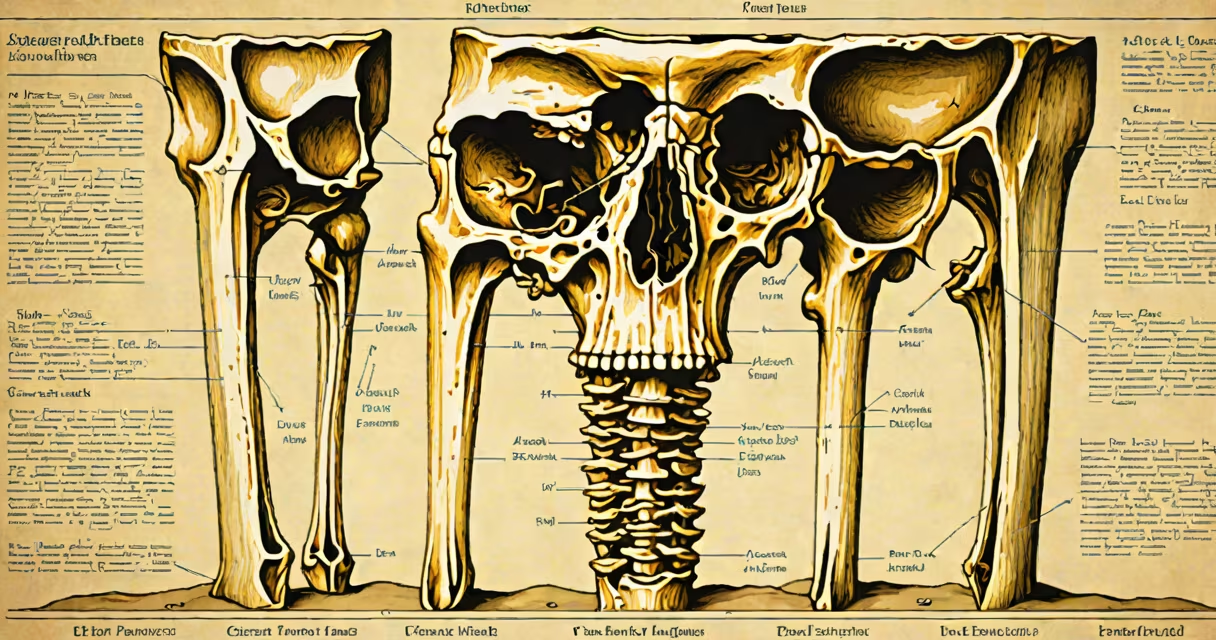
The human skeleton contains five distinct types of skeletal bones: long, short, flat, irregular, and sesamoid. Each type serves a specific mechanical or protective role based on its shape and location.
Long bones are cylindrical and elongated, designed for use and support. They include the femur, humerus, and metacarpals. These bones have a shaft (diaphysis) and expanded ends (epiphyses) filled with spongy bone and red marrow. The femur, for example, is the longest bone in the body at about 48 cm in adults and bears most of the weight during walking and running.
Short bones are roughly cube-shaped and provide stability with limited motion. Examples include the carpals in the wrist and tarsals in the ankle. These bones allow fine adjustments in joint position, such as when gripping or balancing on uneven ground. The scaphoid bone in the wrist, for instance, contributes to the complex motion of hand rotation.
Flat bones form broad surfaces for muscle attachment and protect internal organs. The sternum, ribs, and parts of the skull fall into this category. The frontal bone of the skull shields the brain, while the sternum acts as a central anchor for the rib cage. These bones contain diploë-a layer of spongy bone between two outer layers of compact bone-that reduces weight without sacrificing strength.
| Type | Shape | Examples | Primary Function |
|---|---|---|---|
| Long | Longer than wide, with shaft and rounded ends | Femur, humerus, phalanges | Use, weight-bearing, movement |
| Short | Cube-like, equal dimensions | Scaphoid, lunate, cuboid | Stability, controlled motion |
| Flat | Broad, thin plates | Sternum, scapula, cranial bones | Protection, muscle attachment |
| Irregular | Complex shapes, no standard form | Vertebrae, facial bones | Support, structural integration |
| Sesamoid | Small, round, embedded in tendons | Patella, some hand/foot bones | Reduce friction, improve mechanical advantage |
Irregular bones have complex, asymmetrical shapes suited to specialized roles. Vertebrae, for example, interlock to form the spinal column and absorb shock during movement. The mandible (lower jaw) supports teeth and enables chewing. These bones often feature multiple processes, facets, and foramina that accommodate nerves and blood vessels.
Sesamoid bones are small, round bones formed within tendons. The patella, or kneecap, is the largest sesamoid bone and sits within the quadriceps tendon. It increases the mechanical advantage of the knee extensor muscles by changing the angle of pull. Without the patella, knee extension would require more force. Other sesamoids appear in the hands and feet, particularly under pressure points during locomotion.
A common misconception is that all bones grow uniformly. In reality, bone growth follows precise patterns governed by epiphyseal plates-cartilage zones at the ends of long bones. These plates close around age 18 in females and 21 in males, ending longitudinal growth. This timing explains why adult height varies by sex and genetics.
During my time assisting in orthopedic clinics, I observed a patient with a fractured tibia-a long bone-requiring surgical stabilization. The surgeon emphasized that the fracture pattern depended on whether the injury occurred near the diaphysis or the metaphysis. This distinction matters because the blood supply differs in each region, affecting healing speed and treatment options.
Another key insight: bone shape correlates directly with function. A long bone's design maximizes force transmission; a flat bone's surface area allows for broad muscle attachment. This principle is documented in Gray's Anatomy (41st edition), which states that "the form of a bone is adapted to its function." Similarly, the National Institutes of Health notes that sesamoid bones evolve independently in species with high locomotor demands, indicating functional adaptation across mammals.
Understanding the types of skeletal bones clarifies how structure supports movement, protection, and metabolic activity. For example, the humerus-classified as a long bone-transmits forces from the shoulder to the forearm. Its hollow shaft resists bending under load, while the rounded head articulates with the scapula to enable many arm motion.
For deeper exploration of bone anatomy, explore the full range of skeletal bones and their roles in the body's structure. To compare how different materials affect biological systems, learn about pollution types and their impact on living tissues.