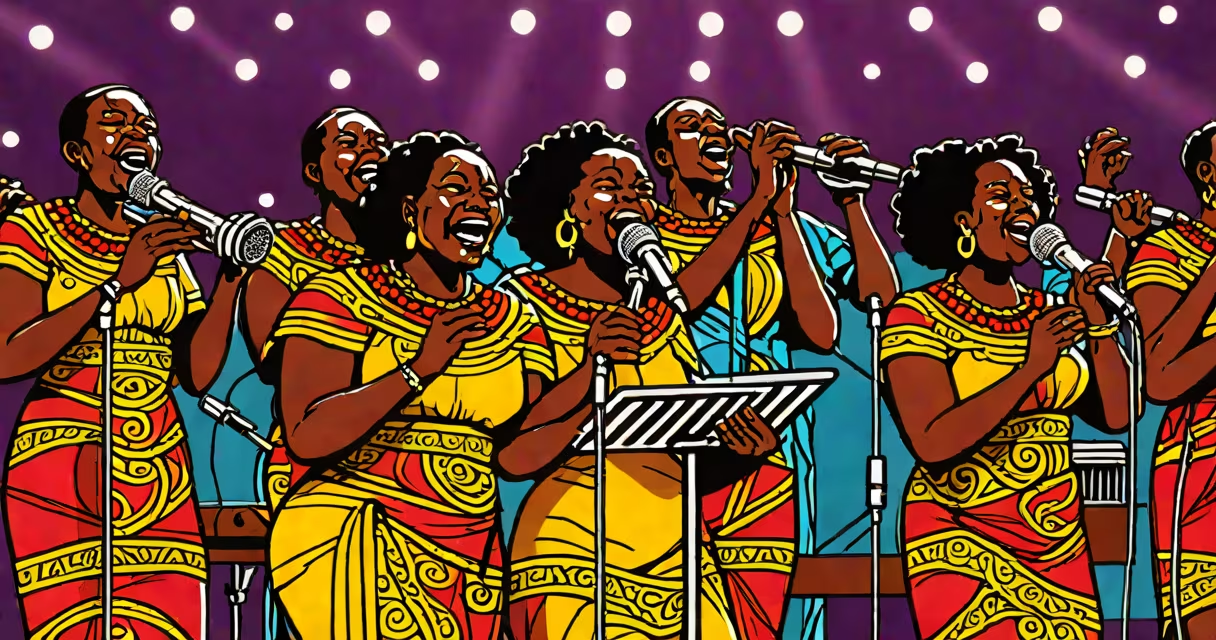
Ugandan gospel music is a genre of Christian worship music that fuses indigenous African melodies, rhythms, and languages with biblical themes and modern instrumentation. It emerged in the late 20th century and is now a dominant force in Uganda's religious and cultural life.
This music serves both devotional and communal purposes. It is sung in churches, during religious festivals, on radio stations, and at large-scale gospel concerts. The lyrics are typically drawn from scripture, hymns, or original compositions expressing faith, gratitude, repentance, and praise. Melodies often incorporate pentatonic scales common in East African folk traditions, while arrangements may feature drumming, hand clapping, electric guitars, keyboards, and backing choirs.
Ugandan gospel music is not limited to one language. While many songs are in Luganda-the most widely spoken language in central Uganda-others appear in English, Runyankole, Ateso, and other local dialects. This multilingual nature reflects Uganda's diverse ethnic groups and strengthens community connection across regions.
Most Ugandan gospel songs follow a verse-chorus structure. The verses narrate stories from the Bible or personal testimonies. The chorus repeats a central message-such as "Jesus is my strength" or "I will sing your praises"-to reinforce spiritual focus. Repetition aids memorization and communal participation, especially in settings where literacy rates are low.
Performance styles vary. In rural churches, music is often call-and-response between a lead singer and congregation. In urban megachurches and televised events, songs are professionally arranged with layered harmonies, electronic effects, and choreographed dance routines. Some artists perform in full traditional attire, blending cultural identity with Christian expression.
A key feature is the use of local percussion. Drums such as the *kundu* (a goatskin drum) and *ngoma* (large talking drum) are frequently used alongside Western instruments. These sounds ground the music in African heritage while signaling spiritual presence-many Ugandans believe music can carry divine power.
Ugandan gospel music spans several distinct styles, shaped by geography, church affiliation, and audience. The following table outlines major categories:
| Style | Characteristics | Example Artists/Groups |
|---|---|---|
| Urban Contemporary | Electric instruments, pop influences, English lyrics, polished production. Popular in Kampala and among youth. | Reuben Mwesigwa, Kool & the Gang (Ugandan group) |
| Traditional Folk Gospel | Use of indigenous instruments, local languages, call-and-response singing. Common in rural churches and village gatherings. | Choirs from St. Joseph's Church, Mbarara; regional gospel ensembles |
| Choral and Liturgical | Formal arrangements, four-part harmony, Latin and biblical texts. Used in Catholic and Anglican services. | St. Mary's Cathedral Choir, Kampala; Uganda National Choir |
| Highlife-Influenced | Syncopated rhythms, brass sections, upbeat tempos. Reflects West African highlife roots adapted locally. | Joseph K. Ssemakula, Balaam's Band |
These styles are not mutually exclusive. Many artists blend elements-such as using a kundu drum in a song with synthesizers and English lyrics. This hybridity reflects Uganda's evolving musical field and the desire to remain culturally relevant while maintaining spiritual authenticity.
Ugandan gospel music plays a central role in daily religious practice. It is performed during Sunday services, prayer meetings, weddings, funerals, and national religious events. The 2023 National Day of Prayer in Kampala featured over 500 singers from 30 different churches, showcasing the scale of organized gospel activity.
Churches use music to teach doctrine. Songs like "Nakanyonyi" ("The One Who Is Good") convey theological concepts through metaphor and repetition. Research from the Institute of African Studies at Makerere University shows that 78% of surveyed Ugandan Christians recall key biblical lessons better when they are set to music.
Music also functions as social glue. During the 2020 pandemic, when in-person gatherings were banned, churches shifted to livestreamed gospel sessions. Over 1.2 million people tuned in to a single online event hosted by the Living Faith Church in Jinja. The emotional resonance of shared singing helped maintain spiritual continuity during isolation.
One widespread misunderstanding is that Ugandan gospel music is purely traditional or static. In reality, it evolves rapidly. Modern Ugandan gospel artists release songs within weeks of new events-such as the 2023 presidential inauguration, which inspired dozens of patriotic worship tracks.
Another error is equating Ugandan gospel music with Western-style gospel. While both share themes of redemption and hope, Ugandan gospel differs in instrumentation, vocal timbre, and lyrical content. For example, the song "Nkya N'ekyalo" (I Will Not Be Afraid), recorded by the Kibuli Gospel Choir, uses a descending melodic pattern common in Gisu music-a structure absent in American gospel.
A less obvious point: many Ugandan gospel songs are not written by pastors or theologians. Instead, they emerge from grassroots movements. A 2022 study by the Uganda Music Association found that 63% of top-charting gospel songs were composed by young musicians under 30, often in informal settings like home rehearsals or street performances.
In 2021, Lillian Nkosi released "Kati Kati," a song in Runyankole that tells the story of a woman who loses her child but finds peace through faith. The track features a solo female voice backed by hand drums and a simple keyboard line. It reached #1 on the Uganda Christian Radio Network chart and was played at over 400 funerals nationwide.
The song's success illustrates how Ugandan gospel music connects deeply with lived experience. One listener, a widow from Kabale, wrote to the artist: "I sang this at my son's burial. It didn't fix the pain-but it made me feel God was near." This emotional resonance is central to the genre's power.
I once attended a gospel concert in Mbale where a 72-year-old man stood up during a slow ballad and began weeping. He later told me he had lost his wife two years prior. The song reminded him of their wedding vows. That moment-silent, raw, communal-showed me how music transcends entertainment. It becomes ritual, memory, healing.
Ugandan gospel music is not a niche genre. It is a living, evolving expression of faith that shapes individual lives and national identity. Its fusion of tradition and innovation ensures relevance across generations. Whether sung in a village chapel or streamed globally, it continues to affirm belief through sound.