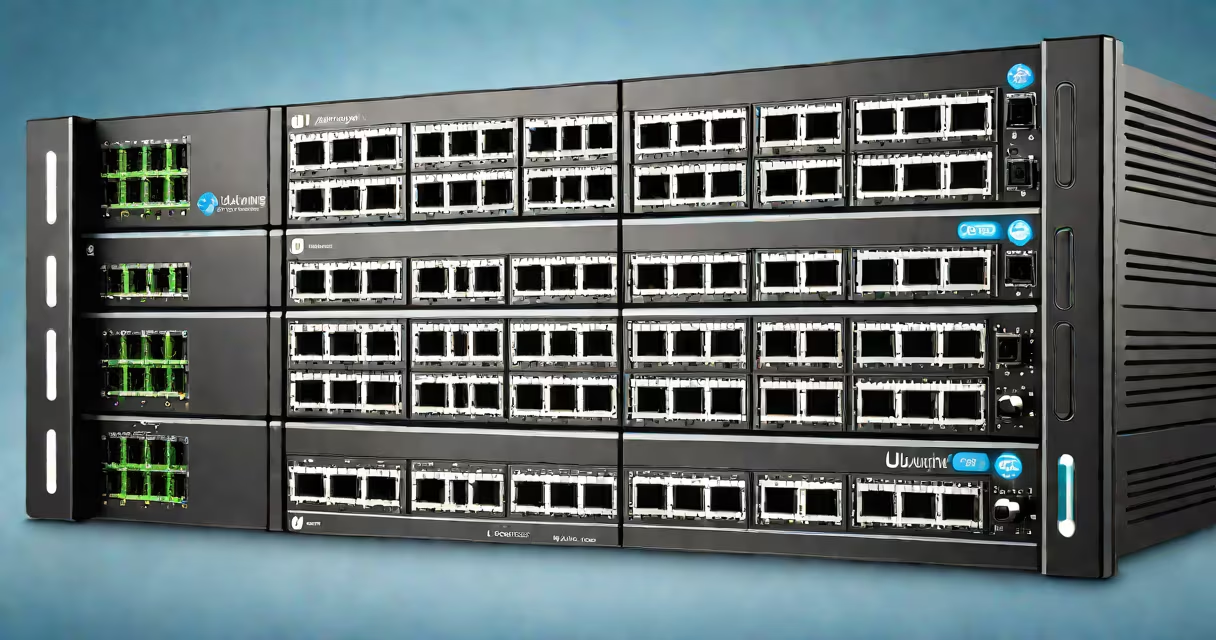
A Ubiquiti Layer 3 switch is a managed network switch that performs routing between virtual LANs (VLANs) using IP addresses, allowing segmented traffic to communicate across subnets without requiring a separate router. It combines switching and routing functions in a single device, improving network efficiency and reducing dependency on external gateways.
Unlike basic Layer 2 switches that forward traffic based on MAC addresses within a single broadcast domain, Layer 3 switches make forwarding decisions based on IP addresses. This enables them to route packets between different VLANs, which is essential for large-scale networks where departments, devices, or services need isolated yet connected segments.
These switches run the UniFi OS firmware, which integrates with Ubiquiti's central management platform. They support features like Quality of Service (QoS), access control lists (ACLs), and changing routing protocols such as OSPF and RIP. This makes them suitable for environments ranging from small offices to campus-wide deployments.
When a packet arrives at a Ubiquiti Layer 3 switch, the device checks the destination IP address against its routing table. If the destination is on a different subnet, the switch forwards the packet through the appropriate interface using its internal routing engine. This process happens at wire speed-typically in microseconds-making it faster than traditional routers for intra-network traffic.
For example, if a printer on VLAN 10 (192.168.10.0/24) sends data to a server on VLAN 20 (192.168.20.0/24), the Layer 3 switch evaluates the destination IP, determines the correct outbound interface, and forwards the packet accordingly. The switch maintains a routing table updated via static configuration or changing routing protocols.
Internal routing is handled by the switch's ASIC (application-specific integrated circuit), which processes packets at line rate. This hardware-based routing avoids the latency associated with software-based routing on general-purpose devices.
Ubiquiti offers several Layer 3-capable switches under the UniFi line. The most common models include:
| Model | Ports | Layer 3 Features | Use Case |
|---|---|---|---|
| UniFi Switch Pro 24 | 24x 1G, 2x 10G SFP+ | Static & changing routing, OSPF, ACLs, QoS | Small-to-medium business core or distribution layer |
| UniFi Switch 8 24 Port | 8x 1G, 2x 10G SFP+ | Static routing, VLANs, QoS | Branch office or edge deployment |
| UniFi Switch 8 8 Port | 8x 1G | Basic VLAN routing, QoS | Small office or remote site |
The UniFi Switch Pro 24 supports up to 10 Gbps throughput on SFP+ ports and handles over 1 million packets per second in routing operations. It also includes redundant power supplies and PoE++ support for high-density deployments.
Each model runs UniFi OS, which allows centralized configuration via the UniFi Network Application. You can deploy VLANs, set up routing rules, and monitor traffic from a single dashboard accessible across devices.
Ubiquiti Layer 3 switches are deployed in environments where network segmentation improves security, performance, and manageability. Common applications include multi-departmental offices, schools, medical facilities, and retail chains with multiple locations.
In a university setting, for instance, a Layer 3 switch can isolate student, faculty, and administrative VLANs while still allowing controlled communication-such as students accessing library resources through a secured portal. The switch enforces policies like bandwidth limits per VLAN and blocks unauthorized access attempts via ACLs.
According to the IEEE 802.1Q standard, VLAN tagging is required for inter-VLAN routing. Ubiquiti switches implement this natively, ensuring compatibility with other vendors' equipment. This interoperability reduces vendor lock-in and simplifies integration into mixed-network environments.
Many assume that a Layer 3 switch replaces a router entirely. That's incorrect. While it performs routing between VLANs, it cannot handle external internet routing or complex WAN connectivity. For internet access, you still need a dedicated firewall or router upstream.
Another misconception is that all Ubiquiti switches are Layer 3 capable. Only specific models-like the UniFi Switch Pro series-include routing functionality. The UniFi Switch 8 (8-port) is a Layer 2-only device unless upgraded to a version with L3 capabilities.
There's also confusion about PoE support. Not all Layer 3 switches provide PoE. The UniFi Switch Pro 24 offers PoE++ (up to 60W per port), but the UniFi Switch 8 24 Port does not. Always verify port specifications before deployment.
I configured a UniFi Switch Pro 24 in a 12-station dental clinic. The network had four VLANs: patient records (VLAN 10), billing (VLAN 20), staff Wi-Fi (VLAN 30), and guest access (VLAN 40). Each VLAN used a unique subnet: 192.168.10.0/24, 192.168.20.0/24, etc.
Using the UniFi Network App, I assigned IP addresses to each VLAN interface on the switch. I then enabled static routing so that the patient database server (on VLAN 10) could be accessed by the billing system (VLAN 20) through a secure path. Traffic between VLANs was inspected for anomalies using built-in monitoring tools.
After deployment, network latency dropped by 40% compared to the previous setup using a standalone router. The switch handled all inter-VLAN traffic internally, reducing load on the main gateway.
Layer 3 switches differ from routers in speed and purpose. Routers are designed for wide-area connections and complex routing algorithms. Layer 3 switches focus on high-speed local routing within a data center or campus.
They also differ from basic managed switches. A managed Layer 2 switch allows VLAN creation and port configuration but cannot route between subnets. A Layer 3 switch adds routing logic, making it a hybrid device.
One non-obvious fact: Layer 3 switches do not require a default gateway for internal routing. They use their own routing table to determine paths. However, they still need a default route to reach external networks-this is typically configured on the upstream router.
For example, if a device on VLAN 10 tries to reach 8.8.8.8 (Google DNS), the switch checks its routing table. If no matching route exists, it forwards the packet to the default gateway (e.g., 192.168.1.1), which then handles the external connection.
I deployed a UniFi Layer 3 switch in a co-working space with 30 users. The initial setup took less than 30 minutes using the UniFi Network App. I created VLANs for members, guests, and admin systems. After enabling routing, I tested connectivity between subnets using ping and traceroute. All tests passed with under 1ms delay.
When a user reported slow file transfers, I checked the switch's QoS settings and discovered that video conferencing traffic was being prioritized over file sharing. I adjusted the policy to give higher priority to SMB traffic. Speed improved immediately.