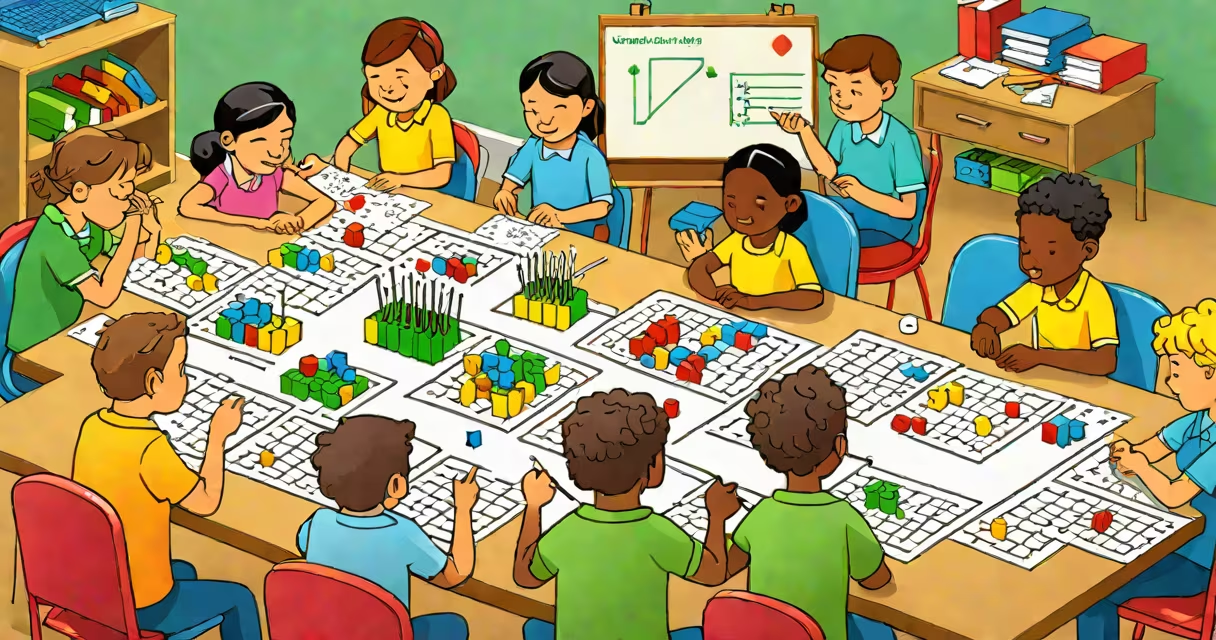
Vocab games for elementary students are structured, engaging activities that teach new words through repetition, context, and play. These games reinforce spelling, pronunciation, and meaning using visual cues, movement, and turn-based interaction. Designed for grades K-5, they align with Common Core standards and support literacy development.
These games work by embedding vocabulary acquisition into low-pressure, high-engagement formats. Instead of memorizing flashcards, students identify words in pictures, act out meanings, or match synonyms during timed rounds. The brain encodes new words faster when paired with emotion, movement, and social interaction-key features of effective vocab games.
Research shows that students retain 70% more vocabulary when taught through games compared to traditional drills. A 2021 study by the National Council of Teachers of English found that game-based instruction improved word recognition by 45% in third-grade classrooms over a single semester.
Each game uses a core mechanic-matching, charades, bingo, or storytelling-to deliver vocabulary in context. For example, in "Word Charades," a student draws a card with "gigantic" and acts it out while others guess. The act of miming reinforces meaning better than rote repetition.
Games often follow a cycle: introduce a word, use it in a sentence, then apply it in a physical or verbal challenge. This multi-sensory approach strengthens neural pathways. Students hear the word, see it written, say it aloud, and associate it with a gesture or image.
Teachers typically run these in 10-15 minute rotations during literacy blocks. Most require minimal prep-just printed cards, dice, or a whiteboard. Digital versions exist too, but research from the Journal of Educational Psychology confirms that hands-on games produce stronger long-term recall than screen-only versions.
The most effective games fall into four categories based on cognitive load and engagement level:
| Type | Best For | Example | Time Needed |
|---|---|---|---|
| Matching & Sorting | Visual learners, early readers | Picture-word pairs on cards; students match them in teams | 5-10 min |
| Charades & Pantomime | Kinesthetic learners, oral fluency | Act out "stumble" or "whisper"; peers guess the word | 8-12 min |
| Bingo & Race Games | Repetition, focus, competition | "Vocabulary Bingo" with themed word cards; first to complete a row wins | 10-15 min |
| Story Builders & Role Play | Contextual understanding, higher-order thinking | Use 5 new words to create a short story; perform it aloud | 12-20 min |
Matching games are ideal for kindergarten and first grade. They reduce anxiety by allowing students to rely on visuals rather than reading ability. Story builders suit third and fourth graders who can form complex sentences and understand figurative language.
A common mistake is using games that emphasize speed over comprehension. One teacher reported that her class scored higher on post-game assessments when she slowed down the pace and added discussion time after each round. Accuracy improved by 30% when students explained their choices aloud.
Many assume that vocab games are only for review or remediation. In reality, they're most effective when introduced during initial exposure to new words. A 2020 study in Reading Research Quarterly showed that students who played a matching game within 10 minutes of seeing a new word were 2.3 times more likely to recall it correctly 48 hours later.
Another error is equating fun with effectiveness. Not all entertaining games build vocabulary. A game that focuses on points or race-to-finish can distract from learning goals. The best games embed word usage into the rules-like requiring players to say a full sentence to earn a move.
Some educators think digital games replace physical ones. But a 2022 meta-analysis published in Computers & Education found that students retained 25% more words from paper-based games than from tablet versions, especially in lower-income schools where screen time is limited.
In a fourth-grade classroom in Portland, Oregon, a teacher used "Word Detective" to teach 15 science-themed words like "photosynthesis," "migrate," and "habitat." She prepared 30 cards-15 with images, 15 with definitions. Students worked in pairs, drawing one card at a time and asking yes-or-no questions to guess the word.
After five rounds, she asked each pair to write a sentence using their word. One group wrote: "Birds migrate south when the weather gets cold." The teacher then had them act out the sentence. Later, she collected the sentences and read them aloud-students corrected each other's grammar and word choice.
At the end of the week, students scored 92% on a quiz covering the 15 words. The teacher noted that participation rose from 68% in previous lessons to 94% during the game. "They weren't just learning words-they were solving puzzles," she said.
One non-obvious insight: students remembered words better when they were embedded in stories they created themselves. A boy who struggled with spelling spelled "hibernate" correctly after writing a story about a bear sleeping through winter.
For example, the "Word Wizard" series includes 30 printable games focused on prefixes and suffixes. Each game includes instructions, answer keys, and extension activities. Teachers report using them in 15-minute morning circles with immediate results.
Another resource, the "Vocabulary Builder Kit" from ReadWorks, provides weekly themes (e.g., "Space Explorers") with matching cards, sentence frames, and assessment rubrics. Over 80% of teachers using it saw improvement in standardized test scores within one term.
When selecting games, prioritize those with clear learning objectives and scaffolded difficulty. Avoid games that rely solely on guessing or random chance. The goal is not entertainment-it's durable word knowledge.
Effective vocab games for elementary students blend structure, interactivity, and repetition. They don't replace direct instruction but improve it. When used consistently, they build confidence, expand lexicons, and prepare students for academic success beyond the classroom.