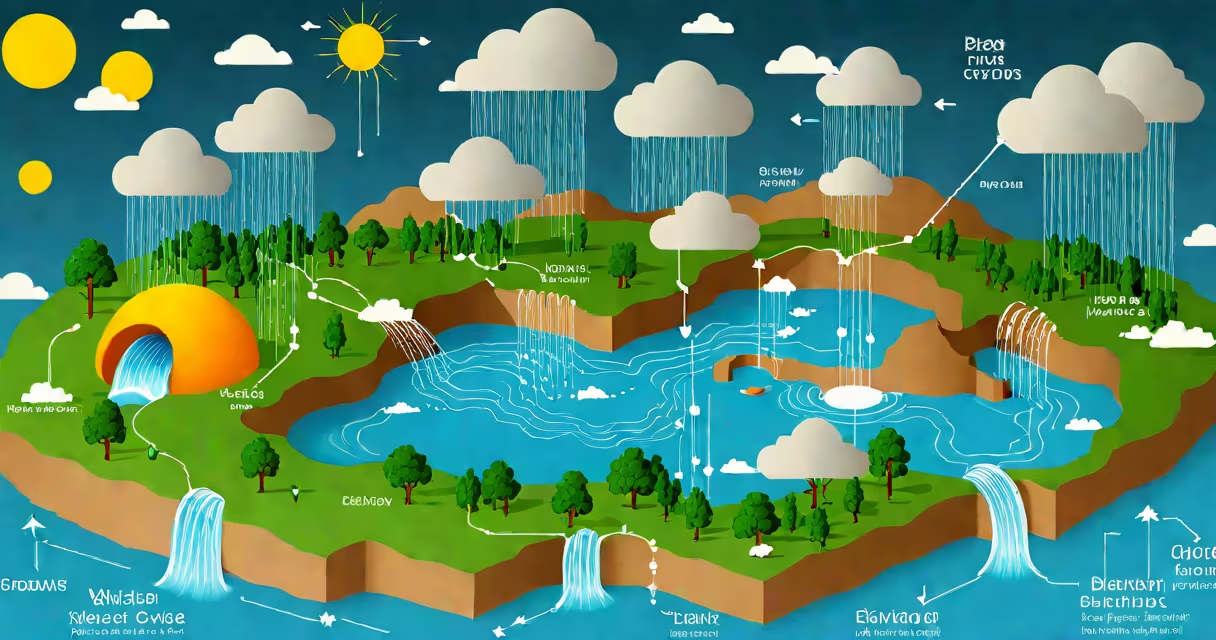
The water cycle for class 6 is a continuous process where water evaporates from Earth's surface, rises, cools, condenses into clouds, and returns as precipitation. It includes evaporation, condensation, precipitation, and collection. This natural movement ensures fresh water is constantly recycled across land, oceans, and atmosphere.
Water begins its process when sunlight heats liquid water from oceans, lakes, rivers, and even soil. The heat energy turns water into invisible vapor-this is evaporation. For every 1°C rise in temperature, evaporation rates increase by about 7%. A single square meter of ocean surface can lose up to 1.5 liters of water per day through evaporation under direct sunlight.
As warm, moist air rises, it cools. When air reaches its dew point-typically around 10-15°C-the water vapor condenses into tiny droplets around dust particles. These droplets cluster into visible clouds. A single cumulus cloud can hold up to 1 million tons of water, though most of it remains suspended in the air until gravity pulls it down.
When droplets grow too heavy, they fall as precipitation-rain, snow, sleet, or hail. Rain occurs when temperatures remain above freezing. Snow forms when air temperatures drop below 0°C. In mountainous regions, such as the Himalayas, snowpacks store water for months before melting into rivers during spring. Precipitation replenishes freshwater sources and feeds ecosystems.
After falling, water collects in bodies like rivers, lakes, and oceans. Some seeps into the ground-this is infiltration. Water travels through soil and rock layers, eventually joining underground aquifers. In India, the Ganges River basin receives over 1,000 mm of annual rainfall, much of which flows into groundwater reserves used by millions.
| Stage | Process | Real-World Example |
|---|---|---|
| Evaporation | Water turns to vapor due to heat | Steam rising from a hot bath |
| Condensation | Vapor cools and becomes liquid droplets | Fog on a cold window |
| Precipitation | Droplets fall as rain or snow | Monsoon rains in Mumbai |
| Collection | Water gathers in oceans, rivers, or soil | Rainwater filling a puddle after a storm |
Students often confuse evaporation with boiling. Boiling happens at a specific temperature (100°C at sea level) and involves rapid bubble formation. Evaporation occurs slowly at any temperature and only at the surface. A glass of water left out at room temperature will fully evaporate in about 10 days-no boiling required.
Another common mistake is thinking water only cycles between land and sky. In reality, water moves through living organisms too. Plants absorb water through roots and release it via leaves in a process called transpiration. Together, evaporation and transpiration make up evapotranspiration-a major part of the water cycle. In tropical forests, up to 90% of moisture returns to the atmosphere through plant leaves.
I once watched a classroom experiment where students placed a bowl of water under a clear plastic dome over a lamp. After 30 minutes, droplets formed on the inside of the dome-simulating cloud formation. The teacher then asked them to predict where the water would go next. One student said "back to the bowl." That was correct. The cycle had completed in miniature.
The water cycle for class 6 is not just a classroom concept-it shapes weather patterns, supports agriculture, and influences climate. Without it, Earth would have no fresh water. NASA estimates that the global water cycle moves about 500 trillion tons of water annually across the planet's surface and atmosphere.
Understanding the water cycle helps explain droughts, floods, and seasonal changes. During dry seasons, reduced evaporation leads to less cloud formation and lower rainfall. In contrast, high evaporation during summer increases storm frequency. The 2018 Kerala floods were partly caused by unusually high monsoon evaporation from the Arabian Sea.