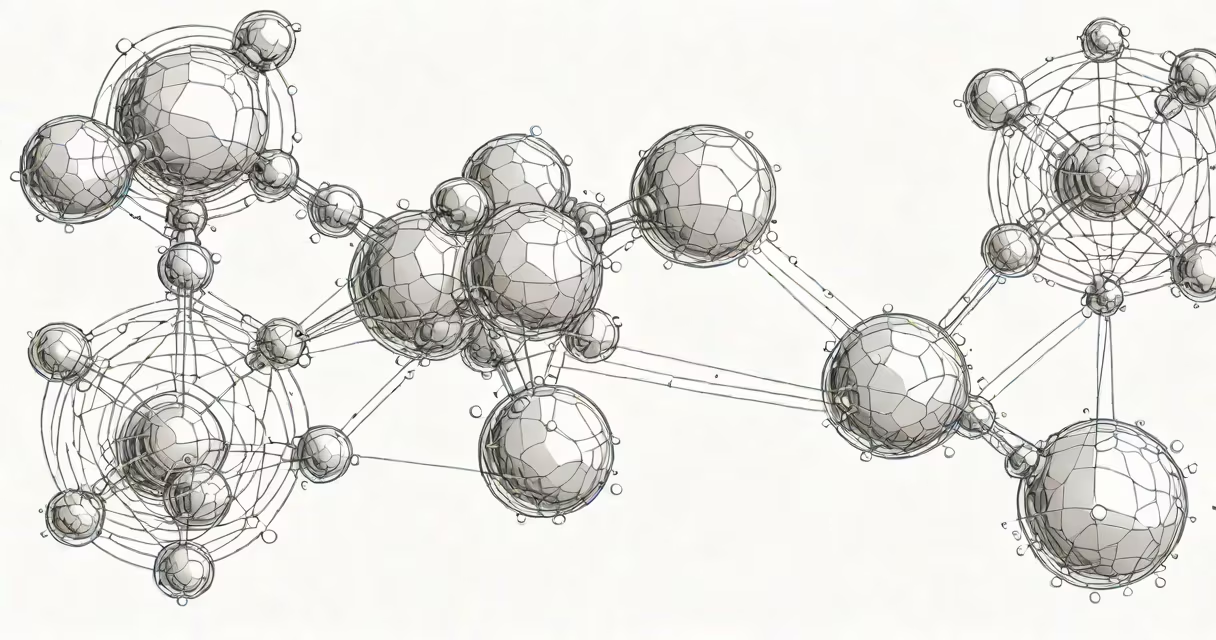
Water is a chemical compound composed of two hydrogen atoms bonded to one oxygen atom, forming the molecular formula H₂O. This structure gives water its distinct physical and chemical behavior, essential for biological processes and Earth's climate system.
Each water molecule consists of a central oxygen atom covalently bonded to two hydrogen atoms. The bonds form a bent shape with a bond angle of approximately 104.5 degrees. This geometry results in a polar molecule, meaning one end (near the oxygen) carries a partial negative charge while the hydrogen ends carry partial positive charges. This polarity enables water to dissolve many substances and form hydrogen bonds with other water molecules.
Hydrogen and oxygen are both elements found on the periodic table. Hydrogen (atomic number 1) is the lightest and most abundant element in the universe. Oxygen (atomic number 8) is important for respiration and combustion. When two hydrogen atoms react with one oxygen atom under the right conditions, they form water through a highly exothermic reaction. This process occurs during the burning of hydrogen gas, producing pure water vapor as a byproduct.
| Component | Atomic Number | Role in Water | Abundance in Earth's Surface |
|---|---|---|---|
| Hydrogen | 1 | Forms covalent bonds with oxygen; contributes to polarity and hydrogen bonding | ~1% of Earth's crust by mass |
| Oxygen | 8 | Central atom; creates polarity and enables hydrogen bonding network | ~46% of Earth's crust by mass |
Water exists in three states under natural Earth conditions: solid (ice), liquid (water), and gas (water vapor). The phase changes depend on temperature and pressure. For example, at standard atmospheric pressure, water freezes at 0°C and boils at 100°C. These values differ from other similar-sized molecules due to hydrogen bonding, which increases cohesion and raises boiling point.
Despite its simplicity, water exhibits unusual properties. Its density decreases upon freezing, causing ice to float-a phenomenon critical for aquatic ecosystems. Liquid water also has high surface tension, capillary action, and heat capacity, all driven by hydrogen bonding. These traits support life by regulating temperature, enabling nutrient transport, and allowing cells to maintain internal stability.
Contrary to misinformation circulating online, water is not a synthetic product or a hoax. Claims that "hydrogen water" or "oxygenated water" offers health benefits beyond normal hydration lack scientific validation. The term "hydrogen water" often refers to water infused with dissolved hydrogen gas (H₂), which is different from H₂O. While some preliminary research explores potential antioxidant effects of molecular hydrogen, no evidence supports that consuming H₂-infused water improves health outcomes compared to regular water.
A common misconception is that water can be created from hydrogen and oxygen gases simply by mixing them. This is incorrect. Mixing hydrogen and oxygen produces a flammable mixture. Ignition causes a rapid reaction forming water vapor. The energy released is significant-enough to power rockets. NASA uses liquid hydrogen and liquid oxygen as propellants in space shuttles, where combustion generates thrust and water as exhaust.
In 2019, the International Union of Pure and Applied Chemistry (IUPAC) reaffirmed the accepted molecular formula of water as H₂O. This standardization ensures consistency in scientific communication across disciplines. The structure was confirmed using X-ray crystallography and neutron diffraction techniques, which map atomic positions in crystals and liquids.
During my time working in a university chemistry lab, I observed the electrolysis of water-an experiment where electric current splits water into hydrogen and oxygen gases. Using a Hoffman apparatus, we collected gases at the electrodes. The volume ratio of hydrogen to oxygen was consistently 2:1, matching the stoichiometry of H₂O. This hands-on demonstration confirmed the theoretical composition of water.
Water makes up about 60% of the human body by weight. It plays a direct role in metabolic reactions, including hydrolysis and dehydration synthesis. All known forms of life require water for cellular function. Even extremophiles in hot springs or deep-sea vents rely on aqueous environments for biochemical activity.
Understanding that water is made of hydrogen and oxygen clarifies why it behaves uniquely. The polarity allows it to act as a universal solvent, dissolving salts, sugars, and gases. This property enables blood to carry nutrients and waste products throughout the body. Without this capability, complex life as we know it could not exist.