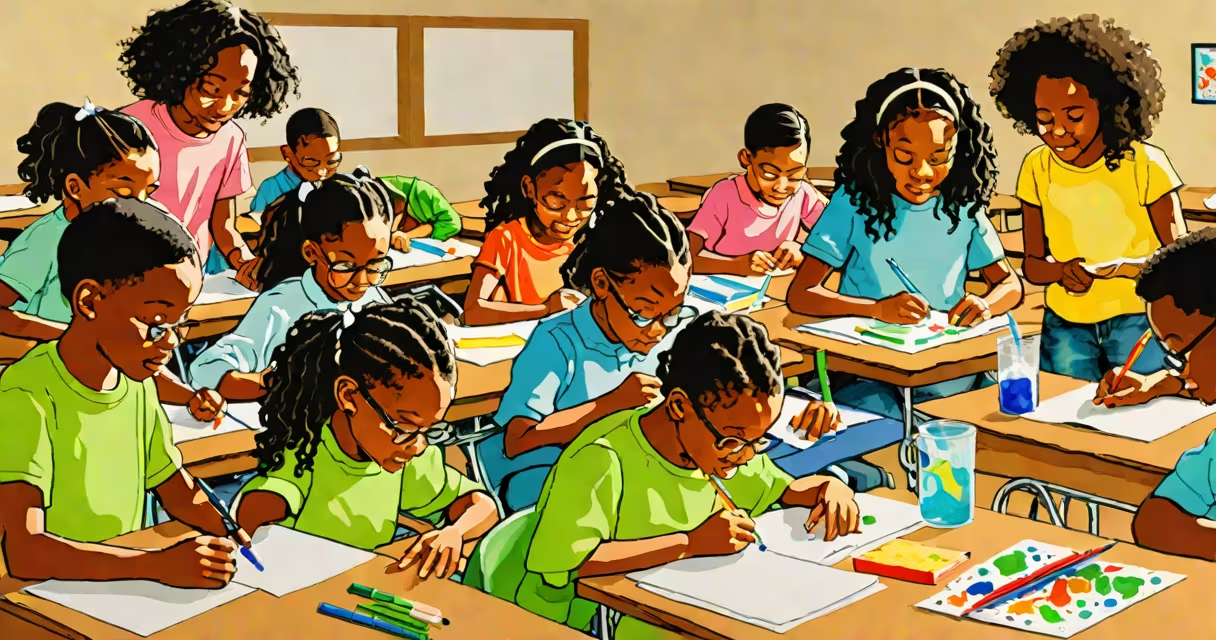
By the end of fourth grade, a student should confidently multiply multi-digit numbers, read and analyze fiction and nonfiction texts at grade level, and understand foundational scientific principles such as weather patterns and ecosystems. They should be able to write structured paragraphs with clear introductions, supporting details, and conclusions.
Fourth grade marks a key shift to reading to learn. Students encounter longer texts across subjects-science, social studies, and literature-requiring them to identify main ideas, summarize content, and cite evidence. A typical classroom assignment involves reading a 600-word passage about the water cycle and answering questions that ask them to explain cause-and-effect relationships between evaporation and precipitation.
Math instruction focuses on mastering multiplication and division of whole numbers up to 100, understanding fractions as parts of a whole, and solving word problems involving time, money, and measurement. Students begin using area models and arrays to visualize multiplication. For example, a problem might state: "A garden has 8 rows of tomato plants, with 12 plants in each row. How many plants are there?" The correct solution uses 8 × 12 = 96.
Fourth graders are expected to meet specific learning goals in math, language arts, science, and social studies. These expectations align with the Common Core State Standards and are validated by organizations like the National Council of Teachers of Mathematics (NCTM) and the International Literacy Association (ILA).
In math, students should be able to solve multi-step word problems using the four operations, compare fractions with different numerators and denominators, and classify two-dimensional shapes based on their properties. A student who can determine that 3/4 is greater than 2/5 because 3/4 equals 0.75 while 2/5 equals 0.40 demonstrates mastery of fraction comparison.
Reading proficiency is measured by the ability to read aloud with expression and accuracy, comprehend texts with complex plots, and make inferences. A fourth grader should be able to identify the theme of a story like *Charlotte's Web* and explain how the author develops it through character actions and dialogue.
| Subject | Key Skills | Example Task |
|---|---|---|
| Math | Multiply 2-digit numbers, compare fractions, find area | Solve: 24 × 15 = ? |
| Language Arts | Summarize nonfiction, write opinion essays | Write a 5-paragraph essay arguing whether schools should have uniforms. |
| Science | Understand weather systems, energy transfer, ecosystems | Explain how solar energy drives wind patterns. |
| Social Studies | Map U.S. states, describe colonial life, analyze historical documents | Read a primary source letter from a Revolutionary War soldier and summarize key points. |
Many assume fourth graders are still learning basic arithmetic. In reality, they are applying multiplication and division to real-world contexts. A student who solves 48 ÷ 6 = 8 is not just recalling a fact-they're using division to split 48 cookies among 6 friends equally.
Another misconception is that writing at this level is limited to simple sentences. Students are expected to write compound and complex sentences with coordinating and subordinating conjunctions. A correct sentence might be: "Although the rain fell heavily, we still went to the park because we had planned it for weeks."
Some parents believe that science in fourth grade is only about memorizing facts. However, the focus is on inquiry-based learning. Students conduct experiments, such as testing which materials conduct electricity, then record observations and draw conclusions based on data. This process builds scientific reasoning, not just recall.
I once observed a fourth-grade class in a suburban public school where students designed a model city using cardboard and craft supplies. Each group had to calculate the area of their streets and buildings, assign population density based on square footage, and present their city's transportation plan. One group used 12 × 15 cm blocks to represent city blocks and calculated that their city needed 480 meters of road to connect all zones.
This project integrated math, writing, and critical thinking. Students wrote descriptions of their city's layout, explained how traffic flow was managed, and defended design choices using data. The teacher assessed both content knowledge and collaboration skills, using rubrics aligned with state standards.
What a fourth grader should know differs from third grade expectations. Third graders focus on mastering single-digit multiplication and beginning to read chapter books. By contrast, fourth graders apply multiplication to larger numbers and read informational texts with multiple sections and diagrams.
For example, a third grader might solve 7 × 8 = 56. A fourth grader would solve 34 × 27 = 918, using the standard algorithm or partial products. They also begin using fractions in measurement-like measuring a ribbon as 3 1/2 feet long rather than just estimating.
By sixth grade, students are expected to work with decimals, ratios, and algebraic expressions. A sixth grader might solve: "If 3 apples cost $1.50, how much do 5 apples cost?" using proportions. What a fourth grader should know sets the foundation for these later skills.
These benchmarks are not arbitrary. Research from the National Assessment of Educational Progress (NAEP) shows that students who meet fourth-grade reading and math standards are more likely to graduate high school on time. The U.S. Department of Education reports that 72% of fourth graders who read at or above proficiency in 2022 were on track for college readiness by eighth grade.