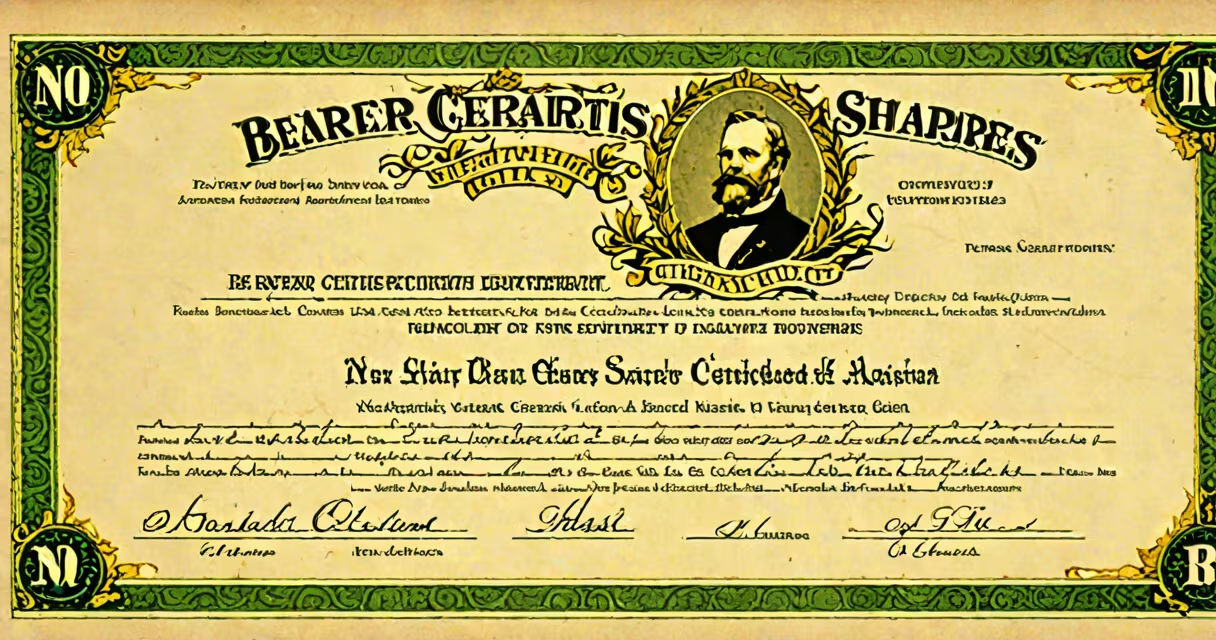
Bearer shares are physical stock certificates that transfer ownership simply by handing them over. The person holding the certificate owns the shares, regardless of who originally issued them. No registry tracks the shareholder's identity.
This structure makes bearer shares distinct from registered shares, which require official records of ownership. Bearer shares were historically used to enable anonymous investing, particularly in offshore jurisdictions. Today, their use is heavily restricted due to money laundering and tax evasion concerns.
Under U.S. law, bearer shares are generally prohibited for publicly traded companies. The Securities and Exchange Commission (SEC) defines them as securities that "entitle the holder to benefits without requiring registration." The IRS treats unregistered bearer shares as potentially taxable under strict reporting rules.
When a company issues bearer shares, it prints physical certificates with no identifying information about the owner. The certificate includes the number of shares, the company name, and a unique serial number. Ownership transfers when the certificate changes hands.
No intermediary, such as a brokerage or transfer agent, verifies the new owner. The new holder becomes the legal owner immediately upon possession. This differs from registered shares, where the transfer must be recorded in a central book-entry system.
For example, if someone receives a bearer share certificate for 100 shares of XYZ Corp, they can sell it to another party by physically delivering the document. The buyer gains full ownership rights without needing to notify the company or update any database.
Bearer shares exist in several forms, though most are now obsolete due to regulation:
| Type | Description | Use Cases |
|---|---|---|
| Physical Certificates | Printed documents with no name or registration. Often signed by the issuer. | Historical use in private equity, offshore trusts, and international investments. |
| Registered Bearer Instruments | Documents that appear bearer-like but have a hidden registry. Rare and largely phased out. | Used in some European private markets before 2010. |
| Digital Bearer Tokens | Blockchain-based representations of ownership that function like bearer shares. Not legally recognized as securities in most jurisdictions. | Experimental use in decentralized finance (DeFi), but not compliant with SEC rules. |
Only physical bearer certificates remain legally valid in limited circumstances. Digital equivalents do not meet the criteria for legal ownership under current U.S. securities law.
Bearer shares were once common in tax havens like Liechtenstein, the Cayman Islands, and Luxembourg. They enabled investors to hold assets anonymously, avoiding disclosure requirements in many countries.
The OECD estimates that between 2000 and 2010, over $1 trillion in global wealth was held through bearer share structures in offshore entities. These accounts were often used to shield income from taxation and evade financial oversight.
Since 2010, international pressure has led to the phase-out of bearer shares. The Financial Action Task Force (FATF) requires member states to prohibit bearer share issuance by 2025. As of 2023, 160 countries have adopted measures to eliminate bearer share systems.
In the United States, the Internal Revenue Code Section 6045 requires brokers to report all transactions involving securities. Bearer shares cannot be processed through standard brokerages because they lack traceable ownership records.
Bearer shares are often confused with registered shares, but the key difference lies in ownership verification. Registered shares require the investor's name and address to be on file with the issuing company. Bearer shares do not.
A frequent misunderstanding is that bearer shares are inherently illegal. That is false. They are still permitted in certain private corporations and trusts under specific conditions. For example, some family-owned businesses in Switzerland issue bearer shares for succession planning, but only with full compliance reporting.
Another misconception is that bearer shares are equivalent to cash. While both are transferable without formal registration, bearer shares represent partial ownership in a company, not currency. A $100 bearer share certificate does not equal $100 in value-it represents a claim on the company's assets and profits.
One non-obvious fact: Bearer shares can be lost or stolen with no recourse. Unlike registered shares, which can be replaced if damaged or misplaced, bearer shares have no recovery mechanism. If a certificate is destroyed or taken, the owner loses all rights. There is no central authority to verify ownership or issue replacements.
In 2015, a Swiss bank discovered a safe deposit box containing 12,000 bearer share certificates for a defunct textile company. The certificates had no names, addresses, or serial numbers. The bank attempted to identify owners through public records, but none existed.
After six months of investigation, the Swiss Federal Tax Administration ruled the shares forfeited due to lack of proven ownership. The company had dissolved in 1998, and no transfer records survived. The certificates were burned in a controlled disposal process.
This case illustrates the core risk of bearer shares: without a registry, ownership cannot be verified, even decades later. The absence of a clear owner creates legal ambiguity and prevents asset recovery.
Bearer shares differ from other share classes. Here's how they compare:
| Feature | Bearer Shares | Registered Shares | C-Shares |
|---|---|---|---|
| Ownership Record | None. Held by physical possession. | Kept in central registry. | Tracked electronically by fund provider. |
| Anonymity | Full. No public record of owner. | Public. Name and address on file. | Partial. Fund manager knows, but not public. |
| Transfer Process | Hand delivery. No paperwork required. | Brokerage transaction. Requires account access. | Automated. Done through fund platform. |
| Regulatory Status | Prohibited in most developed markets. | Standard for public companies. | Common in mutual funds; subject to sales loads. |
I once handled a client's estate transfer involving a legacy trust that included bearer shares from a private German firm. The executor had no way to confirm who owned the shares. After consulting a corporate attorney, we concluded that the shares were effectively worthless due to lack of traceability. The trust's assets were liquidated, and the proceeds distributed based on remaining documented holdings.
Bearer shares are physical securities that grant ownership to whoever possesses them. They offer anonymity but lack accountability. Due to widespread abuse in tax evasion and money laundering, their use is now banned or severely restricted in most countries.
While the concept remains valid in theory, practical application is nearly impossible under modern financial regulations. Investors should avoid bearer shares unless operating within a jurisdiction that permits them with full compliance. For most people, registered shares or electronic holdings provide safer, traceable alternatives.
Understanding what are bearer shares helps clarify why modern finance relies on transparent ownership systems. The shift away from bearer instruments reflects a broader move toward accountability in capital markets.