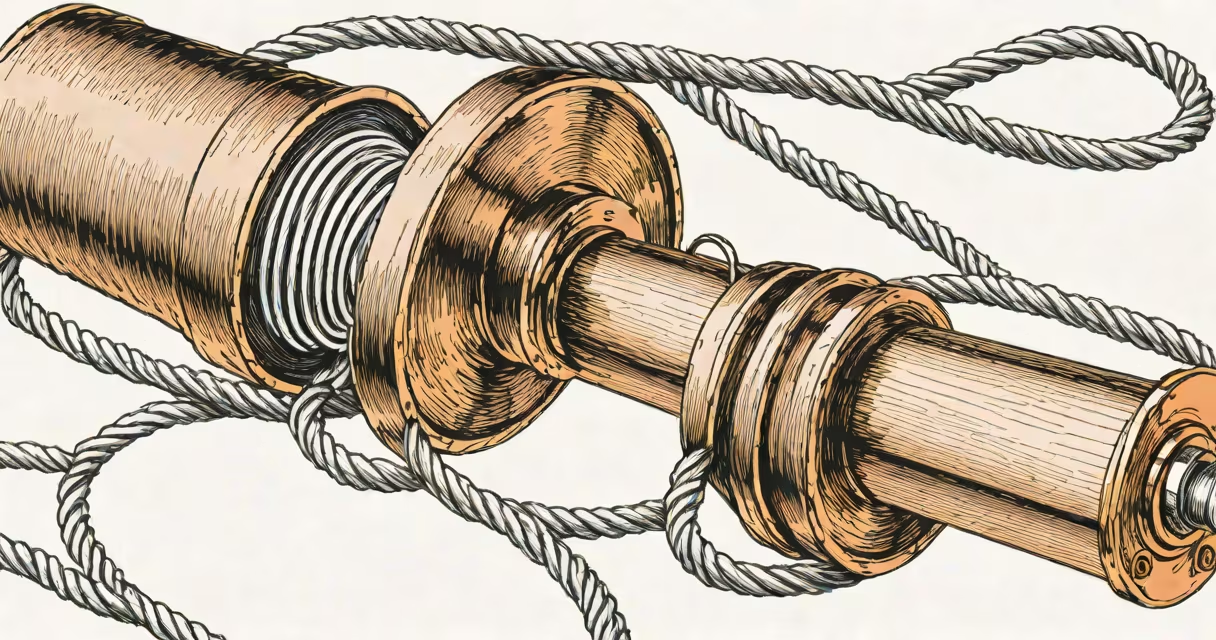
An electromagnet consists of a wire coil wrapped around a ferromagnetic core, powered by an electric current to produce a magnetic field. The strength and presence of the field depend on the current flow and core material.
The core function of an electromagnet lies in its ability to generate magnetism only when energized. This differs from permanent magnets, which maintain their field without external input. The key components are the coil, core, power source, and control mechanism.
When electric current flows through a wire, it generates a circular magnetic field around the conductor. Winding the wire into a coil concentrates this field along the coil's axis. The magnetic field lines align through the center of the coil, creating a strong, directional field.
Inserting a ferromagnetic core-typically iron or steel-into the coil amplifies the field. The core becomes magnetized as its internal domains align with the applied field. This increases the magnetic flux density by hundreds or thousands of times compared to air-core coils.
For example, a 10-turn coil with 1 amp of current produces about 1.25 mT of field strength in air. Adding a soft iron core increases that to approximately 1.25 T-over 1,000 times stronger. This principle enables industrial lifting magnets to hold tons of scrap metal.
The primary parts of an electromagnet are the coil, core, power supply, and switch. Each serves a distinct role in generating and controlling the magnetic field.
| Component | Function | Material Examples |
|---|---|---|
| Coil | Generates magnetic field when current passes through it | Copper wire, insulated enamel coating |
| Core | Amplifies and directs the magnetic field | Soft iron, silicon steel, ferrite |
| Power Source | Supplies continuous current to the coil | Battery, DC power supply, AC adapter |
| Switch | Controls on/off state of current flow | Mechanical toggle, relay, transistor |
Coils are typically wound with insulated copper wire due to its high conductivity and low resistance. A single layer of 20 AWG wire with 100 turns around a 2 cm diameter form creates a coil with ~1.5 ohms resistance. At 12 volts, this draws 8 amps, producing a field strength of roughly 1.8 Tesla near the core center.
Core materials are chosen based on permeability and saturation levels. Soft iron saturates at ~1.6 T and is ideal for applications requiring rapid switching. Silicon steel, used in transformers, reduces eddy current losses. Ferrite cores are common in high-frequency devices due to low conductivity and minimal energy loss.
Many assume that any wire carrying current becomes a magnet. That's incorrect. A straight wire produces a weak, circular field that doesn't concentrate in one direction. Only coiled configurations create usable directional fields.
Another misunderstanding is that the core itself becomes permanently magnetized. In reality, most electromagnets use soft magnetic materials that lose magnetization when current stops. Hard magnetic materials like neodymium would retain residual field, defeating the purpose of controllability.
A non-obvious fact: the number of turns in the coil affects both field strength and heat generation. Doubling the turns doubles the inductance and resistance. For a 12V system, doubling turns increases resistance from 0.75 Ω to 1.5 Ω. Current drops from 16 A to 8 A, reducing field strength despite more turns. This illustrates the trade-off between turns and current.
Electromagnets are used in MRI machines, relays, particle accelerators, and industrial cranes. In MRI systems, superconducting electromagnets generate fields up to 3 Tesla-strong enough to align hydrogen nuclei in the human body for imaging.
Relays use small electromagnets to control larger electrical circuits. A 5V coil with 100 turns and a laminated iron core can switch 240V AC at 10A. The switch closes when current flows, pulling a movable contact closed. This allows low-power signals to manage high-power loads safely.
I once built a small electromagnet using a 12V car battery, 500 turns of 22-gauge enameled copper wire, and a 1-inch iron rod. With 1.2 A current, it lifted 2.5 kg of steel washers. When disconnected, the load dropped instantly. This confirmed the direct relationship between current, coil design, and magnetic force.
Understanding the parts of an electromagnet is essential for designing efficient systems. Engineers must balance wire gauge, turn count, core material, and voltage to achieve desired performance without overheating or excessive power draw.