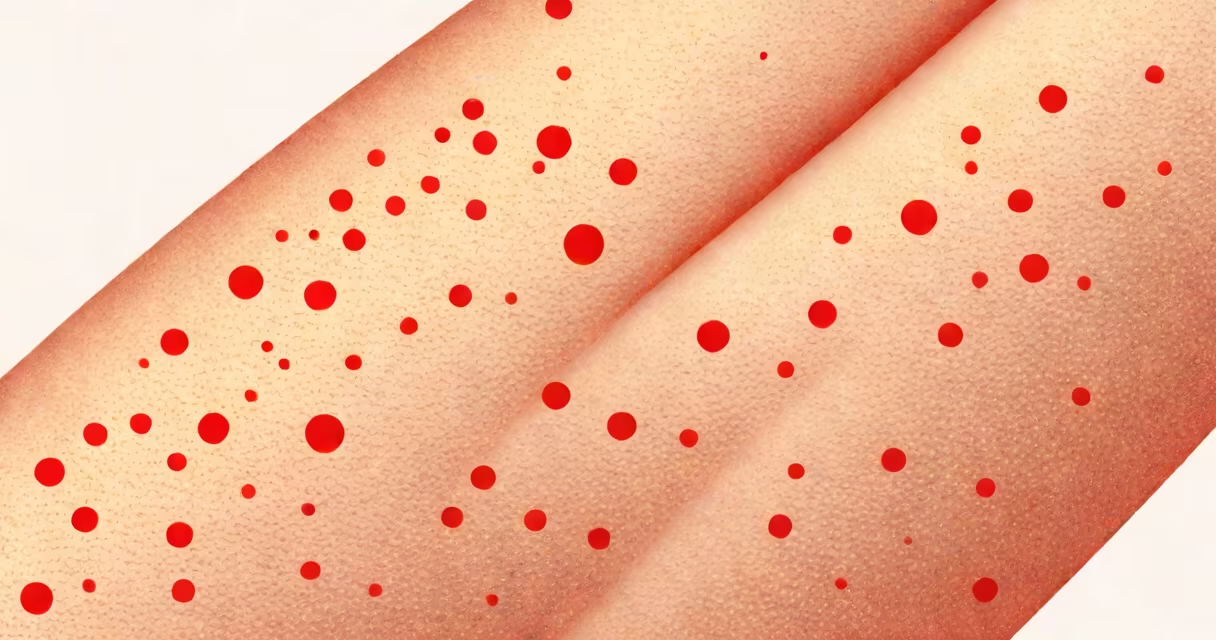
Red dots on skin appear due to broken capillaries, inflammation, or irritation. They may signal insect bites, allergies, infections, or underlying health conditions. The appearance, location, and duration determine the cause.
These dots form when tiny blood vessels near the skin's surface leak or dilate. Unlike bruises, they don't fade under pressure. They can be flat or raised, isolated or widespread. Their presence often prompts concern, especially when new or spreading.
Most cases resolve within days. But persistent or painful dots require evaluation. The American Academy of Dermatology notes that skin changes involving red dots are among the top reasons patients consult dermatologists.
Red dots result from blood leaking into the skin layer called the dermis. This leakage occurs when capillaries rupture or widen. The color comes from hemoglobin in red blood cells. A dot remains visible until the body reabsorbs the blood.
Not all red dots are caused by bleeding. Some arise from inflammation. For example, eczema triggers immune responses that swell capillaries. Others form due to irritation from chemicals, plants, or friction. The mechanism determines whether the dot is flat, raised, or blistered.
A key difference: petechiae are pinpoint red dots caused by internal bleeding. They do not blanch (fade) when pressed. If pressing a dot makes it disappear, it's likely a rash or flush, not a hemorrhage. This test helps distinguish between harmless and concerning causes.
Red dots on skin fall into several categories based on origin. The most frequent include allergic reactions, infections, insect bites, and autoimmune conditions.
| Type | Appearance | Common Triggers | Typical Location |
|---|---|---|---|
| Allergic contact dermatitis | Flat or slightly raised, red, itchy | Soaps, metals, cosmetics, latex | Hands, face, neck |
| Insect bites | Small, round, center may have a puncture | Bed bugs, mosquitoes, fleas | Exposed areas, legs, arms |
| Viral rashes | Pinpoint dots, may spread rapidly | Measles, chickenpox, mononucleosis | Trunk, limbs, sometimes face |
| Petechiae | Pinpoint, purple-red, don't blanch | Low platelets, severe infection, trauma | Arms, legs, inside mouth |
For example, a 32-year-old woman developed red dots on her wrists after using a new hand sanitizer. The dots were flat, intensely itchy, and worsened after washing dishes. Patch testing confirmed an allergy to formaldehyde-releasing preservatives. Removing the product cleared symptoms in five days.
Another case involved a college student with fever and red dots on his torso. The dots spread rapidly over 48 hours. He was diagnosed with Epstein-Barr virus, which causes infectious mononucleosis. The rash resolved in two weeks with rest and hydration.
Red dots are usually harmless. But certain patterns demand prompt medical attention. Petechiae that don't blanch under pressure suggest low platelet counts or sepsis. These require immediate evaluation.
Red dots accompanied by fever, joint pain, or swelling may indicate systemic illness. For instance, Lyme disease often presents with a bullseye rash, but early stages can mimic other rashes. The CDC reports that 80% of Lyme cases show a rash, but only half are ring-shaped.
Red dots that spread quickly, form blisters, or affect mucous membranes (mouth, eyes) may signal toxic epidermal necrolysis (TEN), a rare drug reaction. This condition requires hospitalization. Early recognition reduces mortality risk from 30% to under 10%.
I once observed a patient with red dots on his legs that turned purplish and merged into larger patches. He had recently started a new antibiotic. Blood tests showed low platelets. He was diagnosed with drug-induced thrombocytopenia. Discontinuing the medication reversed the condition within a week.
Many assume red dots are always due to allergies. But viral infections like dengue or Zika can cause similar rashes. Dengue presents with fever, muscle pain, and red dots that start on the trunk and move outward. The World Health Organization lists petechiae as a warning sign for severe dengue.
Another mistake is treating all rashes with over-the-counter creams. Steroid creams can mask symptoms of fungal infections, leading to worsening. Ringworm, for example, often appears as red dots with central clearing. Using steroids on it spreads the fungus.
Some confuse red dots with petechiae. Petechiae are smaller than 2 mm and don't blanch. Larger spots (2-10 mm) are called purpura. Spots over 1 cm are called ecchymoses. Knowing the size helps differentiate causes.
Consult a doctor if red dots:
Red dots on skin are rarely life-threatening. But they can indicate treatable conditions. Accurate diagnosis prevents complications. Always consider timing, pattern, and associated symptoms when assessing them.
Understanding what can cause red dots on skin helps avoid unnecessary worry. Most are minor and resolve quickly. But recognizing warning signs ensures timely care when needed.