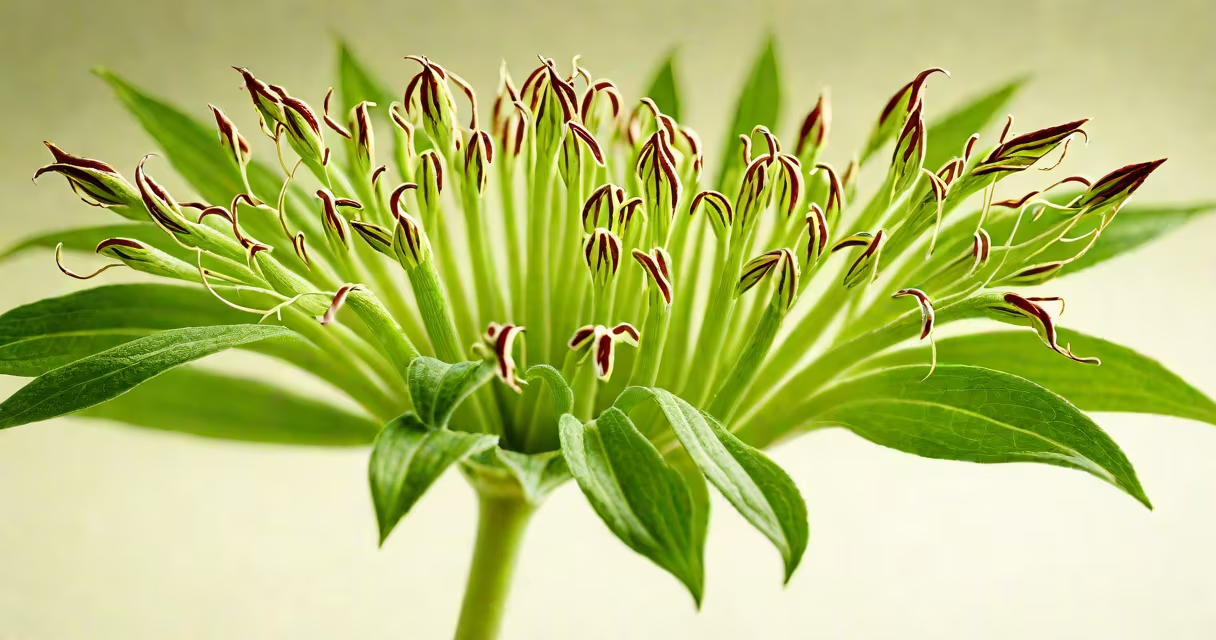
The stem is the central supportive structure of a flowering plant, anchoring the flower, transporting water and nutrients between roots and leaves, and enabling upright growth. It acts as a conduit and scaffold, integrating mechanical strength with internal transport systems.
Stems are composed of specialized tissues: epidermis for protection, cortex for storage, and vascular bundles containing xylem and phloem. Xylem moves water and minerals upward from roots, while phloem transports sugars produced during photosynthesis throughout the plant. This dual transport system ensures the flower receives hydration and energy needed for development and blooming.
Without a stem, flowers would collapse under their own weight, especially in tall species like sunflowers or lilies. The stem's rigidity comes from collenchyma and sclerenchyma cells-thick-walled cells that provide structural support. In herbaceous plants, stems remain soft and flexible; in woody species, lignin deposition hardens them over time.
Stems grow through cell division in apical meristems located at the tips. These undifferentiated cells produce new tissue, allowing the stem to lengthen and push the flower toward sunlight. This process, called primary growth, is essential for reaching optimal light conditions for photosynthesis and pollination.
Secondary growth occurs in woody plants, where lateral meristems (cambium and cork cambium) produce additional vascular tissue and protective bark. This thickening increases stability and resistance to environmental stress, such as wind or drought. A mature oak tree's stem can withstand high winds due to this layered reinforcement.
Flowers develop from modified stems called inflorescences. For example, in daisies, the flower head forms at the tip of a stem that bears small bracts. In tomatoes, the flower grows at the junction of stem and leaf (axil), supported by a short pedicel-a specialized stem segment. This shows that the stem's role extends beyond mere support-it shapes floral architecture.
Stems vary widely in form and function across plant species. The table below outlines key types and their biological roles:
| Type | Description | Example Plant | Function |
|---|---|---|---|
| Herbaceous | Soft, green, temporary growth | Pansy, basil | Supports annual flowers; dies after seed set |
| Woody | Hardened with lignin; long-lived | Oak, rose | Provides long-term structural support; withstands seasonal changes |
| Modified (tuber) | Underground stem with nodes and buds | Potato | Stores food; regenerates new plants |
| Modified (rhizome) | Horizontal underground stem | Ginger, iris | Spreads vegetatively; connects multiple plants |
Some stems, like those in cacti, perform photosynthesis themselves. These succulent stems replace leaves in arid environments, storing water and producing energy. This adaptation allows survival in deserts where soil moisture is scarce.
Many assume stems are passive structures. In reality, they actively regulate water flow via stomatal-like pores in the epidermis and control nutrient distribution based on hormonal signals. Auxin, a plant hormone, directs stem elongation and influences where flowers emerge.
A frequent error is confusing the stem with the peduncle-the stalk supporting a single flower. While both are stem-derived, the peduncle specifically connects the flower to the main stem. In tulips, the peduncle is the visible stem rising from the bulb; the base of the flower attaches to it. Confusing these parts leads to misidentification in botanical studies.
Another misconception is that all stems are rigid. Some, like those in ivy, are highly flexible and capable of climbing. Ivy uses modified stems called tendrils to grip surfaces, demonstrating that stem function includes mobility and environmental interaction, not just static support.
Consider the common sunflower (*Helianthus annuus*). Its stem reaches 2 meters in height and supports a large flower head weighing up to 1.5 kilograms. The stem contains dense vascular bundles arranged in a ring around the pith, maximizing water and nutrient delivery.
During rapid growth, the stem elongates at a rate of 10-15 cm per day. This speed relies on auxin-driven cell expansion and turgor pressure within parenchyma cells. When wind hits the plant, the stem bends slightly-thanks to flexible collenchyma tissue-then returns to upright position, preventing breakage.
After pollination, the stem redirects resources from leaf production to seed maturation. This shift is controlled by abscisic acid and ethylene, hormones that regulate senescence and resource allocation. The stem doesn't just hold the flower-it actively manages its life cycle.
I once observed a tomato plant in my garden whose stem was partially severed by a lawnmower. Within 48 hours, the plant began forming callus tissue at the wound site. New vascular connections regenerated, restoring water flow to the upper branches. The flower cluster survived and produced fruit, though smaller than normal.
This demonstrated that stems possess regenerative capacity. The plant redirected resources to heal the injury, proving that stems are changing, responsive organs-not inert supports.
While roots absorb water and anchor the plant, and leaves conduct photosynthesis, the stem integrates both functions. It transports water and flowers, and distributes sugars reproductive organs. This makes the stem a central hub in plant physiology.
For comparison, consider a daffodil. Its bulb stores energy, the leaves make food, and the stem lifts the flower above ground. Without the stem, the flower would remain buried and unable to attract pollinators. The stem's role is not auxiliary-it is essential to reproductive success.
According to the National Center for Biotechnology Information, vascular tissue accounts for 60-70% of stem volume in dicots. This highlights the dominance of transport systems in stem architecture., Plant Physiology journal notes that stem diameter correlates strongly with drought tolerance in grasses, emphasizing structural resilience.
Understanding what a stem does for a flower reveals a complex network of support, transport, and regulation. It is not merely a stick holding up a bloom-it is a living, adaptive system that sustains the entire plant's life cycle.