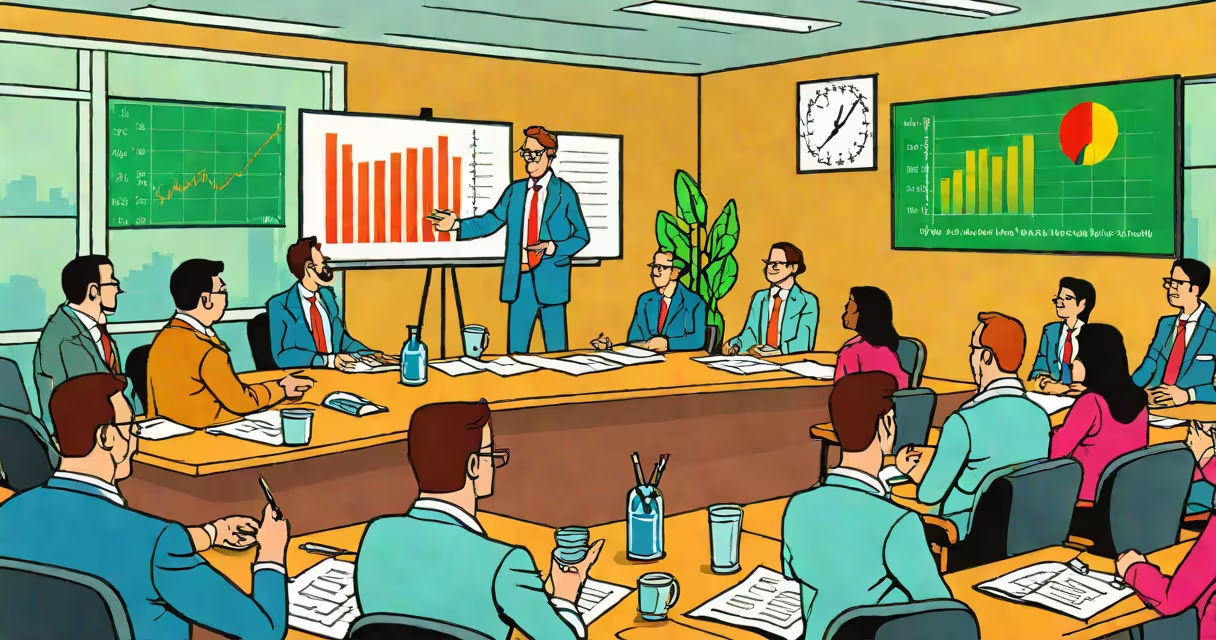
Economists study how people, organizations, and governments make choices about using limited resources. They collect and interpret data on spending, production, employment, prices, and trade to understand current conditions and forecast future outcomes.
These professionals work across sectors including government, central banks, universities, consulting firms, and international agencies. Their core task is to explain complex systems-like markets or national budgets-using models and statistics. They don't predict the future with certainty, but they assess probabilities based on historical patterns and real-time indicators.
For example, during the 2022 U.S. inflation surge, economists analyzed consumer price index (CPI) data, wage growth reports, and supply chain disruptions to determine whether rising prices were temporary or structural. Their findings informed Federal Reserve decisions on interest rate changes.
Economists begin by identifying a question-such as "Will raising the minimum wage reduce employment?"-then gather relevant data. They use statistical tools like regression analysis to isolate cause-and-effect relationships while controlling for other variables.
They build models that simulate how changes in one factor (e.g., tax rates) affect others (e.g., business investment). These models range from simple equations to complex computer simulations. The goal is not perfection but insight: showing plausible outcomes under different assumptions.
A key part of their job is testing hypotheses. For instance, when the U.S. government passed the 2021 American Rescue Plan, economists evaluated its projected impact on GDP growth and unemployment using input-output models and changing stochastic general equilibrium (DSGE) frameworks.
Economists specialize by focus area and workplace. The main categories include macroeconomists, microeconomists, labor economists, development economists, and financial economists.
| Type | Focus Area | Typical Employer | Example Task |
|---|---|---|---|
| Macroeconomist | National output, inflation, unemployment, fiscal/monetary policy | Federal Reserve, World Bank, Treasury Department | Forecasting GDP growth using leading indicators like manufacturing surveys |
| Microeconomist | Consumer behavior, firm pricing, market competition | Consulting firms, tech companies, antitrust divisions | Assessing how a merger affects product prices in a specific industry |
| Labor Economist | Wages, employment trends, workforce participation | Bureau of Labor Statistics, think tanks, universities | Analyzing the effect of remote work on long-term job retention |
| Development Economist | Poverty reduction, education access, infrastructure in low-income countries | UNDP, IMF, NGOs | Evaluating whether cash transfer programs improve child nutrition in rural Kenya |
Each role uses similar methods-data collection, model building, hypothesis testing-but applies them to different scales and contexts. A macroeconomist might analyze national debt levels over decades, while a labor economist focuses on hourly wage shifts in a single city.
Economists are often misunderstood as fortune-tellers who predict recessions or stock market crashes. This is incorrect. While some economists comment publicly on events, their formal work relies on evidence, not speculation.
Another myth is that all economists agree on policy. In reality, disagreement is normal and healthy. For example, during the 2008 financial crisis, economists debated whether stimulus packages should prioritize tax cuts or direct spending. The debate led to better-designed interventions.
A less obvious point: economists don't always use advanced math. Many rely on clear logic and accessible visualizations. When I reviewed a report on housing affordability in Seattle, the lead economist used a simple scatter plot comparing rent increases against new construction permits-no equations needed.
In 2020, the Congressional Budget Office (CBO) commissioned a team of economists to estimate the effects of a $50-per-ton carbon tax on U.S. emissions and household income. The team used a computable general equilibrium (CGE) model that included:
The model simulated how higher fuel costs would ripple through the economy. It predicted a 20% drop in transportation emissions over ten years, but also a 1.5% decline in median household income in rural areas. The results were published in a non-partisan report that informed legislative proposals.
This example shows how economists combine diverse datasets and assumptions to produce actionable insights. The final recommendation wasn't "impose the tax" or "don't," but rather "design rebates to offset regressive impacts." That level of nuance separates expert analysis from oversimplified commentary.
Economists provide the analytical foundation for decisions that affect millions. Their work shapes tax laws, interest rate policies, public health funding, and climate strategies. Without them, policymakers would lack consistent benchmarks for evaluating trade-offs.
For instance, when California expanded its cap-and-trade program in 2016, economists modeled how auction proceeds would be reinvested in clean energy projects. Their projections showed a net benefit of $1.8 billion in reduced healthcare costs by 2030, according to a study by the University of California, Berkeley.
Understanding what an economist does helps clarify why their input matters-not just in theory, but in everyday life. From grocery prices to job availability, economic analysis influences outcomes we experience directly.
When you hear a news report about inflation or unemployment, behind the scenes, economists are analyzing the numbers, refining models, and communicating findings. Their work doesn't happen in isolation-it's part of a continuous cycle of observation, interpretation, and policy feedback.
What does an economist do? They turn raw data into understanding. They ask "why" and "what if" in ways that inform decisions shaping society.