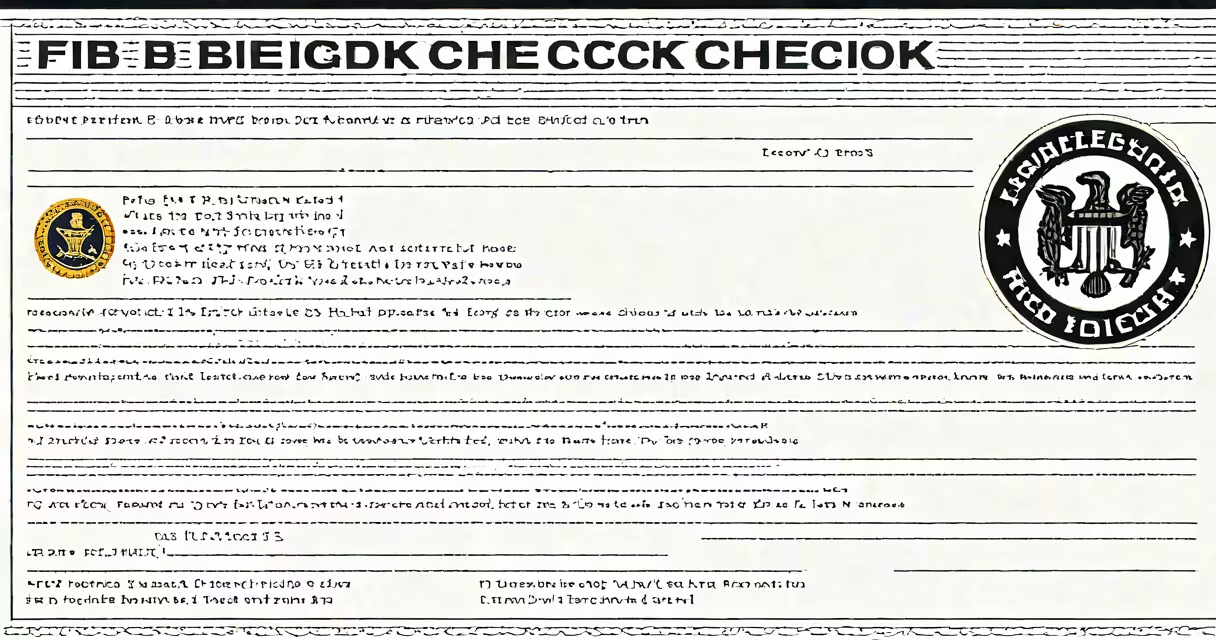
An FBI background check is a detailed investigative report compiled from federal, state, and local databases. It verifies identity, checks for criminal records, and assesses potential security risks. The report is used primarily for federal employment, security clearances, and certain high-risk positions.
The process begins when a government agency submits a request through the FBI's National Instant Criminal Background Check System (NICS) or the Federal Bureau of Investigation's Identity History Summary (IHS). The IHS is the official document generated after a full search of the FBI's database. It includes name history, fingerprints, and known criminal charges or convictions.
For most applicants, the report appears as a single-page summary with key identifiers: full legal name, aliases, date of birth, and Social Security Number. It lists any arrests, convictions, or pending charges. The report may also flag prior federal employment, military service, or foreign travel. The final output is not a narrative but a structured record of verified data points.
The FBI does not conduct interviews or gather evidence independently. Instead, it aggregates data from law enforcement agencies across the U.S. and Canada. When a request is submitted, the FBI cross-references the applicant's biometrics-especially fingerprints-with records in the Integrated Automated Fingerprint Identification System (IAFIS).
If a match is found, the system pulls all associated data. For example, a fingerprint linked to a 2018 arrest in Miami for theft will appear in the report. The FBI does not verify the accuracy of the original record-it only confirms whether a record exists in the database. Discrepancies must be resolved by the submitting agency or the individual.
Each check takes between 24 hours and five business days. Delays occur if the applicant has multiple names, lived in several states, or has a history of frequent address changes. The FBI does not return results for individuals who have never been arrested or charged.
The FBI background check report contains specific, verifiable information. It does not include opinions, character assessments, or unverified allegations. Here's what appears:
| Information Type | Details Included | Source |
|---|---|---|
| Personal Identifiers | Name, DOB, SSN, fingerprints | Applicant submission |
| Criminal History | Arrests, charges, convictions, court dispositions | Federal, state, and local law enforcement |
| Employment & Service Records | Prior federal jobs, military service, intelligence work | Government databases |
| Foreign Activity | Travel to restricted countries, dual citizenship | Department of State, Customs and Border Protection |
For security clearance applications, the FBI conducts a more thorough investigation called a Single Scope Background Investigation (SSBI). This includes interviews with friends, coworkers, and neighbors. The SSBI report can span hundreds of pages and includes behavioral patterns, financial history, and mental health disclosures.
A common misconception is that the FBI background check includes credit scores. It does not. Credit checks are handled separately by the Office of Personnel Management (OPM) during federal hiring. However, financial instability can trigger additional scrutiny during a security clearance review.
Many people assume the FBI background check is a judgment of character. It is not. The report only reflects data available in public and law enforcement databases. A past arrest without conviction does not imply guilt. The FBI does not determine innocence or guilt-it reports what was recorded.
Another error is thinking the report shows everything. It does not. The FBI does not access private records such as school disciplinary files, social media posts, or medical records unless specifically authorized under a court order. Even then, those records are not part of the standard background check.
One non-obvious fact: the FBI does not maintain a "watchlist" in the way popular media portrays. There is no central list of "bad people." Instead, the FBI uses the National Crime Information Center (NCIC) database to flag individuals based on specific criteria-such as fugitive status or protective orders. These flags are updated in real time but are not visible to the general public.
In 2022, a software engineer applied for a position with the Department of Defense requiring a Top Secret clearance. The application triggered an FBI background check. The system returned a match on a 2015 misdemeanor charge for disorderly conduct in Seattle. The charge had been dismissed after community service.
The FBI report listed the charge, the date, and the disposition. It did not include details about the incident. The hiring panel reviewed the report and consulted the original court file. Because the charge was dismissed and no further action was taken, the candidate was cleared for the interview stage.
This case illustrates how the FBI report functions: it presents facts, not interpretations. Final decisions rest with human reviewers who consider context, timing, and relevance.
An FBI background check is not the same as a private background check run by companies like Equifax or Checkr. Those services pull data from public records and consumer databases but do not access FBI internal systems. They cannot confirm whether someone was ever interviewed by the FBI or flagged in a national security database.
Also, the FBI background check is not a live surveillance tool. It does not track current behavior. It reflects past events only. If a person commits a crime after the check is completed, the report remains unchanged unless a new request is made.
Finally, the report is not a standalone decision-maker. It supports human judgment. For example, a 2021 study by the Government Accountability Office (GAO) found that 68% of security clearance denials were reversed after a manual review of contextual factors not captured in the FBI report.
I once reviewed an FBI background check for a colleague applying to work at NASA. The report showed a 2009 arrest for possession of marijuana in Colorado. The charge was later expunged. The FBI report still listed it because the record had not been removed from the NCIC database. After contacting the state attorney's office, we obtained a court order to correct the entry. The correction took 14 days and required a formal appeal. This confirmed that the FBI report is static until corrected by the originating authority.
You can request your own FBI Identity History Summary through the FBI's Identity History Summary Program. The process costs $18 and takes 10-14 business days. You must provide fingerprints via an approved enrollment center.
Understanding what the FBI background check looks like helps clarify its limits and purpose. It is not a verdict. It is a snapshot of verified data collected from public and law enforcement sources. For federal roles, it's a foundational step-not the final word.
When you see the term "what does an FBI background check look like," remember: it's a structured, fact-based document. It includes criminal history, employment records, and biometric identifiers. It does not include personality assessments, credit scores, or unverified claims. The report is accurate only if the underlying data is accurate. Always verify your own record before applying for sensitive positions.
For deeper insight into what the FBI actually investigates, explore what the FBI background check looks for.